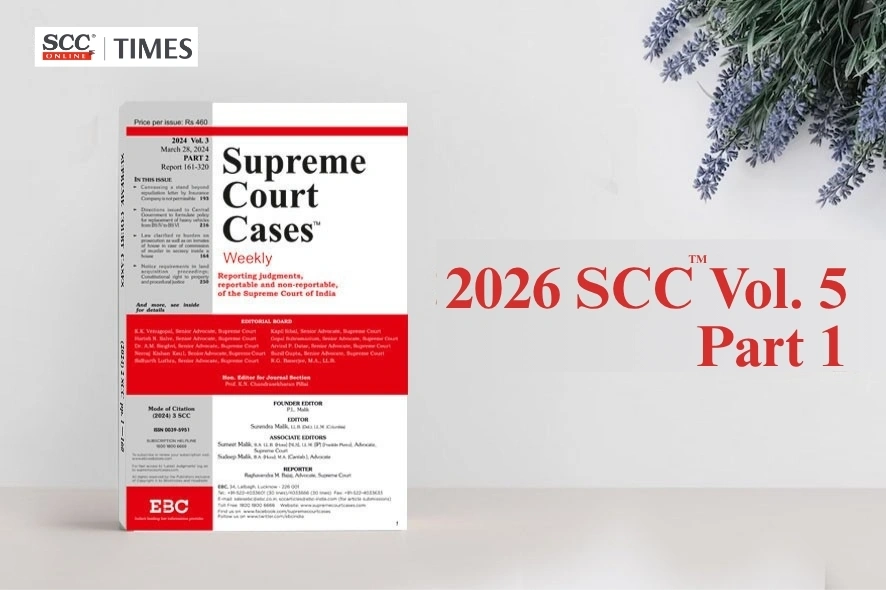
This volume of the Supreme Court Cases (SCC), Part 1 of Volume 5, embodies landmark cases decided by the Supreme Court on issues like execution of conciliation award, right to a healthy environment, quashing of cognizance/summoning order, 100 petitioners for the same real estate project, and more.
Arbitration and Conciliation Act, 1996 — Ss. 36, 34 & 61 to 74 and 11 — Execution of conciliation award: Requirements of conciliation award, clarified, [J. Muthurajan v. S. Vaikundarajan, (2026) 5 SCC 71]
Constitution of India — Arts. 21, 14 and 32: Right to a healthy environment being a non-negotiable component of the right to life. Arbitrary modification of industrial categorisation of polluting industries from “Red” to “Orange” and consequential notifications downgrading regulatory safeguards for siting of known polluting industries, thereby weakening environmental protection without any proportionate and scientifically substantiated justification for the same, [Harbinder Singh Sekhon v. State of Punjab, (2026) 5 SCC 107]
Consumer Protection — Consumer Forums — Exercise of power — Evidence, Sampling and Testing — Recording of evidence before the Commission — Procedure, manner and options: Availability and permissibility of examination-in-chief and cross-examination of witnesses, clarified, though these could be done in various manners. The object is to ensure that the proceedings are not delayed, [ITC Ltd. v. Aashna Roy, (2026) 5 SCC 140]
Drugs and Cosmetics Act, 1940 — Ss. 18(a)(vi), 18-B, 22(1)(cca), 27(d), 28-A, 34(1) and 34(2) — Quashing of cognizance/summoning order — Offence by company: The appellant, being a Non-Executive Director of the company, could not be held vicariously liable and prosecuted for the alleged offences committed by the company, [Shailyamanyu Singh v. State of Maharashtra, (2026) 5 SCC 159]
Insolvency and Bankruptcy Code, 2016 — S. 7 — Minimum requirement of 100 petitioners in relation to the same real estate project — Compliance with: As per R. 28 of the NCLT Rules, 2016 registration of pleading or document, as the case may be, is to take place only after curing of defects. It should be returned to parties for compliance. Hence, mere filing of company petition did not result in the same being registered on the file of NCLT. Only after curing of defects, the petition would be treated as validly filed. Therefore, alternation of memorandum of parties in petition before NCLT did not amount to abuse of process as petition was returned for curing of defects. As amendments were made even before registration, no adverse inference can be drawn against petitioners to non-suit them, [Satinder Singh Bhasin v. Gautam Mullick, (2026) 5 SCC 91]
Insolvency and Bankruptcy Code, 2016 — S. 7 — Scope of enquiry for admission under: When the financial creditor initiates the insolvency process for the purposes of admission, the adjudicating authority is only to ascertain the existence of a default from the records of the information utility or the evidence furnished by the financial creditor within fourteen days from the receipt of such application, [Power Trust v. Hiranmaye Energy Ltd. (Interim Resolution Professional), (2026) 5 SCC 38]
Insolvency and Bankruptcy Code, 2016 — Ss. 61(3)(ii) and 62 — Appeal on the ground of material irregularity: Statutory limits governing appeals challenging approved resolution plan, explained. Commercial wisdom of CoC enjoys primacy and cannot be supplanted by judicial review, reiterated, [Torrent Power Ltd. v. SKS Power Generation Chhattisgarh Ltd. (Resolution Professional), (2026) 5 SCC 1]
Maharashtra Cooperative Societies Act, 1960 (24 of 1961) — Ss. 23(2), 154 and 152 — Right of membership: Proper authority is Joint Registrar, [Shashin Patel v. Uday Dalal, (2026) 5 SCC 58]