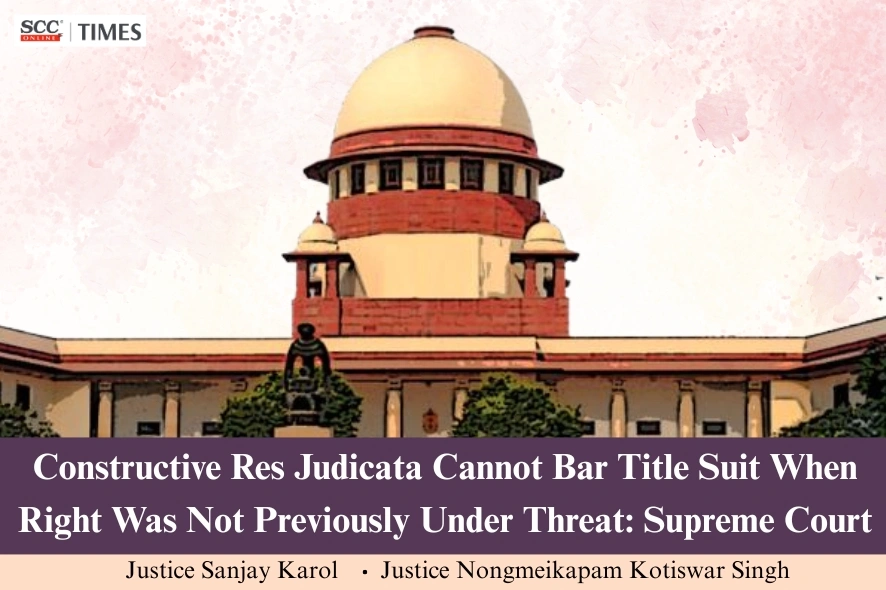
Supreme Court: In a civil appeal arising out of a decades-long family property dispute concerning agricultural land and the applicability of the doctrine of constructive res judicata under Section 11, Civil Procedure Code, 1908 (CPC), a Division Bench of Sanjay Karol* and Nongmeikapam Kotiswar Singh, JJ., held that the appellant’s suit seeking declaration of title and possession could not be barred by constructive res judicata merely because such relief had not been claimed in earlier proceedings challenging specific sale deeds executed by a general power-of-attorney holder.
Observing that the appellant’s title under a 1960 transfer deed had remained undisputed until subsequent mutation proceedings threatened his rights, the Court held that there was no occasion for him to assert title over the larger parcel of land in the earlier suits. Emphasising that the application of constructive res judicata depends on the facts of each case and should not result in harsh or inequitable consequences, the Court set aside the High Court’s judgment and allowed the appeal.
Background
The present appeal arises from a protracted family property dispute dating back to the 1960s concerning agricultural land originally owned by Mahabir Rai, the grandson of Gokul Rai. On 27 July 1960, Mahabir Rai transferred a portion of his land measuring 95.80 acres in favour of his mother, Raj Mohani alias Roopjhari, and his son, Makardhwaj (the present appellant). Subsequently, on 23 April 1962, Mahabir Rai, his wife Gulmati, and his mother executed a general power of attorney (GPA) in favour of their relative Rambhajan. Acting under the said GPA, Rambhajan executed two sale deeds in 1969, transferring 21.43 acres of land to Prem Prakash and 33.76 acres to Chandra Sao. Although the GPA was revoked on 25 June 1969, the transfers had already been effected. The sale deeds were challenged through separate civil suits instituted by Mahabir Rai and Gulmati on behalf of her minor children; however, both suits were dismissed. In 1985, Rambhajan sought mutation of his name in the revenue records, which was ultimately allowed in appeal. Aggrieved by the mutation proceedings and claiming rights in the disputed property as successor-in-interest, Makardhwaj instituted the present civil suit. The litigation eventually reached the High Court, which, by judgment dated 18 September 2009, allowed the second appeal, leading to the present civil appeal before the Supreme Court.
Analysis
The Supreme Court examined the scope and applicability of the doctrine of constructive res judicata under Section 11 CPC and reiterated that while the principle mandates that all grounds which “might and ought” to have been raised in earlier proceedings should be taken to avoid multiplicity of litigation, its application depends upon the facts and circumstances of each case. The Court observed that the principle is founded on public policy and requires an assessment of whether, with reasonable diligence, a party ought to have raised a particular ground in the earlier proceedings.
Applying these principles, the Court found that the High Court had erred in holding that the appellant’s suit was barred by constructive res judicata. The earlier suits were confined to challenging the sale deeds executed by Rambhajan as GPA holder, whereas the present suit sought declaration of title and possession over the remaining property on the strength of the 1960 sale deed. The Court observed that the appellant’s ownership over the larger parcel of land already rested in his favour by virtue of the 1960 deed and, therefore, there was no occasion for him to assert such title in the earlier proceedings, which were directed only against the alienations made by Rambhajan.
The Court held that when Rambhajan subsequently sought mutation of his name in respect of the entire property, the appellant’s right, which had hitherto remained unquestioned, came under threat, necessitating the institution of the present suit. The question as to how and why the appellant was required to assert his title over the larger parcel of land in the earlier proceedings “missed the attention of the High Court”.
The Court further observed that accepting the High Court’s view would deprive the appellant of the entire property conveyed to him by Mahabir Rai under the 1960 deed. Emphasising that the application of law, particularly in inter-family disputes, is not merely a matter of enforcing the black letter of the law, the Court held that Judges must appreciate the surrounding facts and circumstances and arrive at a conclusion consistent with both law and equity. Since the appellant, through his guardians, had already taken steps to protect the portion of his rights that was threatened, there was no occasion to do anything further. In such circumstances, applying constructive res judicata would result in an unduly harsh and unjust consequence.
Decision
Accordingly, the Court set aside the impugned judgment of the High Court, allowed the appeal, and left the parties to take recourse to such remedies as may be available in law. The parties were directed to bear their own costs.
Also Read: Constructive res judicata bars re-litigation of interest claims: Bom HC
[Makardhwaj Ram v. Jagdish Rai, 2026 SCC OnLine SC 1112, decided on 11-6-2026]
*Judgment authored by: Justice Sanjay Karol