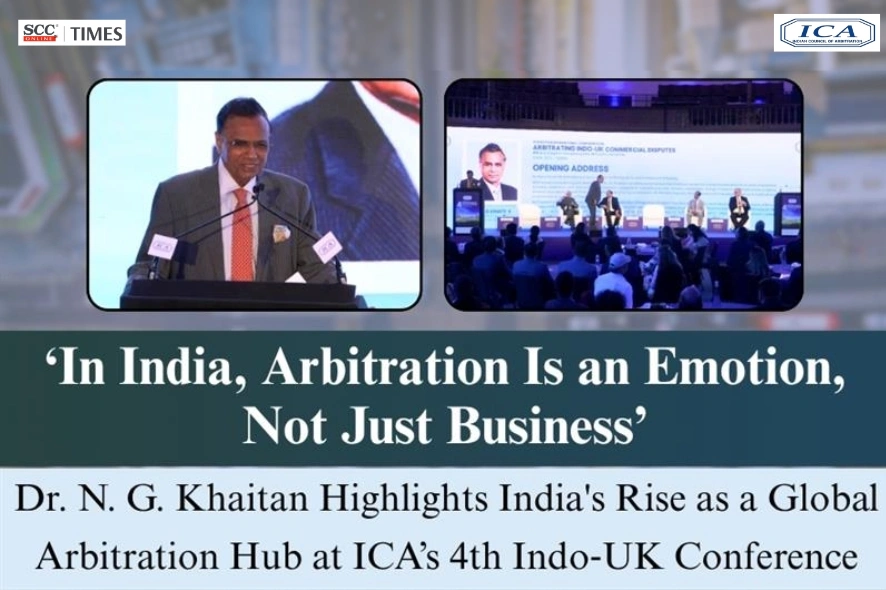
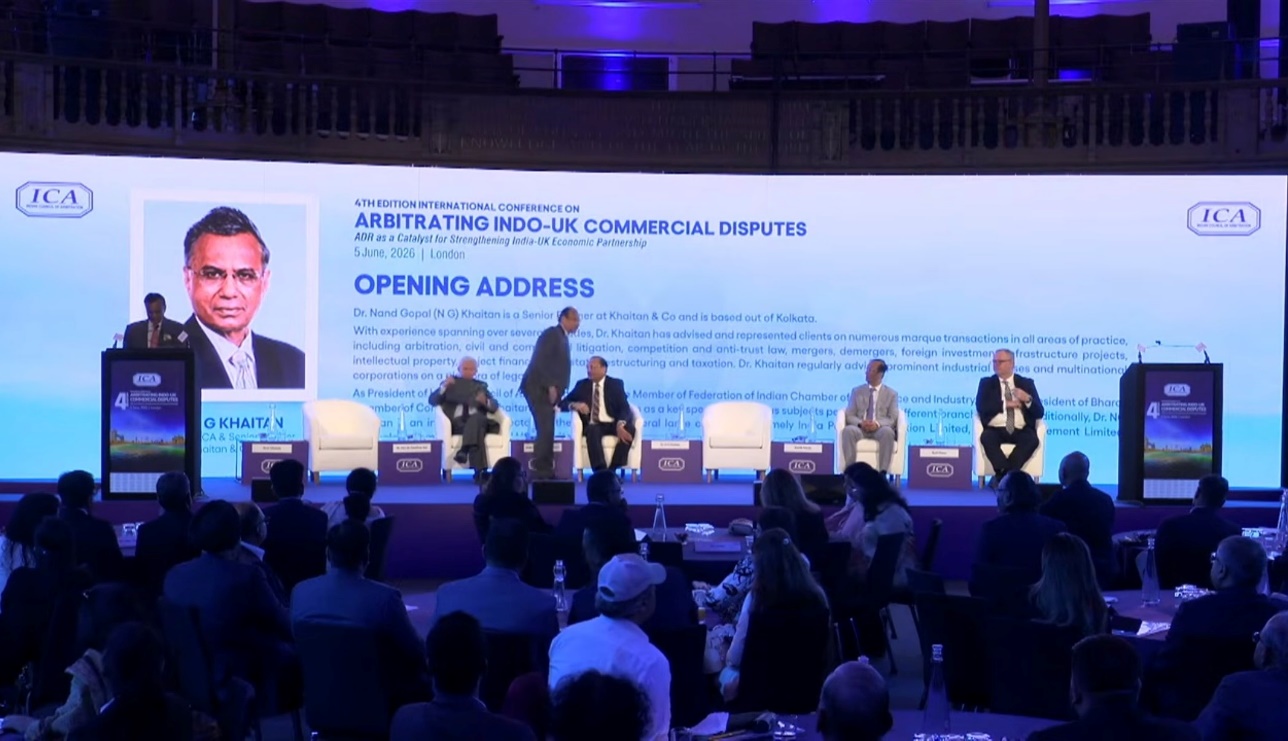
At the 4th International Conference on “Arbitrating Indo-UK Commercial Disputes” on the theme “ADR as a Catalyst for Strengthening India–UK Economic Partnership”, organised by the Indian Council of Arbitration (ICA) in London, Dr. N. G. Khaitan, President of ICA and Senior Partner at Khaitan & Co., delivered the opening address highlighting India’s economic growth, arbitration reforms, and expanding role in international commerce.
The conference brought together leading legal practitioners, policymakers, judges, and arbitration professionals from India and the United Kingdom to deliberate on the future of cross-border dispute resolution, featuring the participation of eminent dignitaries such as Chief Justice of India Justice Surya Kant, Rt. Hon. Sir Geoffrey Vos, Master of the Rolls and Head of Civil Justice of England & Wales, Dr. N. G. Khaitan, President of ICA and Senior Partner at Khaitan & Co., Mr. Kartik Pande, Deputy High Commissioner of India to the United Kingdom, Mr. Brett Dixon, Vice-President of the Law Society of England & Wales, Mr. Arun Chawla, Director General of ICA, along with several other distinguished figures.
India-UK Economic Partnership and Expanding Trade Opportunities
Dr. Khaitan emphasised the importance of the India-UK economic relationship, referring to the recently concluded Free Trade Agreement and the growing movement of goods, investments, students and businesses between the two countries.
According to him, India’s growing network of trade agreements demonstrates increasing international confidence in the country’s economic future.
He observed:
“They now believe in India. They have trust and confidence in India.”
The conference, he noted, was designed not only to strengthen commercial cooperation between India and the United Kingdom but also to promote arbitration as an effective mechanism for resolving the disputes that inevitably arise from expanding cross-border trade.
England’s Influence on Indian Arbitration
Reflecting on the historical development of arbitration law in India, Dr. Khaitan acknowledged the significant influence of England on India’s legal and arbitration framework.
He noted that some of India’s earliest codified arbitration laws originated during British rule and traced the evolution of arbitration legislation from the Bengal Regulation Act, 1781 through subsequent enactments.
Recalling his own early years in practice, he stated that English legal authorities heavily influenced legal argumentation in Indian courts.
As he remarked:
“You taught us what arbitration is all about.”
While recognising those historical foundations, Dr. Khaitan stressed that India’s legal system has evolved significantly and now contributes independently to global jurisprudence.
He observed:
“Today our judgments are cited not only in India, but are in different parts of the world.”
Arbitration, Mediation and India’s Dispute Resolution Culture
Dr. Khaitan argued that dispute resolution has deep roots in Indian society and predates modern arbitration statutes. According to him, communities across India traditionally resolved disputes through informal mechanisms led by village elders, family heads and community leaders long before the existence of formal arbitration legislation. He also highlighted India’s efforts to reduce litigation burdens through alternative dispute resolution mechanisms.
Referring to dispute resolution initiatives undertaken between 2016 and 2025, he stated:
“We were able to resolve 800,000 cases through mediation, through Lok Adalat.”
He suggested that these figures demonstrated the continued relevance of consensual dispute resolution mechanisms within India’s legal ecosystem.
Legal Reforms and Ease of Doing Business
Dr. Khaitan also discussed recent legal reforms undertaken by the Government of India, including the repeal of obsolete legislation and decriminalisation measures. According to him, these reforms are intended to modernise the legal framework and improve India’s business environment.
He argued that such changes, combined with judicial support for arbitration and mediation, strengthen India’s attractiveness as a venue for commercial dispute resolution.
Why Consider India as an Arbitration Seat?
Encouraging international parties to consider India as a destination for arbitration, Dr. Khaitan emphasised cost advantages and recent regulatory developments.
He noted that foreign lawyers are now permitted to undertake arbitration and non-litigation work in India and highlighted ICA’s efforts to provide cost-effective arbitration services.
According to him:
“The cost of arbitration would be maybe 20 per cent of what the cost of arbitration would be in England or London today.”
He also stressed that timely justice remains a key objective of the Indian legal system, referring to recent judicial directions aimed at ensuring quicker pronouncement and publication of court orders.
A Pro-Arbitration Judiciary
A significant portion of Dr. Khaitan’s address focused on the role played by the Indian judiciary in promoting arbitration and mediation.
Recalling observations made by former Chief Justice of India N. V. Ramana at an earlier ICA conference, Dr. Khaitan noted that Indian courts have consistently adopted a supportive approach toward arbitration.
He quoted Justice Ramana as saying:
“Indian courts are known for their pro-arbitration stance.”
He also recalled Justice Ramana’s observation that the court’s in India assist and support arbitration.
Dr. Khaitan further referred to recent remarks made by Chief Justice of India Surya Kant during international engagements. According to Dr. Khaitan, Chief Justice of India Surya Kant has strongly advocated mediation and commercial dispute resolution reforms.
Quoting the Justice Surya Kant, he stated:
“Mediation must be preferred mode of delivering justice, not the last resort.”
He also highlighted the Justice Surya Kant ‘s observations that:
“India has a business-friendly legal system.”
and
“The court should not hurt investment climate. It should be pro-investment.”
Dr. Khaitan noted that Justice Surya Kant has also linked effective dispute resolution with India’s long-term economic ambitions.
Beyond Business: Arbitration as Emotion in India
Concluding his address, Dr. Khaitan reflected on India’s legal culture, values and commitment to fairness.
As he stated:
“If you had been right, you shall succeed.”
He then described arbitration in distinctly personal terms. In one of the most memorable remarks of the session, he observed:
“To arbitrate is a divine function.”
He further added:
“In India, arbitration is an emotion. It’s just not business.”
Concluding Reflections
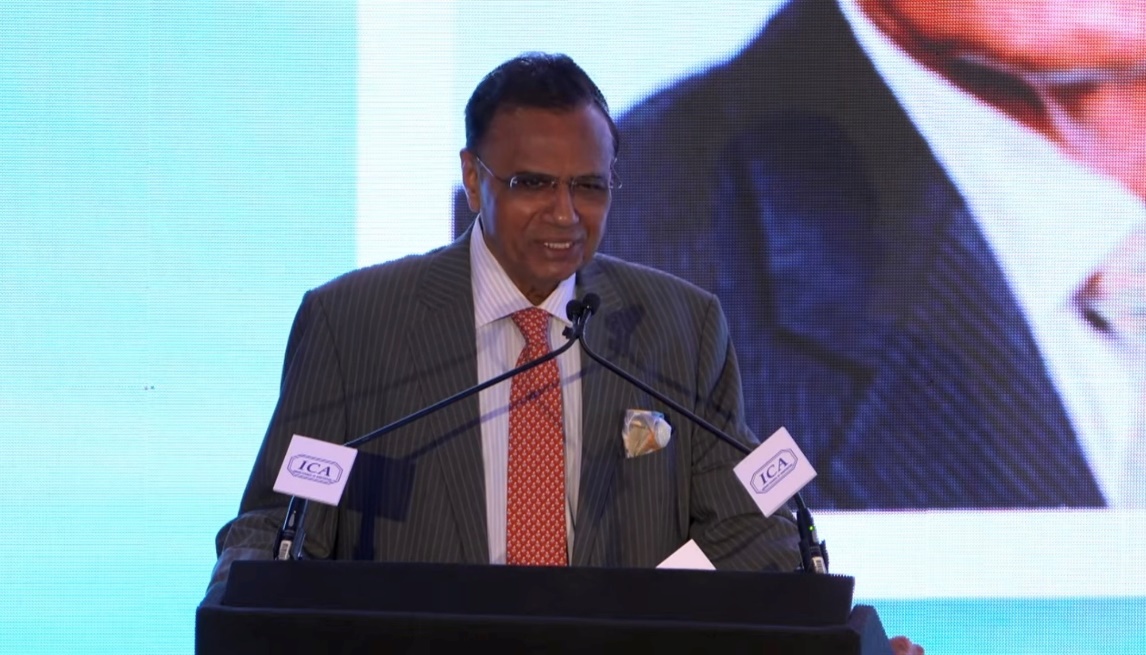
Dr. Khaitan’s address presented a vision of India as an increasingly important centre for international commerce and dispute resolution. Drawing together economic growth, demographic strength, legal reform and judicial support for arbitration and mediation, he argued that India’s future as a global arbitration destination is closely tied to its broader economic rise. His message to the international legal community was clear: as trade and investment flows expand, India seeks not only to participate in global commerce but also to become a preferred venue for resolving the disputes that accompany it.
SCC Times reported the 4th Edition of the International Conference on “Arbitrating Indo-UK Commercial Disputes,” organised by the Indian Council of Arbitration (ICA) on 5 June 2026 at Church House Westminster, London, as part of London International Disputes Week 2026.