Following the great insights provided by Ms. Clare Wardle, LIDW 2026 hosted a panel discussion titled “Access to Justice Internationally – Tradition and Transformation” to talk about comparative perspectives from several key jurisdictions. The discussion explored how legal systems are adapting to technological change, the opportunities and risks presented by AI, and the reforms required to ensure that justice remains accessible, fair, and effective.
The panel was moderated by Ms. Kathleen Donnelly KC, Barrister, Henderson Chambers and consisted of esteemed panellists namely, Sir Geoffrey Vos, Master of the Rolls, Head of Division and Member of the Privy Council, Dr. Dhananjaya Y. Chandrachud, Former Chief Justice of India; Dr. Emilia Onyema, Professor in International Commercial Law, SOAS University of London; and Mr. VK Rajah SC, International Arbitrator, Duxton Hill Chambers.
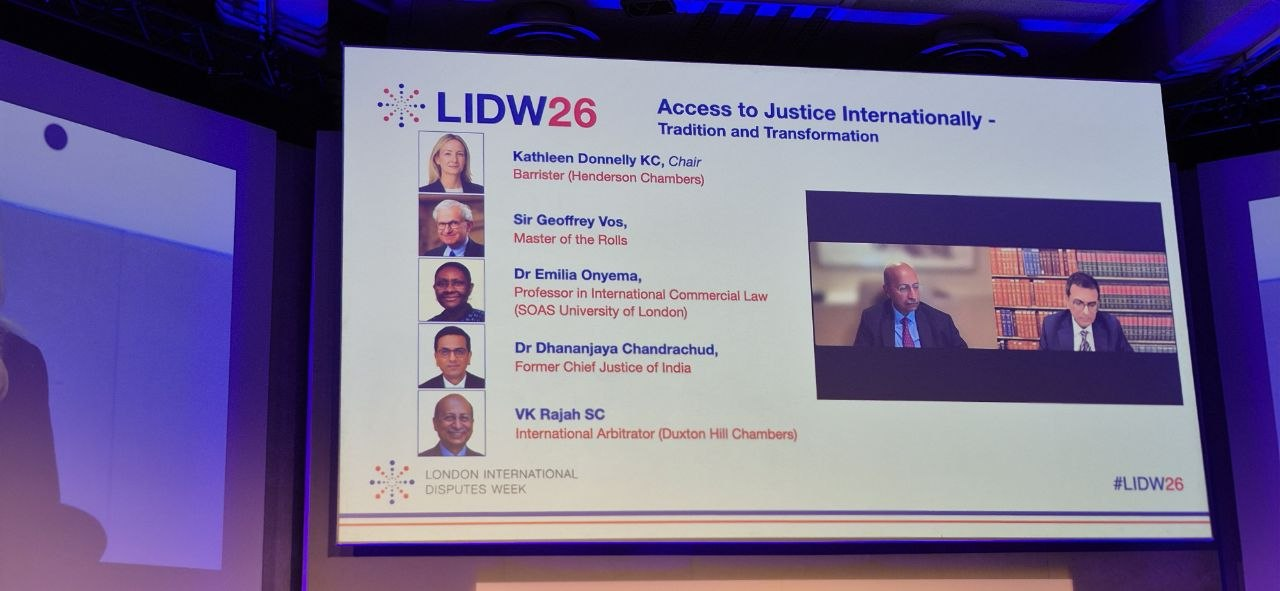
Ms. Kathleen Donnelly KC kickstarted the discussion by introducing the theme of “Tradition and Transformation,” observing that while lawyers are deeply rooted in legal traditions, legal systems have always evolved in response to societal change, public expectations, and technological innovation. She stated that one fundamental question lies at the heart of evolution: how can legal systems ensure meaningful access to justice?
Referring to the Post Office Case in the United Kingdom, she highlighted the importance of collective redress mechanisms, judicial independence, the need to consider the human consequences of delayed justice, and the ethical responsibilities of lawyers working within the system.
Evolution and Future of Access to Justice
Answering the question about the last 25 years of access to justice, Sir Geoffrey Vos remarked that commercial litigation had become unnecessarily complicated due to an extraordinary increase in data and documentation. He stated that 25 years ago, the UK introduced a simplified civil procedure, but there was no ubiquitous internet or such technology to facilitate it.
Sir Geoffrey argued that meaningful access to justice will only be achieved through the development of comprehensive digital justice systems. Drawing comparisons with online dispute resolution platforms such as Amazon and eBay, he noted that millions of disputes are already being resolved digitally, quickly, and at minimal cost. Thus, he suggested the need to find a way in which we can use and embrace technology or harness technology to create a digital justice system. He emphasised the need to rethink the way people arbitrate due to technological advancement.
He also argued that commercial courts, like arbitrators, in different jurisdictions must communicate and benefit from each other’s best practices.
“I believe the last 25 years will be nothing compared to the next 25.”
From the perspective of an international arbitrator, Mr. VK Rajah SC described the transformation of dispute resolution across Asia, especially Singapore. He highlighted Singapore’s emergence as a leading arbitration centre, attributing its success to coordinated efforts between all stakeholders to create an ecosystem that could be trusted by businesses, as well as the legal profession, across several jurisdictions.
He noted that in the past 25 years, as Asian economies expanded, dispute resolution increasingly moved closer to the parties involved. Asian businesses now frequently choose Singapore or Hong Kong rather than traditional Western centres for resolving disputes. Additionally, Asian countries have increased their competency in terms of advocacy and international arbitration in a very substantial way.
Lastly, he opined that young lawyers and legal professionals in Asia will become one of the best legal minds in the next 25 years.
“Law firms in China, India, South Korea, Hong Kong, Japan, and, to a lesser extent, Singapore, are now key players in international transactional work as well as business representation. So we have seen this transformation, and this transformation is not over yet.”
Speaking from the Indian perspective, Dr D.Y. Chandrachud highlighted several initiatives undertaken by the Indian judiciary, including digitisation of court systems, virtual hearings, live-streaming of proceedings, data-flow management, and AI-assisted translation of Supreme Court judgments into 22 constitutional languages. These developments have significantly increased public access to legal information and judicial processes.
With easier access to legal knowledge, he observed, courts now faced greater scrutiny, higher expectations of efficiency, and increased public accountability through social media and digital platforms. Despite the differences between the learning environment of his generation and today’s generation, he noted that the fundamental values of a democratic society, fairness and human dignity, were persisting.

Impact of Tech and AI
In this regard, Dr. Emilia Onyema argued that while AI may improve efficiency, its implementation requires significant investment. She raised pertinent questions, namely, who bears the cost of AI adoption? Will those costs ultimately be passed on to clients? Will AI genuinely reduce dispute resolution costs?
Referring to arbitration, she noted that legal fees remain the largest component of overall costs and continue to be a significant barrier to access.
“If not just the small or micro, small, medium-sized enterprises, but individuals and people who own very small companies, informal businesses, are priced out of dispute resolution, of the use of arbitration, just because of the cost. That’s something that we really do need to think about.”
She cautioned against the assumption that there was an even distribution of technological resources, as not all jurisdictions enjoyed reliable internet access, stable electricity, affordable digital infrastructure, and equal access to AI tools. She questioned the impact of these differences on practitioners from such jurisdictions, as this too was a limitation to access to justice in a form of dispute resolution. For many practitioners and businesses in developing jurisdictions, technological barriers remain substantial.
“We retain this bubble that we all have access to AI at little or no cost. But there are jurisdictions globally that do not have the same access as we do here.”
Dr. Onyema also challenged suggestions that third-party funding can solve access to justice problems. While acknowledging its usefulness, she argued that funders are commercial entities rather than providers of public justice. Responsibility for ensuring access to justice, she maintained, ultimately remains with the state and legal institutions.
Regarding the use of AI in law, Sir Geoffrey challenged the perception that AI’s primary impact will be legal research. Instead, he predicted that AI would fundamentally transform client expectations, legal advice, case preparation, judicial processes, and the economics of legal practice.
He observed that clients increasingly arrive at lawyers’ offices having already consulted AI systems and obtained preliminary legal answers. Lawyers must therefore adapt to a world where they are often validating rather than generating initial legal advice. He opined that this would be a transformational change, perhaps negative, for judges who would have to adjudicate such unreasoned and unsustainable claims.
“I think lawyers need to learn to work with AI, but more importantly, with their clients’ usage of AI. Lawyers need to understand what their clients are getting from AI before they come to you, and how to resolve the disputes that are created in that situation.”
Sir Geoffrey identified several emerging concerns:
-
Pressure to adopt AI-assisted judicial and arbitral decision-making.
-
Humans’ inability to process and understand complex legal advice, as complex decision-making is increasingly provided by AI.
-
Questions about which disputes should remain exclusively within human judicial control, and which can be adjudicated by AI.
-
Lack of digital sovereignty and increased dependence on AI systems developed in only specific jurisdictions.
However, he expressed confidence that technology would ultimately expand access to justice if implemented responsibly and suggested that lawyers should not take the advent of AI lightly.
Steps Towards Driving Change
Regarding actions for increasing access to justice, Mr. Rajah argued that legal systems do not suffer from a lack of reform proposals but rather from insufficient accountability. He observed that public confidence in legal institutions can be undermined when professional interests are prioritised over public needs.
“Too often, the legal profession has placed its interests above the interests of the public that it is supposed to serve. That has created enormous issues in terms of how the public perceives their administration of justice. We do not lack reforms, we do not lack conferences about reforms, what we lack is accountability, the willingness to measure our systems against the experience of those who use them and to change what’s not working.”
Thus, he suggested several reforms:
-
For Lawyers
-
Separate professional interests from public interests
-
Embrace AI and technological innovation rather than fearing it.
-
Take ethics seriously as aspirations, not obligations.
-
-
For Judges and Arbitrators
-
Exercise firmer case management.
-
Embrace transparency and reasonability.
-
Promote meaningful diversity.
-
Integrate technology thoughtfully and be technologically literate.
-
-
For Governments
-
Expand access to justice and legal aid.
-
Invest in digital justice infrastructure.
-
Ensure justice is not determined by economic resources.
-
“Good reputation pays dividends, not merely to the individual practitioner, but to the system as a whole.”
“Procedural reform without enforcement is theatre, not governance.”
He concluded that technology should be used to widen access to justice rather than deepen inequalities.
“The task before us is neither abstract nor lucid. It begins with ethics that are impossible, with case management that is decisive, with technology that widens access rather than deepening it, with leadership and representation that reflect where our societies actually are, not where they were two generations ago, and with the intellectual honesty in the light of what we say and what we do. If we do this across jurisdictions, across the profession, across the bench, we can build those systems that are not only efficient but principled, accessible, and legitimate. That is the work of our time. ”
Adding to this, Dr. Onyema stated that arbitrators and counsels must
-
Be sensitive to differences in cultures, digital access, and digital literacy.
-
Be aware of the cost of AI tools.
-
Be transparent via disclosures regarding the use of AI.
-
Ensure that decision-making has not been done by AI.
-
Be sceptical of AI outcomes and review them.
Thus, the discussion highlighted a legal profession standing at a pivotal moment. Technological innovation is reshaping how disputes are resolved, how legal services are delivered, and how justice is accessed. While the opportunities are substantial, the panel agreed that successful transformation will require careful attention to fairness, accountability, transparency, and human judgment. As legal systems continue to evolve, the challenge will not simply be adopting new technologies but ensuring that those technologies strengthen, rather than undermine, the fundamental principles of justice.
This report forms part of SCC Times’ special coverage of London International Disputes Week (LIDW) 2026. As a Media Partner for the event, SCC Times is reporting key conversations across the conference, highlighting emerging trends and perspectives from the international dispute resolution community.
SCC Times extends its appreciation to Zehra Naqvi, EBC—SCC Online Foreign Student Ambassador and Lawyer, for her on ground presence, valuable assistance and contribution to the reporting of this event.