
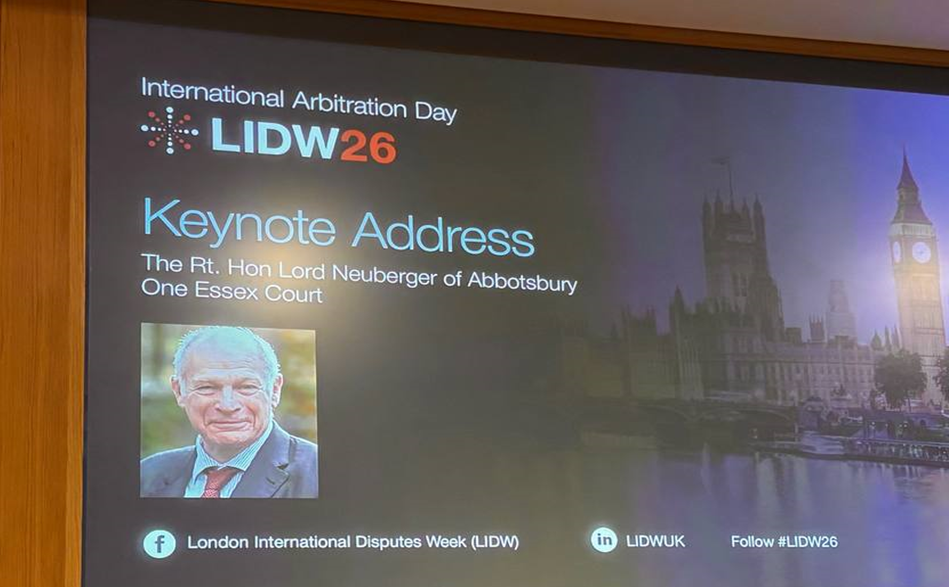
Delivering a thought-provoking keynote address at London International Disputes Week (LIDW) 2026, The Rt. Hon. Lord Neuberger of Abbotsbury, former President of the UK Supreme Court and member of One Essex Court, reflected on the extraordinary rise of international arbitration over the last half-century while urging the arbitral community to confront emerging challenges that threaten its efficiency, credibility and public legitimacy. Drawing together historical, technological and institutional perspectives, Lord Neuberger examined arbitration’s successes, questioned some of its modern practices and proposed a broader conversation about the future direction of the field.
From Bach to Dada: The Many Faces of Arbitration
Opening his remarks with a musical analogy, Lord Neuberger observed that some arbitrations resemble a Bach cantata- orderly, harmonious and efficient, with parties cooperating throughout the process. Others, however, are closer to “Dadaist noise music”, marked by procedural disputes, disagreement at every stage and an absence of consensus on even the most routine matters. The contrast served as a reminder that arbitration’s effectiveness ultimately depends not only on rules and institutions but also on the conduct of parties and counsel.
Arbitration in an Era of Technological Transformation
Lord Neuberger also situated arbitration within a rapidly changing technological landscape. Referring to the possible replacement of physical keys by electronic systems and the prospect of quantum computing rendering current security methods obsolete, he noted that technological disruption is reshaping virtually every aspect of modern life. While artificial intelligence already has a significant and potentially transformative role in dispute resolution, he chose not to dwell on the subject, observing instead that AI’s impact on arbitration is already sufficiently evident and likely to become even more profound in the years ahead.

Arbitration’s Rise Alongside Globalisation
Lord Neuberger noted that the modern arbitration boom cannot be understood without reference to the dramatic expansion of international commerce following the Second World War. The growth of cross-border trade, investment, communications and transportation, coupled with increasing acceptance of the rule of law, created conditions in which international commercial relationships flourished and arbitration became a natural mechanism for resolving disputes arising from them.
He further noted that the emergence of foundational instruments such as the New York Convention of 1958 (“New York Convention”) and the ICSID Convention of 1965 (“ICSID Convention”) reflected this broader trend. He noted that as international business expanded, arbitration institutions evolved alongside it. He also expressed that the long-established bodies reinvented themselves, while new centres emerged across Asia and the Middle East, transforming arbitration from a specialist niche into a sophisticated global industry supported by specialised practitioners, academics and institutions.
Why Arbitration Continues to Attract Commercial Parties
Lord Neuberger identified several reasons why arbitration remains the preferred dispute resolution mechanism for many international businesses, the central attraction being neutrality. He stated that parties are often reluctant to submit disputes to the national courts of another contracting party, particularly where concerns exist regarding familiarity, language or perceived advantage. He furthered that arbitration enables parties to select both the decision-makers and the governing law applicable to their disputes.
He also highlighted confidentiality, party autonomy and finality as enduring advantages. Furthering that arbitral awards generally face only limited avenues of appeal, enabling parties to avoid years of appellate litigation. Above all, however, he pointed to the New York Convention’s enforcement framework as arbitration’s greatest strength, describing the ability to enforce awards across more than 170 jurisdictions as a decisive advantage in an increasingly interconnected commercial environment.
The Role of Lawyers in Arbitration’s Growth
One of the more candid observations in the keynote concerned the role lawyers themselves have played in arbitration’s expansion. Lord Neuberger suggested that arbitration clauses have become embedded in many commercial contracts through a combination of habit, drafting convention and professional caution. Once arbitration becomes standard within a particular sector or type of agreement, lawyers are often reluctant to depart from established practice.
He further observed that arbitration’s emphasis on party autonomy frequently translates into greater procedural control for lawyers than would ordinarily be available in court proceedings, making arbitration particularly attractive from a practitioner’s perspective.
Due Process Paranoia and the Erosion of Arbitration’s Traditional Advantages
A recurring theme of the address was the phenomenon commonly described as “due process paranoia”. Lord Neuberger argued that arbitrators increasingly feel compelled to grant procedural requests, permit extensive document production and produce highly detailed awards out of concern that any perceived procedural defect might later be used to challenge enforcement.
The result, he suggested, is that arbitration no longer enjoys the clear advantages in speed, informality and cost that it once possessed. He suggested that proceedings have become increasingly proceduralised, while concerns about fairness and enforceability have encouraged tribunals to adopt a cautious and often time-consuming approach. In some cases, he suggested, litigation may now be more efficient and less costly than arbitration.
Should Arbitrators Exercise Greater Control?
Lord Neuberger questioned whether the growing significance of arbitration warrants a reassessment of the balance between party autonomy and tribunal authority. Given the substantial economic consequences of modern arbitral awards, he suggested that there may be a stronger case for active tribunal management aimed at controlling costs and preventing unnecessary delay.
At the same time, he acknowledged that any reform in this direction must proceed cautiously. Party autonomy remains one of arbitration’s defining characteristics, and excessive intervention by tribunals could undermine one of the very features that attracts parties to arbitration in the first place.
Transparency, Publication of Awards and Development of the Law
The keynote also addressed the increasing public significance of arbitration. As arbitral awards frequently determine disputes involving substantial commercial interests and, in investment treaty cases, even sovereign states, Lord Neuberger questioned whether greater publication of awards might now be justified.
Publication, he suggested, could contribute to legal development, improve consistency across arbitral decisions and strengthen public confidence in arbitration. Particularly within common law systems, where legal principles evolve incrementally through decided cases, excessive confidentiality may inhibit the development of jurisprudence. Nonetheless, he recognised that transparency reforms must be carefully calibrated so as not to discourage parties who choose arbitration precisely because of its private nature.

Corruption and Arbitration’s Institutional Response
Another significant challenge identified by Lord Neuberger concerns corruption. He discussed situations in which arbitrators may have reason to suspect fraud or corruption despite neither party formally raising the issue. Such circumstances place tribunals in a difficult position, balancing obligations of fairness and neutrality against broader concerns regarding justice and the integrity of the arbitral process.
To address these concerns, he proposed that arbitral institutions consider developing clearer rules and guidance to assist tribunals confronted with corruption-related issues. Such measures, he argued, could provide greater certainty and reduce the risk of arbitrators facing criticism regardless of the course they choose.
London, Competition and the Arbitration Act 2025
Turning to the United Kingdom’s position in the international dispute resolution landscape, Lord Neuberger praised the success of the Arbitration Act 19961 and welcomed the targeted reforms introduced by the Arbitration Act 20252. He described London as continuing to hold a leading position among global dispute resolution centres owing to its legal infrastructure, judiciary, specialist practitioners and international reputation.
Lord Neuberger warned against complacency as competition from centres such as New York, Paris, Singapore and Hong Kong, as well as emerging jurisdictions including India, should be viewed not as a threat but as a catalyst for improving standards. The existence of multiple strong arbitral institutions, he argued, demonstrates the value of competition and innovation within the arbitration ecosystem.
“Arbitration is both very successful and very valuable….improvements have to be made with care and caution because we do not want to undermine that success.”
– The Rt. Hon. Lord Neuberger of Abbotsbury
He also suggested that, contrary to some predictions, Brexit has thus far had only a limited impact on London’s attractiveness as a dispute resolution centre, notwithstanding certain enforcement complications involving court judgments within the European Union.
Arbitration’s Ultimate Foundation: The Rule of Law
“Arbitration has been one of the great success stories of modern dispute resolution. But success cannot be a reason for complacency. Questions of cost, delay, transparency and integrity must now be confronted if arbitration is to retain its legitimacy in an increasingly complex world.”
Concluding his keynote, Lord Neuberger returned repeatedly to what he described as the indispensable foundation of both arbitration and litigation: the rule of law. Arbitration cannot function effectively without legal systems committed to the enforcement of rights and obligations. Equally, arbitration itself contributes to the maintenance of the rule of law by providing an orderly and legitimate mechanism for resolving disputes.
While cautioning against alarmism, he observed that the rule of law faces pressures in several parts of the world. He expressed that for that reason, arbitrators, lawyers, institutions and users of arbitration must recognise that they perform not merely a commercial function but also a public one. The continued success of arbitration, he concluded, depends on preserving the legal principles that make dispute resolution, and indeed modern commerce itself, possible.
This report forms part of SCC Times’ special coverage of London International Disputes Week (LIDW) 2026. As a Media Partner for the event, SCC Times is reporting on key conversations across the conference, highlighting emerging trends and perspectives from the international dispute resolution community.
SCC Times extends its appreciation to Zehra Naqvi, EBC–SCC Online Foreign Student Ambassador and Lawyer, for her on ground presence, valuable assistance and contribution to the reporting of this event.
1. UK Public General Acts, 1996 Chapter 23
2. UK Public General Acts, 2025 Chapter 4