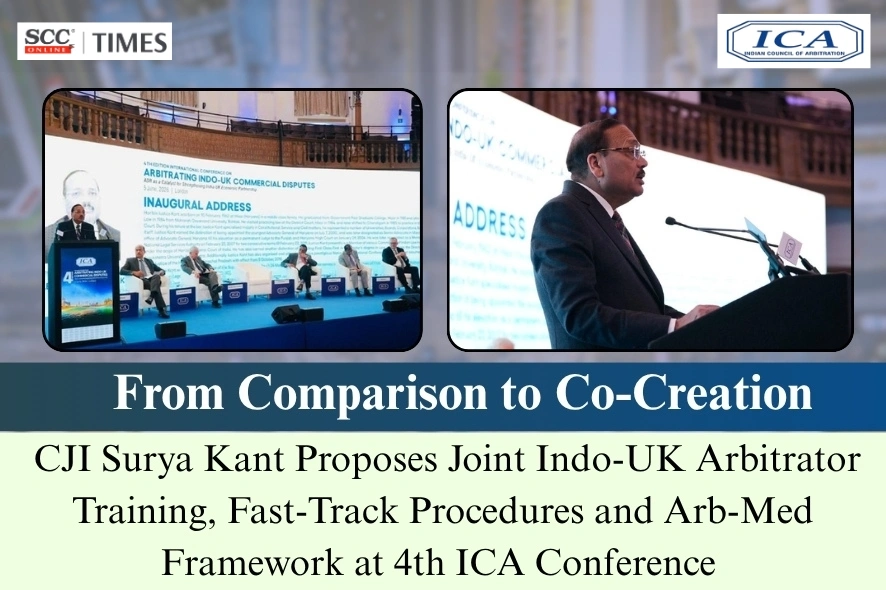
The Chief Justice of India delivered a thought-provoking keynote address at the 4th International Conference of the Indian Council of Arbitration (ICA) on Arbitrating Indo-UK disputes, urging the global arbitration community to return to the foundational purpose of arbitration and ensure that dispute resolution remains accessible, efficient, and responsive to the needs of modern commerce.
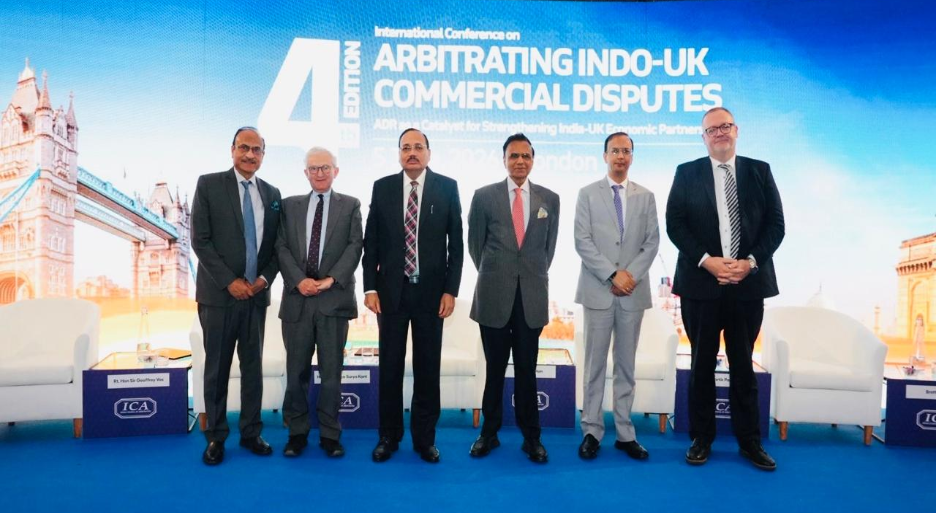
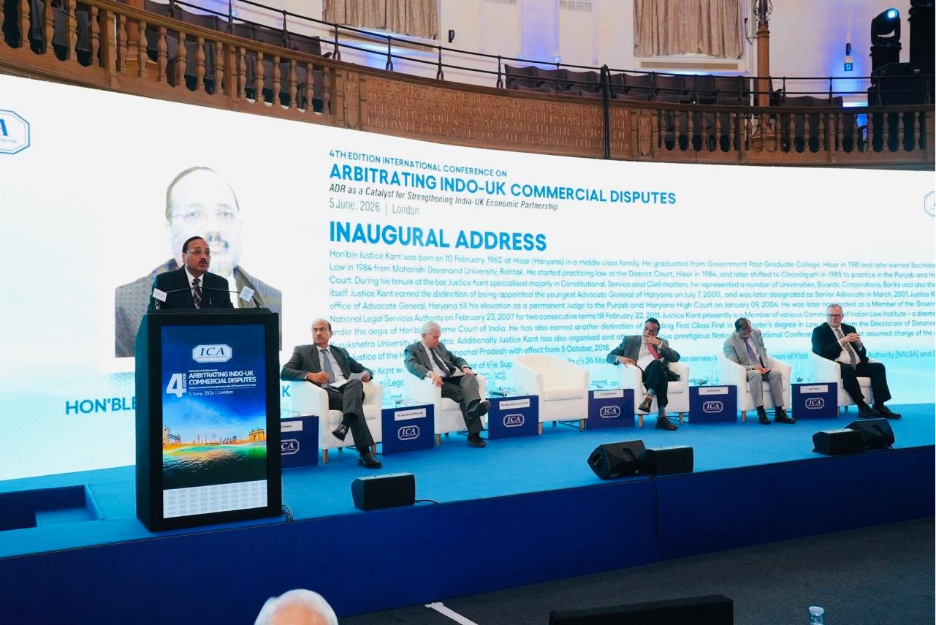
In the backdrop of London International Disputes Week 2026 (LIDW), the ICA held the 4th Edition of the International Conference on “Arbitrating Indo-UK Commercial Disputes” on the theme “ADR as a Catalyst for Strengthening India-UK Economic Partnership”. The conference was graced by various dignitaries, namely, Chief Justice of India Justice Surya Kant, Union Minister of Law & Justice, Government of India, Shri Arjun Ram Meghwal; Master of the Rolls and Head of Civil Justice of England & Wales, Rt. Hon Sir Geoffrey Vos; President, ICA & Senior Partner, Khaitan & Co., Dr N G Khaitan; Deputy High Commissioner of India to the United Kingdom, Mr. Kartik Pande; Vice- President of the Law Society of England & Wales, Mr Brett Dixon; Director General, ICA, Mr Arun Chawla, among others.
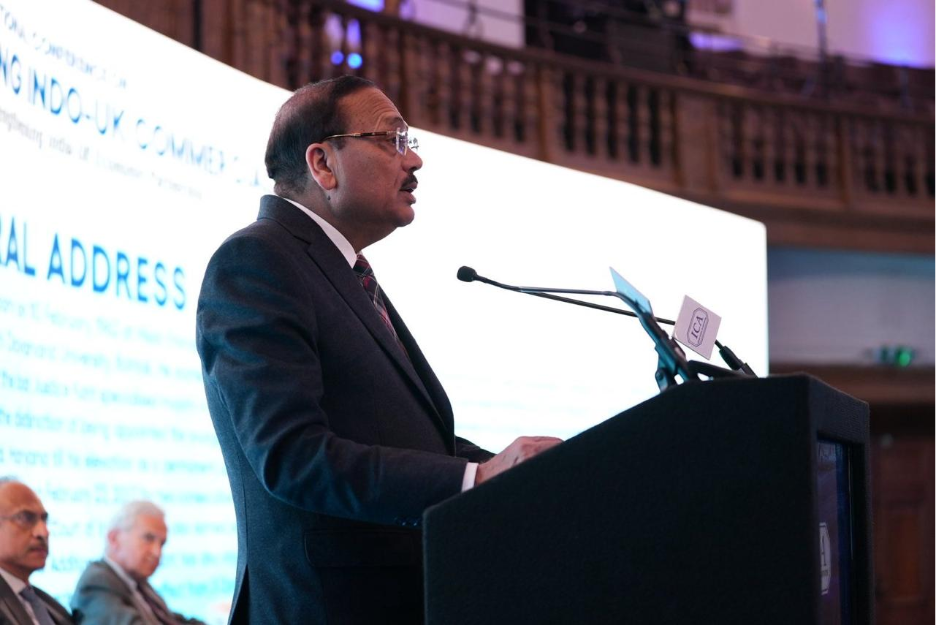
Delivering the inaugural address, Justice Surya Kant began by extending his heartfelt gratitude towards ICA for bringing together such a distinct gathering from the world of law, commerce, public policy, and dispute resolution. He remarked that arbitration is a critical pillar in strengthening the growing economic partnership between India and the United Kingdom, particularly in light of the recently concluded India-UK Free Trade Agreement (FTA).
He remarked that as the head of the Indian Judiciary, he was not only a major stakeholder in arbitration but also a coparcener in the arbitration family. Noting that at its best, arbitration provides commercial expertise, neutrality, confidentiality, finality, and practical good sense, he stated that there were some concerns.
“The arbitration, when we are referring to it, also requires us to ask with candour where it may have drifted from its founding purpose and what must be done to restore that purpose.”
History of Arbitration
Reflecting on the historical origins of arbitration, the Chief Justice noted that arbitration emerged not from legislation such as the English Arbitration Act, 1889, the Indian Arbitration Act, 1899, or the New York Convention, 1958; those instruments merely recognised, regularised, and regulated a practice that commerce had already developed for centuries. It emerged from the practical needs of merchants seeking swift and informed dispute resolution. Drawing parallels between the medieval lex mercatoria and India’s traditional Panchayat system, he emphasised that arbitration’s legitimacy rests on its ability to deliver justice that is fair, timely, informed, and proportionate.
“Justice is most legitimate when it is chosen freely, delivered by someone who understands your world and proportionate to what is actually at stake. Arbitration is simply what happens when you take this instinct and give it a framework.”
Growing Concerns in Arbitration
-
Gatekept Community: Justice Kant cautioned that arbitration today faces a few structural challenges, partially because it has increasingly come to be treated as a product to be promoted rather than a mechanism to be refined. For instance, high-value international arbitration often relies on a relatively small circle of repeat arbitrators, counsel, and experts. While acknowledging that expertise naturally develops through experience, he warned that excessive concentration can create perceptions of exclusivity and limit opportunities for broader participation.
“In some cases, international arbitration has absorbed the very habits of litigation that it was designed to avoid.”
-
Cost, Duration, and Complexity: The growing cost and duration of proceedings also came under scrutiny. According to Justice Surya Kant, many arbitrations now resemble traditional litigation through extensive pleadings, multiple procedural stages, prolonged hearings, and escalating legal expenses. He further highlighted the increasing complexity of arbitration agreements, observing that parties frequently become embroiled in preliminary litigation over issues such as jurisdiction, governing law, validity of arbitration clauses, and seat determination before reaching the merits of the dispute.
-
Party Autonomy: He remarked that the principle of party autonomy, one of the defining strengths of arbitration, was misunderstood and stretched beyond its intended purpose. He argued that party autonomy should not be interpreted as an unrestricted right to select specific arbitrators in a manner that could undermine perceptions of neutrality.
“Party autonomy was never intended to mean that parties are entitled to engineer the identity of the decision-maker, most likely to favour their position.”
Instead, the principle should guarantee an independent, impartial, and credible process capable of inspiring confidence in its outcomes. He suggested that clearer institutional safeguards and doctrinal development may be necessary to prevent appointment disputes from becoming a source of delay and inefficiency.
“We need to strengthen the institutions of arbitration that are required to ensure that party autonomy remains a guarantee of procedural fairness rather than a source of procedural contestation.”
He remarked that “Arbitration was built to be the answer to the pathologies of formal litigation, and it is seemingly acquiring each of those very failings. The remedy has come to resemble the disease it was designed to cure.” He suggested a collective attempt to fix these fault lines by championing international adoption of best practices, holding conferences with timely themes that demand institutional reflection, and a global collaborative approach among genuine and ethical platforms.
Arbitration as a Catalyst for the India-UK Economic Corridor
Turning to the conference theme, the Chief Justice described alternative dispute resolution (ADR) as an essential enabler of the expanding India-UK economic relationship. Referring to the recent FTA concluded between India and UK, he said it is expected to increase bilateral trade between the two nations soon by an estimated USD 34 billion a year, which is indeed an aspiration of extraordinary ambition.
“But ambitions are realised in contracts, not in communiqués. The Indo-UK economic partnership cannot be strengthened by trade agreements, tariff schedules, and investment announcements alone. It also needs an ADR architecture that converts commercial confidence into day-to-day practice”
He warned that the structural failures of ADR could hinder the aspiration of FTA and the commercial reality that it is meant to enable.
“A corridor is not strengthened merely because goods, capital, and services are allowed to move across it. It is strengthened when those who use that corridor know that if something goes wrong, they will not be priced out, delayed out, or forced into a process that had no real power to choose.”
The Chief Justice warned that many smaller businesses, start-ups, suppliers, and medium-sized enterprises often have limited bargaining power when agreeing to dispute resolution clauses and may be disproportionately affected by expensive arbitral procedures.
As observed by Justice Surya Kant, the next wave of Indo-UK trade will not be carried out by only conglomerates but will also be taken forward by pharmaceutical suppliers, fintech firms, clean energy businesses, digital platforms, and mid-market manufacturers on both sides. He remarked that “if our ADR mechanisms work only for disputes large enough to justify high fees or large legal teams, that might fail the very commercial partnerships that are meant to support”. Thus, he stressed that real party autonomy requires accessible model clauses, transparent costs, diverse panels, digital case management, and procedures proportionate to the value and urgency of the disputes.
“The autonomy that arbitration promises must be made genuinely usable for all parties to the corridor, not just the most powerful ones.”
Rejecting outdated narratives that portray India as merely seeking to catch up with London as an arbitration hub, the Chief Justice advocated a model of Indo-UK collaboration built on mutual strengths. He highlighted several recent developments demonstrating convergence between the two jurisdictions, including:
-
the enactment of the UK’s Arbitration Act, 2025;
-
India’s liberalisation of legal services through amendments permitting greater participation of foreign lawyers and law firms;
-
India’s creation of the comprehensive Mediation Act, 2023;
-
the commercial opportunities created by the India-UK Free Trade Agreement.
According to him, these developments create an opportunity for both countries to jointly shape the future of international dispute resolution. “What is needed now is not comparison but co-creation.”
“What the FTA’s commercial reality demands are hybrid mechanisms, an arbitration mediation protocol that preserves commercial relationships rather than destroy them, a joint institutional framework that builds shared arbitration panels and digital platforms that make these mechanisms accessible to businesses of every scale. This is where co-creation must begin.”
Three Proposals for an Indo-UK ADR Framework
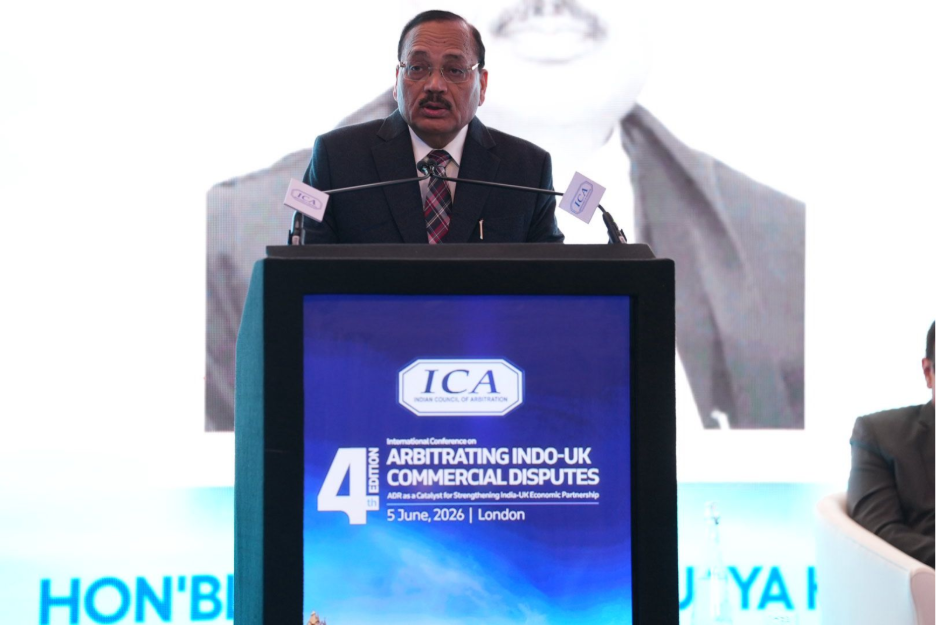
Justice Surya Kant outlined three concrete recommendations for arbitral institutions and stakeholders.
-
Build informed neutrality: He proposed a joint India-UK arbitrator accreditation and cross-training programme to develop a shared pool of practitioners with a deep understanding of both legal systems, commercial cultures, and regulatory environments. Such initiatives, he argued, would promote informed neutrality while broadening participation in international arbitration.
-
Create fast-track procedures for mid-market disputes: Recognising that future trade growth will increasingly involve technology companies, fintech businesses, clean-energy enterprises, and medium-sized manufacturers, he called for streamlined arbitration frameworks featuring capped fees, primary document-based procedures, online hearings where appropriate, limited mediation windows, and defined timelines for final awards. These measures, he said, would address the needs of the “missing middle” of commercial users.
-
Integrate Arbitration and Mediation: The Chief Justice also advocated for properly designed hybrid dispute resolution mechanisms that combine arbitration and mediation. Drawing on India’s Mediation Act and the UK’s growing mediation culture, he encouraged the development of protocols that preserve commercial relationships while ensuring confidentiality and procedural fairness. In sectors characterised by long-term commercial relationships, such as joint ventures, technology partnerships, and distribution agreements, he suggested that preserving business relationships may often be more valuable than securing a purely adversarial victory.
Concluding Reflections
Concluding his address, Justice Surya Kant urged the arbitration community to undertake serious self-reflection and recommit to the values that originally justified arbitration as an alternative to litigation. He emphasised that parties who choose arbitration over national courts make a profound act of trust and are entitled to expect fairness, efficiency, expertise, and finality.
“Arbitration does not need another ceremonial tribute to its past; it needs a serious recommitment to the reasons it came into being.”
Congratulating the ICA for convening the conference, he expressed confidence that the discussions would help advance reforms aimed at improving affordability, certainty, productivity, and timeline.
The address set the tone for the conference’s deliberations, highlighting both the opportunities and responsibilities facing arbitration institutions as they seek to support the next phase of India-UK commercial cooperation.