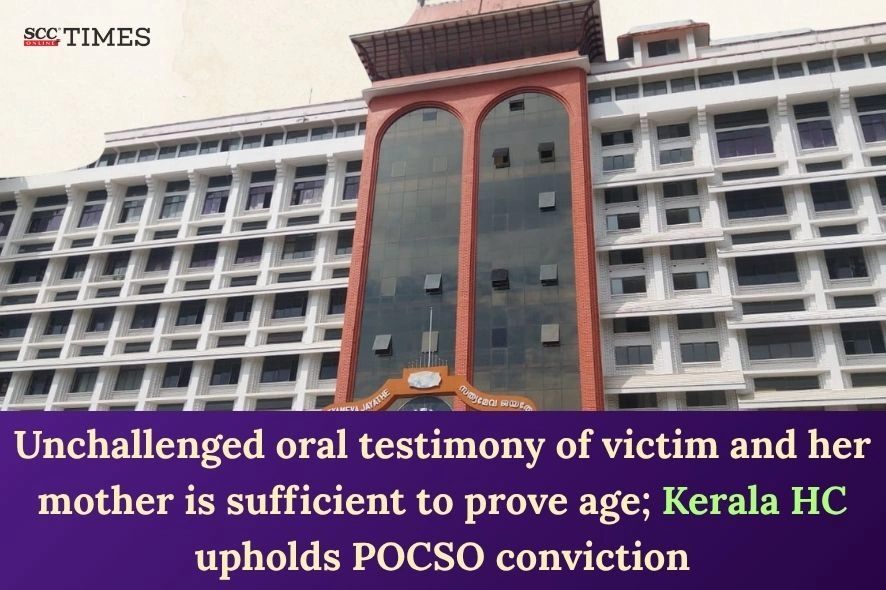
Kerala High Court: While declining to interfere with the conviction under Section 7 read with Section 8, Protection of Children from Sexual Offences Act, 2012 (POCSO Act) and Section 354, Penal Code, 1860 (IPC), a Single Judge Bench of A. Badharudeen, J., held that the prosecution had successfully established that the victim was a child and that the evidence on record proved sexual assault beyond reasonable doubt. The Court observed that the age of the victim can be proved through admissible oral evidence and where the oral testimony of the victim and her mother regarding age remains unchallenged, conviction under the POCSO Act is legally sustainable.
The Court observed that,
“When the accused contends that the victim is not a child as defined in the POCSO Act, it is the prosecution’s duty to prove the victim’s age. When the child and her mother state the date of birth which substantially shows that the victim is below 18 years, and the accused does not dispute it by cross-examining them, their substantial evidence remains unchallenged.”
Also Read: Bring Romeo-Juliet clause in POCSO Act to exempt genuine relationships: SC
Background
On 19 May 2014, when the victim was playing, the accused who was a security guard, allegedly took her inside the security cabin on the pretext of showing her a camera and sexually molested her. The victim ran home crying and told her mother that the accused had touched on her vagina and other body parts and on the same day, an FIR was filed. The next day, the mother went to the police station along with the victim and the victim was taken for medical examination.
Upon completion of trial, the Special Judge found that the accused guilty under Section 7 read with Section 8, POCSO Act and Section 354 IPC, and sentenced the accused to 3 years’ rigorous imprisonment and fine, with no separate sentence under Section 354 IPC in view of Section 42, POCSO Act.
Aggrieved by the conviction, the accused filed an appeal contending that the prosecution had failed to establish the victim’s age by convincing evidence, and therefore, the Special Judge was wrong in finding that he had committed the offence under the POCSO Act. It was argued that except for the oral testimony of the victim and her mother, no other evidence was produced to establish minority. It was also submitted that even the place of occurrence was not proved. On the other hand, the prosecution opposed the appeal, contending that both the victim and her mother deposed that the victim was 8 years old on the date of occurrence and the same was sufficient to prove the age as it was never challenged during cross-examination.
Also Read: Del HC discourages repeated summoning of minor victims
Points to be considered
-
What is the mode of proof of the age of a victim in POCSO Act cases recognised by law?
-
Whether the prosecution succeeded in proving the age of the victim below 18 years in the instant case?
-
Whether the Special Court was right in holding that the accused committed offence punishable under Section 7 read with Section 8, POCSO Act?
-
Whether the Special Court was right in holding that the accused committed offence punishable under Section 354 IPC?
Analysis
The Court referred to Jarnail Singh v. State of Haryana, (2013) 7 SCC 263, which prescribed a hierarchy for determination of age, but did not exclude reliance on medical or other evidence. The Court noted that the victim deposed that she was 8 years old at the time of occurrence and studied in 4th standard, and her mother corroborated the same during cross-examination. The Court relied on Biju v. State of Kerala, 2024 SCC OnLine Ker 7786, where it was held that when the oral testimony of the victim is of sterling quality, there is nothing in the POCSO Act which would indicate that the unchallenged oral testimony of the mother of the victim could not be taken as proof of date of birth of the victim.
The Court highlighted that a fact in issue can be proved either by oral evidence or by documentary evidence or by both including circumstances arising therefrom. The Court explained that when the accused contends that the victim is not a child as defined in the POCSO Act, it is the bounden duty of the prosecution to prove the victim’s age. When the child and her mother state the date of birth which substantially shows that the victim is below 18 years, and the accused does not dispute it by cross-examining them, their substantial evidence remains unchallenged. But when the oral testimony given by the victim and the mother has been challenged during cross-examination and the prosecution fails to prove the victim’s age to be below 18 years, it is unsafe to fasten criminal culpability on the accused under the POCSO Act. The Court observed that in the present case it would be unsafe to hold that the prosecution failed to prove the victim’s age to be below 18 years.
Further, the doctor who had examined the victim deposed that the victim reported that the accused had caught on her vagina and that it was highly improbable that the girl would lie. Another security guard deposed that on 19 May 2014, the victim’s father came to the flat and assaulted the accused, alleging that he had sexually assaulted his daughter.
The Court opined that the ingredients of offences under Section 7 read with Section 8, POCSO Act as well as under Section 354 IPC, were established by the prosecution beyond reasonable doubt. Therefore, the Special Judge rightly convicted the accused and no interference was required. The Court further observed that the sentence imposed was the statutory minimum prescribed under the POCSO Act, and therefore, no reduction in sentence was possible.
Decision
Accordingly, the Court, while dismissing the appeal, cancelled the order suspending sentence and granting bail to the accused as well as the bail bond executed by the accused. The accused was directed to surrender before the Special Court to undergo the sentence, failing which, the Special Court is directed to execute the sentence.
[Joseph v. State of Kerala, 2026 SCC OnLine Ker 4310, decided on 10-4-2026]
Advocates who appeared in this case:
For the Petitioner: Manju Antoney, R. Anas Muhammed Shamnad, P.Mamatha, Advocates.
For the Respondents: Vipin Narayan.A, Sr. Public Prosecutor.
Buy Protection of Children from Sexual Offences Act, 2012 HERE
Buy Penal Code, 1860 HERE