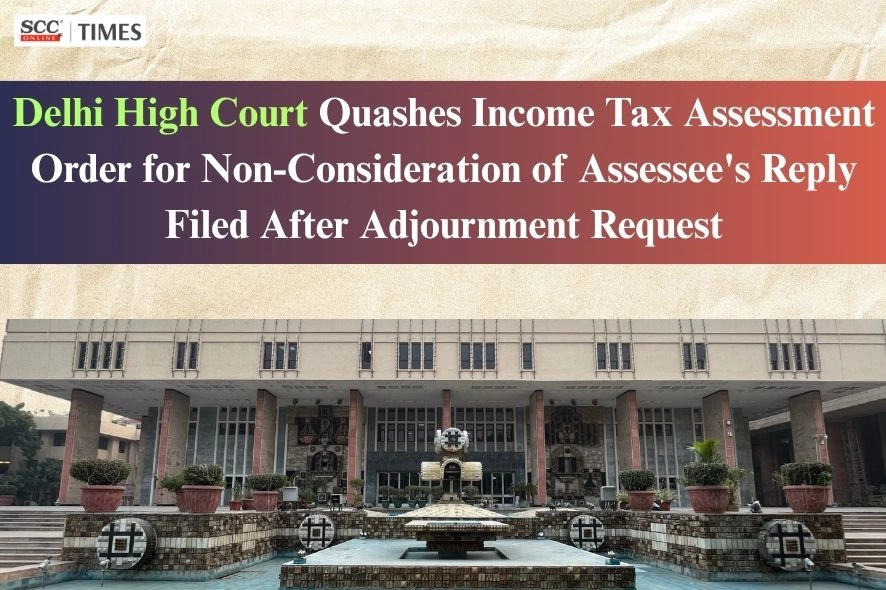
Delhi High Court: In a writ petition challenging an assessment order passed under Section 143(3) read with 144-B, Income-tax Act, 1961, a Division Bench of Dinesh Mehta and Vinod Kumar, JJ., quashed the assessment order and consequential demand notice after finding violation of the principles of natural justice and infringement of the petitioner’s right to be heard under Article 14 of the Constitution. The Court held that where an assessee seeks adjournment, it is incumbent upon the assessing officer to specifically communicate whether such request has been accepted or rejected and to intimate the next date of hearing in accordance with the prescribed procedure.
The Court set aside the impugned order and directed the assessing officer to undertake the assessment proceedings afresh after granting proper opportunity of hearing, including through video conferencing, and to pass a fresh order in accordance with law.
Background
The present writ petition was filed challenging the assessment order dated 28 February 2026 passed under Sections 143(3) read with 144-B, Income-tax Act, 1961 for Assessment Year 2024-25, as well as the consequential demand notice issued under Section 156 on the same date. The petitioner had filed his return of income on 30 December 2024 declaring a total income of Rs 7,61,260. During the scrutiny proceedings, the assessing officer issued notices dated 24 June 2025 and 14 January 2026 seeking information and supporting documents from the petitioner. Subsequently, a show-cause notice dated 6 February 2026 was issued raising various queries and requiring the petitioner to furnish a response by 13 February 2026.
A day prior to the due date, i.e. on 12 February 2026, the petitioner sought adjournment till 28 February 2026 on the ground that requisite material was being collected. According to the petitioner, no appearance or response was made on 13 February 2026 under the bona fide belief that the request for adjournment would be accepted. However, since no reply was furnished within the stipulated period, the assessing officer proceeded to pass the impugned assessment order on 28 February 2026.
Analysis
The Court heard the parties and perused the record, including the communication dated 20 April 2026 sent by the assessing officer to the Senior Standing Counsel, which was taken on record. On examination of the record, the Court noted that the petitioner had moved an adjournment request on 12 February 2026 seeking time till 28 February 2026 for gathering requisite material. However, the respondents were unable to demonstrate from the record whether such request for adjournment had been rejected or whether the petitioner had been informed about the next date of hearing upon acceptance of the request. The Court observed that, in the absence of any such communication,
“… it always remained in the realm of guess work as to what was the time allowed or the date fixed by the Assessing Officer to file reply”.
The Court further noted that the petitioner had admittedly filed his reply on 28 February 2026 and held that it was incumbent upon the assessing officer to at least consider the same before passing the assessment order. On perusal of the impugned assessment order, the Court found that there was neither any reference to the petitioner’s reply nor any consideration of the contentions and material furnished therewith. Taking note of the contents of Para 5 of the communication dated 20 April 2026 sent by the assessing officer, the Court reiterated that whenever an assessee moves an application for adjournment, the assessing officer, whether faceless or jurisdictional, should pass a specific order indicating whether the request is being acceded to or not, and should invariably intimate the next date of hearing either through e-mail or by making an appropriate entry on the Income Tax Business Application (ITBA) portal in accordance with the prescribed procedure.
Decision
The Court held that the petitioner’s right of being heard had been infracted and that the violation of the petitioner’s fundamental right guaranteed under Article 14 of the Constitution was apparent. Holding that the assessment order and consequential demand notice dated 28 February 2026 had been passed in violation of the principles of natural justice, the Court quashed and set aside the same. The assessing officer was directed to undertake the assessment proceedings afresh after duly intimating the petitioner about the date of hearing and providing the video conferencing link in accordance with law. The Court further directed that no additional reply or document shall be filed by the petitioner unless specifically required by the assessing officer, and that the fresh assessment order shall be passed after considering the petitioner’s replies, including the reply dated 28 February 2026, and oral submissions, if any, on or before 31 August 2026. Consequently, the writ petition stood allowed.
Also Read: Raj HC quashes unreasoned order withholding pension permanently following conviction |SCC Times
[Sanjeev Kumar Bidhuri v. National Faceless Appeal Centre, New Delhi, 2026 SCC OnLine Del 3960, decided on 12-5-2026]
Advocates who appeared in this case:
For the Petitioner: Ananya Kapoor, Advocates
For the Respondents: Abhishek Maratha, SSC, Apoorv Agarwal, Viplav Acharya, JSCs.