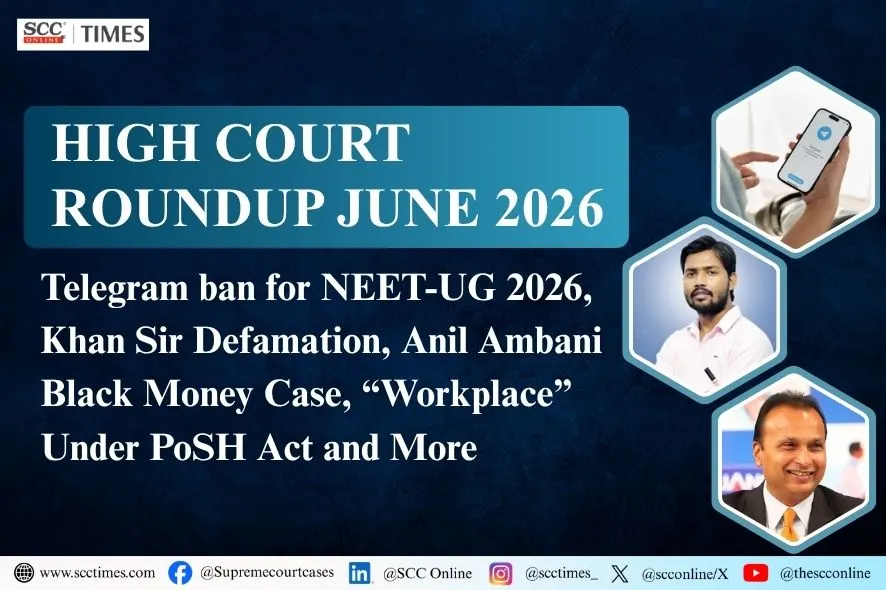
June 2026 was a busy month across India’s High Courts. The Telegram ban ahead of NEET-UG 2026 dominated headlines, with the Delhi High Court upholding platform-wide blocking under Section 69-A of the IT Act as a proportionate measure. High Courts across the country addressed questions of ₹2 crore defamation suit filed by journalist Anjana Om Kashyap against Khan Sir, child welfare, bail in serious offences, workplace definitions under the PoSH Act, insolvency, GST penalties, and land acquisition compensation alongside a Kerala High Court order directing a decade-long audit of Sabarimala temple finances. Here is a quick summary of the month’s most significant High Court rulings.
STORIES OF THE MONTH
Section 69-A, IT Act empowers platform-wide blocking: Delhi HC upholds temporary Telegram Ban as proportionate amid risk of fabricate leak claims in NEET-UG 2026
Delhi High Court in Telegram FZ LLC v. Union of India, 2026 SCC OnLine Del 4750, held that:
-
The interim and final orders did not suffer from non-application of mind.
-
The expression “information” under Section 2(1)(v), IT Act is broad enough to include an entire software platform or application.
-
The Government was empowered under Section 69-A, IT Act to issue directions for blocking public access to Telegram, where circumstances warrant such action.
-
The temporary blocking of Telegram and the disabling of its message-editing feature were proportionate, necessary and legally sustainable measures aimed at protecting the integrity of the National Eligibility-cum-Entrance Test (Undergraduate), 2026 (NEET-UG 2026) examination and preserving public order. Read more HERE
Anjana Om Kashyap & TV Today Network Files Defamation Suit Against Khan Sir and Others; Delhi HC issues summons
Delhi High Court in Anjana Om Kashyap v. Faisal Khan, 2026 SCC OnLine Del 4621, a ₹2 crores defamation suit filed under Order 39 Rules 1 and 2, Civil Procedure Code, 1908 (CPC), by Journalist Anjana Om Kashyap and the TV Today Network against popular educator Faisal Khan (popularly known as Khan Sir) and several other individuals over their allegedly defamatory, insulting and derogatory comments following her criticism of the growing influence of “star teachers”, the Single Judge Bench of Neena Bansal Krishna, J., issued summons to the defendants. Read more HERE
ARBITRATION LAW
No stay on arbitral award means execution cannot be obstructed
Bombay High Court in Unity Small Finance Bank Ltd. v. Meena Kumar Rohra, 2026 SCC OnLine Bom 3833 observed that in absence of stay on arbitral award, disclosure orders and continuation of injunction granted by Arbitral Tribunal are justified in execution proceedings. The Court directed Meena Kumar Rohra (borrower) to disclose her assets and encumbrances thereon on oath within 4 weeks. The Court further directed that the injunction restraining the borrower from disposing of her assets shall continue till further orders. Read more HERE
Delhi HC: Binding Heads of Terms Gives Rise to Bona Fide Arbitral Claim
Delhi High Court in Conscient Infrastructure (P) Ltd. v. Mahesh Kapoor 2026 SCC OnLine Del 4436, held that the HoT prima facie constituted a binding commercial arrangement and disclosed a bona fide arbitral claim and that questions relating to the enforceability of the HoT and the petitioner’s entitlement to specific performance were matters to be determined by the Arbitral Tribunal. Read more HERE
Technical Disputes Do Not Mandate a Technical Presiding Arbitrator; Tribunal May Seek Expert Assistance
Kerala High Court in Ambica Praveesh v. BMH Care Hospital Ltd., 2026 SCC OnLine Ker 5681 held that the presiding arbitrator has no noteworthy superior role compared to other arbitrators except in matters of procedure. Accordingly, the Court directed the Kerala High Court Arbitration Centre to nominate a former Judge from its panel as the third arbitrator, clarifying that the technical aspects can be addressed by seeking expert assistance. Read more HERE
CIVIL LAW
Order XIII Rule 9 CPC| Read why Karnataka High Court rejected plea seeking return of document
Karnataka High Court in K. Lokanath Naidu v. M. Malar Raja, 2026 SCC OnLine Kar 3006, a writ petition challenging an order of the trial court that dismissed an application under Order 13 Rule 9, Civil Procedure Code, 1908 (CPC) which sought return of Ext. P-15 (the document concerned), a Single Judge Bench upheld the trial court’s order and stated that only the party who produced the documents before the Court is entitled to seek its return. Read more HERE
Second Application Under Order 7 Rule 11 CPC Maintainable If Filed on Ground Different from First; Can Be Filed Even at Appellate Stage: Rajasthan HC
In Jaipur Development Authority v. Ravi Soni, 2026 SCC OnLine Raj 3546, a revision petition filed against the impugned order rejecting the second application filed for rejection of plaint under Order 7 Rule 11, Civil Procedure Code, 1908 (CPC), a Single Judge Bench, set the impugned order aside holding that after the rejection of the first application, if the second application is filed on a ground different from the first, then the second application is maintainable in law even if filed at the appellate stage and such application shall be decided on merits by the Court. Read more HERE
CONSTITUTIONAL LAW
Delay of 8 Years Defeats Plea for Correction of DOB in CBSE Records; Article 226 Cannot Be Invoked to Bypass CBSE Bye-Laws
Delhi High Court in Rewant Ahlawat v. CBSE, 2026 SCC OnLine Del 4581, arising from Single Judge’s judgment dismissing writ petition whereby the appellant sought correction of his date of birth (DOB) in records maintained by the Central Board of Secondary Education (CBSE) nearly 8 years after issuance of the CBSE certificate, and consequential issuance of a fresh Class X Board Examination Certificate, the Division Bench affirmed the Single Judge’s judgment, holding that,
-
The claim for correction of DOB in the CBSE certificate was barred by limitation under the applicable CBSE bye-laws.
-
Writ jurisdiction under Article 226 of the Constitution of India cannot be used to serve a cause which is barred by time.
-
The appellant’s claim was founded upon 2 contradictory birth certificates and lacked reliable supporting material.
-
Appropriate statutory and civil remedies remained available to resolve the dispute concerning the actual date of birth. Read more HERE
Prior Possession Cannot Be Taxed Under Article 5(e)(i) Karnataka Stamp Act; Statute Has No Residual Clause for Pre-Existing Possession
Karnataka High Court in Tulasamma v. M.S. Seethalakshmi, 2026 SCC OnLine Kar 3008, dealing with a writ petition under Article 227 of the Constitution, set aside the impugned order directing the plaintiff to pay a sum of ₹25,900 as deficit stamp duty and penalty of 10 times. Read more HERE
Rejecting Reimbursement Solely Due to Non-Empanelment, Places Procedure Above Human Survival
Punjab & Haryana High Court in Swati Yadav v. State of Haryana 2026 SCC OnLine P&H 13335, held that medical reimbursement policies, being instruments of social welfare and an extension of the right to health under Article 21 must be interpreted in a humane and purposive manner and not in a way that defeats genuine claims on technical grounds. Noting that the State was revisiting the policy framework, the Court directed the Competent Committee to reconsider each petitioner’s claim independently and pass a reasoned decision within 4 weeks, with any amount found payable carrying interest at 6 per cent per annum. Read more HERE
CONSUMER PROTECTION
Pharmacies Can Sell Below MRP But Cannot Display Vague Discount Boards
In Pharmadude Pharmacy Vannappuram v. State of Kerala, 2026 SCC OnLine Ker 5906, the Kerala HC upheld the validity of the circular and held that the licensing authority possesses incidental regulatory powers to prescribe reasonable conditions while granting or renewing drug licences. The Court observed that the circular was intended to protect consumers from misleading or vague discount advertisements and to promote transparency in the sale of medicines. Holding that the circular did not prohibit pharmacies from offering discounts or selling medicines below the Maximum Retail Price (MRP), but merely regulated deceptive promotional practices, the Court ruled that the stipulation did not amount to an unreasonable restriction on the right to carry on business. Read more HERE
CONTEMPT OF COURT
Delhi HC Directs Immediate Takedown of “Scandalous” Social Media Posts Against Sitting Judge; Restrains Further Dissemination in Criminal Contempt Case
Delhi High Court in Delhi High Court Bar Assn. v. Kapil Kakar, 2026 SCC OnLine Del 4631, held that freedom of speech does not extend to publications which prima facie scandalise the Court, undermine public confidence in the administration of justice, or interfere with the independent discharge of judicial functions. Finding the impugned videos and posts to be “absolutely scandalous, contumacious” and a direct interference with the justice delivery system, the Court directed their immediate takedown and restrained further dissemination of the content. the Court observed that while fair criticism of judicial orders and institutions is permissible, allegations of corruption, collusion, criminality and improper motives against Judges without any lawful basis cannot be equated with legitimate criticism. Read more HERE
CRIMINAL LAW
“Communal Harmony Forms the Bedrock of a Democratic Nation”: Allahabad HC Rejects Bail to Main Conspirator in Bareilly Violence Case
Allahabad High Court in Tauqeer Raja Khan v. State of U.P., 2026 SCC OnLine All 13919, rejected the application, holding that there was a significant risk that, if released, he may once again incite a particular community and disturb peace and harmony. Read more HERE
Can Witness Statements Recorded Before Summoning Be Used Against an Accused?
Allahabad High Court in Pramod Kumar Singh v. State of U.P., 2026 SCC OnLine All 10411, allowed the appeal, after observing that the trial court had relied on witness statements recorded before the accused was summoned to face trial. The Court held that such evidence could not be read against the accused, particularly when the witness, after his summoning, did not support the prosecution. Accordingly, the Court set aside the judgment and acquitted the accused of all the charges. Read more HERE
Can Loan Recovery Action by Bank Officials or Creditors Amount to Abetment of Suicide?
Bombay High Court in Amit Padmakar More v. State of Maharashtra, 2026 SCC OnLine Bom 3740, stated that normal or even harsh reaction, made in anger or momentarily, does not amount to abetment. Section 306 IPC requires a clear, deliberate, and intentional act to drive a person to suicide. Lawful actions such as loan recovery by bank officials, reminders for repayment, or strict conduct by authorities or parents do not constitute abetment of suicide. The Court stated that prima facie, the allegations, apart from being unsustainable and untenable, were also clearly contrary to the medical reports. Even if the allegations are accepted at face value, the same were general and vague in nature. Accordingly, the application was allowed. Read more HERE
Can a Murder Conviction Be Based on Confessional Statements Under S. 164 CrPC Recorded in Presence of Police Officer?
Gauhati High Court in Jiten Engti v. State of Assam, 2026 SCC OnLine Gau 3880, observed that the alleged confessions of the appellants had been made in the presence of a police officer. Thus, the Court held that that the said confessions cannot be said to be voluntary and as such, cannot be relied as substantive admissible evidence. Thus, the Court set aside the appellants’ conviction directed the appellants to be released from judicial custody. Read more HERE
Imprisonment in Default of Fine is Coercive, Not Punitive
Karnataka High Court in Dinesh Malpani v. State of Karnataka 2026 SCC OnLine Kar 4401, held that imprisonment in default of payment of fine is intended to operate as a coercive mechanism for recovery and not as a disproportionately punitive measure. Thus, the Court moderated the aggregate default sentence to the period already undergone and directed his release. Read more HERE
Here’s why Karnataka High Court declined interference in plea to amend final decree
Karnataka High Court in Y. Anirudha Rao v. S. Rathna, 2026 SCC OnLine Kar 3005, rejecting an application under Sections 151 and 152, Civil Procedure Code, 1908, (CPC) to amend the final decree, and dismissed the same and held that once a final decree has been passed, it can neither be amended nor revised, and the remedy available to the party is to challenge the decree under appropriate provisions of law. Read more HERE
Kerala HC Grants Bail to Mother Accused Finding No Direct Evidence Linking Her with Crime
Kerala High Court in Sreethu v. State of Kerala, 2026 SCC OnLine Ker 5466, held that, despite the grave nature of the allegations, the absence of direct evidence connecting the applicant to the crime and the overall circumstances warranted her release on bail subject to strict conditions. Read more HERE
MP HC Denies Bail to Paediatric Doctor Who Prescribed Banned Fixed Dose Compound to Children Below 4 Despite Government Circular
Madhya Pradesh High Court in S.S. Thakur v. State of M.P.,2026 SCC OnLine MP 14540, dismissed the application, holding that the accused prescribed the fixed dose compound to the children below the age of 4 years, which was banned by the Circular issued by the Government on 18 December 2023 (the Circular), due to which many innocent children died. Read more HERE
Ankita Bhandari case: ‘To Malign a Person’s Image to Implicate Them in a Concluded Murder Case Is a Serious Issue’: Uttaranchal HC Quashes Two FIRs Against Former MLA
Uttaranchal High Court in Suresh Rathore v. State of Uttarakhand, 2026 SCC OnLine Utt 1332, while considering a batch of 4 petitions filed by Suresh Rathore, former MLA, for quashing of FIRs on the ground that all 4 FIRs did not disclose any cognizable offence and that he was himself a victim and had not uploaded any conversation with his wife in any social media platform pertaining to the Ankita Bhandari’s murder case, a Single Judge Bench held that while 2 FIRs were liable to be quashed, the remaining 2 prima facie disclosed cognizable offences and therefore required thorough investigation. Read more HERE
FAMILY LAW
Termination of Pregnancy Beyond 26 Weeks Allowed Considering Medical Board’s Unambiguous Opinion on Foetal Anomalies
Bombay High Court in X v. State of Maharashtra, 2026 SCC OnLine Bom 4020 placed reliance on the Medical Board’s report and allowed termination of pregnancy beyond 26 weeks in view of serious foetal abnormalities, anticipated medical complications, and the petitioner’s financial condition. Read more HERE
Can the 30-day notice period under the Special Marriage Act be waived?
Delhi High Court inSyed Fayazuddin v. State (NCT of Delhi), 2026 SCC OnLine Del 4637 dismissed the petition, holding that the statutory waiting period forms an integral part of the legislative framework and cannot be waived by the Court in exercise of its writ jurisdiction.The Court observed that neither personal hardship nor individual exigencies could justify deviation from an express statutory mandate and reiterated that where a statute prescribes a particular procedure, it must be followed in the manner contemplated by law. Consequently, the Court declined to direct the Marriage Officer to solemnize the marriage before expiry of the prescribed notice period. Read more HERE
Custody Dispute Concerning Minor Child amid Complex Factual Disputes Require Adjudication by “Competent Family Court”, Not Summary Writ Proceeding
Delhi High Court in Somya Goel v. State (NCT of Delhi), 2026 SCC OnLine Del 4629, declined to exercise its discretionary jurisdiction under Article 226 of the Constitution and held that the petitioner’s claim regarding custody and visitation should be adjudicated before the “competent family court” where a detailed inquiry into all disputed facts could be undertaken. Read more HERE
Marital Discord Cannot Penalise a Sister-in-Law Who Opened Her Home in Good Faith
The Court in X v. Y, 2026 SCC OnLine Del 4611, reiterated that while remedies under the Protection of Women from Domestic Violence Act may be considered in civil proceedings by virtue of Section 26 DV Act, a daughter-in-law cannot enforce a right of residence against a sister-in-law who is the exclusive owner of the property. The Court further observed that any claim for alternative accommodation or residence lay against the husband in appropriate proceedings and could not be imposed upon the plaintiff-owner. Read more HERE
Parents Who Solemnise Child Marriages Cannot Escape Liability”: MP High Court Tells Husband to Seek Recourse from Them, Enhances Wife’s Maintenance Threefold
Madhya Pradesh High Court in R v. S, 2026 SCC OnLine MP 15133, partially allowed the application, holding that she could not be denied a reasonable amount of maintenance and the amount of Rs 2000 per month could not be justified. Accordingly, the maintenance amount was enhanced from Rs 2000 to Rs 6000 per month from the date of application. Read more HERE
GOODS AND SERVICE TAX
Gauhati HC disagrees with Bombay HC on Section 122(1-A), CGST Act; Holds partners liable to penalty for GST-Evasive transactions
In Mayank Bansal v. Union of India, 2026 SCC OnLine Gau 3796, the Court held that liability under the provision is not confined to a “taxable person” but extends to any person who retained the benefit of transactions covered under Section 122(1) and at whose instance such transactions were conducted. Holding that Section 122(1-A) is complementary to Section 122(1) and merely identifies the person responsible for, and benefiting from, such violations, the Court ruled that the provision could be applied even in relation to transactions predating its enforcement on 1 January 2021. Read more HERE
INSOLVENCY AND BANKRUPTCY LAW
Bombay High Court Grants Interim Relief to Anil Ambani in Black Money Case; CIT(A) Appeal to Continue but No Prosecution or Penalty Till Writ Petition Disposal
Bombay High Court in Anil Dhirajlal Ambani v. Union of India, 2026 SCC OnLine Bom 3732 directed that since the petitioner, Anil Ambani, had already appealed the assessment order, the said appeal can proceed and orders can be passed thereon, but no coercive action shall be taken against the petitioner, including that of prosecution and penalty, till the hearing and final disposal of the present petition. Read more HERE
INTELLECTUAL PROPERTY
Trade mark
Delhi HC Holds “GLASS SKIN” Descriptive; Directs Removal of Trade Mark Registration in Class 3
Delhi High Court in Renee Cosmetics (P) Ltd. v. Rupali Sharma, 2026 SCC OnLine Del 4593, held that the impugned mark was “descriptive” of the goods in question and fell within the prohibition under Section 9(1)(b), Trade Marks Act, 1999. Consequently, the Court allowed the petition and directed cancellation and removal of the registration of the mark “GLASS SKIN” from the Register of Trade Marks. The Court held that the expression “GLASS SKIN”, used in relation to skincare and cosmetic products, directly conveyed the intended purpose and end result of the goods, and therefore lacked inherent distinctiveness. Observing that the mark had not acquired any secondary significance, the Court concluded that its registration was without sufficient cause and was wrongly remaining on the Register. Read more HERE
Delhi HC Restrains Use Of ‘Prestige Ocean Pearl’, Finds ‘Ocean Pearl’ to be Dominant Feature of Impugned Mark; Parties Referred to Mediation
Delhi High Court in Ocean Pearl Hotels (P) Ltd. v. Prestige Estates Projects Ltd., 2026 SCC OnLine Del 4673, held that the impugned mark “PRESTIGE OCEAN PEARL” prima facie subsumed the plaintiff’s registered trade mark “Ocean Pearl”, with the expression “Ocean Pearl” being used as the dominant and distinctive element of the defendant’s branding and granted an ex parte ad interim injunction restraining the defendant from using the impugned marks and directed removal of all websites, domain names and promotional material bearing the said marks. Subsequently, upon the defendant filing an application seeking vacation of the injunction, the Court referred the parties to mediation before the Delhi High Court Mediation and Conciliation Centre for an amicable resolution of the dispute. Read more HERE
Delhi HC protects MakeMyTrip trade mark; restrains use of deceptively similar “MakeMyIndiaTrip” marks
Delhi High Court in MakeMyTrip (India) (P) Ltd. v. MakeMyIndiaTrip, 2026 SCC OnLine Del 4633, granted an ex parte ad interim injunction restraining the defendant from using the impugned marks, trade name, logo and domain name “www.makemyindiatrip.com”, or any other mark deceptively similar to the plaintiff’s well-known “MakeMyTrip”trade marks. The Court held that the plaintiff had established a prima facie case of trade mark infringement and passing off, that the balance of convenience lay in its favour, and that continued use of the impugned marks was likely to cause consumer confusion, dilute the plaintiff’s goodwill and reputation, and result in irreparable harm to its business interests. Read more HERE
LABOUR AND EMPLOYMENT LAW
Whether Employer’s Intentional Assault on Employee Constitutes “Accident” Arising Out of Employment Under Employees’ Compensation Act?
Karnataka High Court in Swamy v. Kumara, 2026 SCC OnLine Kar 2992, examining the scope of an employer’s liability under Section 3(1), Employees’ Compensation Act, 1923 (EC Act) particularly whether injuries sustained by an employee as a result of an intentional assault by the employer can be regarded as an “accident” arising out of and in the course of employment, held that assault by the employer cannot be termed as “accident” arising out of and in the course of employment under Section 3(1), EC Act as it had no connection to the employment. Accordingly, the Court dismissed the appeal and upheld the judgment by the trail court dismissing the claim petition filed under Section 10, EC Act, praying for the compensation arising out of an accident at the workplace under Section 3(1), EC Act. Read more HERE
LAND LAW
Landowners Entitled to Compensation Even for Land Acquired for Service Road: Bombay High Court
Bombay High Court in Youvraj v. NHAI, 2026 SCC OnLine Bom 3802, held that the petitioners were entitled to compensation for the land acquired for the service road in a National Highway widening project and directed the authorities to pay the compensation amount within 2 months, holding the denial of compensation to be arbitrary. Read more HERE
POSH
Whether a Shared Autorickshaw Used for Office Commute Constitutes a “Workplace” Under POSH Act?
Bombay High Court in Siddhesh Pradeep Satpute v. SBI, 2026 SCC OnLine Bom 3824, stated that in the present case, although the petitioner was going to his office, the said transportation had not been provided either by his employer or Respondent 3’s employer. In these circumstances, such transportation would not fall within the definition of a “workplace” as defined by Section 2(o)(v), POSH Act. Thus, the Court held that the alleged incident had not taken place at a “workplace”. Read more HERE
PROPERTY LAW
Better possessory title prevails over mere occupation
Delhi High Court in Khatiza Begam v. Salma Khan, 2026 SCC OnLine Del 4749, upheld the decree for possession in favour of the respondent. The Court reiterated that a person who establishes a better title to possession cannot be denied recovery of property merely because absolute ownership is not proved. Therefore, a person who establishes a better possessory title to a property is entitled to recover possession from an occupant who fails to demonstrate any superior or lawful right to continue in possession. Read more HERE
RELIGIOUS AND CHARITABLE ENDOWMENTS AND TRUSTS
Kerala High Court Orders 10-year Audit of Sabarimala Temple Accounts Over Alleged Financial Irregularities in Procurement and Management
Kerala High Court in Suo Motu v. State of Kerala, 2026 SCC OnLine Ker 5587, a suo motu matter initiated on the basis of a report submitted by the Sabarimala Special Commissioner, which highlighted alleged misuse of temple funds, failure to maintain mandatory records, acceptance of pooja materials without proper accounting, and the absence of adequate safeguards to prevent financial impropriety within the Travancore Devaswom Board, the Division Bench directed the Travancore Devaswom Board (TDB) to produce records relating to various temple rituals and offerings (Vazhipadu) conducted at the Sabarimala Temple over the past 10 years and ordered an independent audit of its financial practices. The Court expressed serious concern over alleged irregularities in reimbursement claims, unregulated supply of pooja materials, failure to maintain mandatory records, and the absence of adequate safeguards against financial misuse, emphasising that statutory religious institutions are bound by principles of transparency, accountability, and sound financial management. Read more HERE
RTI
Recruitment Transparency Prevails: Sikkim HC Orders Disclosure of Merit List and Marks Sought Under RTI, Subject to No Social Media Publication
Sikkim High Court in Sikkim PCS v. Sikkim Information Commission, 2026 SCC OnLine Sikk 42, directed the State Public Information Officer to furnish the relevant information to the RTI applicant and recorded the applicant’s undertaking not to place the information on any social media platform. Read more HERE
SERVICE LAW
Appointment to Newly Created Post Upon Abolition of Earlier Post Not a Promotion for ACP/MACP Upgradation in Absence of Feeder Cadre Relationship
Meghalaya High Court in Union of India v. Veena Dhoundiyal, 2026 SCC OnLine Megh 453, set aside the writ petition objecting the entitlement of the benefits received by the respondent. The Court upheld the impugned order by Central Administrative Tribunal allowing the benefits of the schemes to the respondent as petitioners were not able to make out a case to set aside and quash the impugned order. Read more HERE