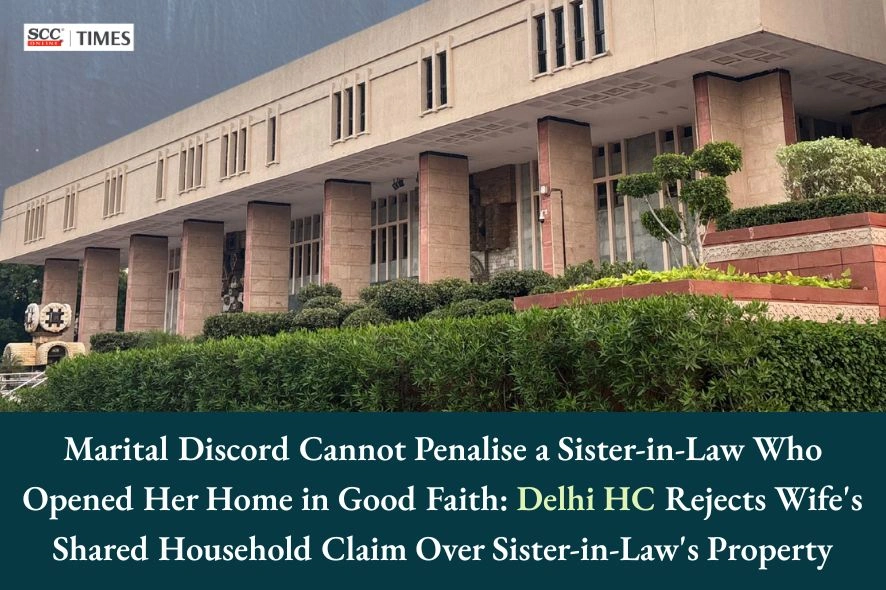
Delhi High Court: In a regular second appeal concerning a daughter-in-law’s claim to continue residing in her sister-in-law’s property as a shared household under the Protection of Women from Domestic Violence Act, 2005 (DV Act), a Single Judge Bench of Neena Bansal Krishna, J., held that a wife who enters a property solely by virtue of her husband’s permissive occupation cannot claim a better right than the husband after his licence stands terminated. Observing that the appellant had no independent right, title or interest in the suit property and that no domestic relationship existed between her and the plaintiff-owner, the Court held that the property could not be treated as a shared household vis-à-vis the plaintiff. Finding no merit in the allegations of collusion between the plaintiff and her brother, and no substantial question of law arising for consideration, the Court dismissed the appeal and upheld the decree directing the appellant to vacate the premises.
The Court reiterated that while remedies under the Protection of Women from Domestic Violence Act may be considered in civil proceedings by virtue of Section 26 DV Act, a daughter-in-law cannot enforce a right of residence against a sister-in-law who is the exclusive owner of the property. The Court further observed that any claim for alternative accommodation or residence lay against the husband in appropriate proceedings and could not be imposed upon the plaintiff-owner.
Background
The dispute concerned property bearing No. 2-A/44, ground floor and second floor with roof rights, Ramesh Nagar, New Delhi. The plaintiff, claimed ownership of the property on the basis of a will dated 6 February 2012 executed by her mother, who passed away on 20 May 2012. After the mother’s demise, the plaintiff permitted her brother (Defendant 1), to occupy the ground floor as a gratuitous licensee. Following his marriage Defendant 2/Appellant in October 2012, both defendants resided in the premises. According to the plaintiff, the defendants subsequently harassed her and attempted to assert rights over the property, compelling her to revoke the licence through a legal notice dated 2 July 2015 and seek possession and injunctions against them.
Defendant 1 admitted that he had been residing in the premises as a licensee but asserted that he had already vacated the property along with his daughter owing to matrimonial disputes with Defendant 2. Defendant 2, however, resisted the suit contending that the premises constituted her matrimonial home/shared household and that the suit had been instituted in collusion between the plaintiff and Defendant 1 to deprive her of her right of residence. She further challenged the validity of the will executed by the plaintiff’s mother and claimed that the plaintiff was not the exclusive owner of the property.
The trial court, upon appreciation of the evidence, held that the plaintiff had successfully established her ownership under the will and that Defendant 2 had failed to prove any domestic relationship with the plaintiff so as to claim a right of residence under the Protection of Women from Domestic Violence Act. Consequently, a decree of mandatory injunction directing delivery of possession and a permanent injunction restraining creation of third-party interests were granted in favour of the plaintiff. The first appellate court affirmed these findings, leading Defendant 2 to file the present regular second appeal.
Analysis
The Court observed that the plaintiff had successfully established her exclusive ownership over the suit property through the will dated 6 February 2012 executed by plaintiff’s mother, which stood duly proved by the attesting witnesses. It further noted that Defendant 1, the plaintiff’s brother, had been residing in the suit premises only as a permissive user/licensee and had himself admitted that he had vacated the property and claimed no independent right therein. The appellant-wife had entered the premises only after her marriage to Defendant 1 and had joined her husband in occupation of the property. Consequently, once the husband’s permissive right to occupy the premises stood terminated and he had vacated the property, the appellant could not claim a better right than him and had no independent right, title or interest to continue in possession of the suit property.
Dealing with the appellant’s plea that the premises constituted her matrimonial home/shared household, the Court concurred with the findings of the courts below that the appellant and the plaintiff had never lived together in a domestic relationship and, therefore, the suit property could not be treated as a shared household vis-à-vis the plaintiff. The Court rejected the contention that the Trial Court had exceeded its jurisdiction by referring to the Protection of Women from Domestic Violence Act, observing that Section 26 DV Act itself permits consideration of such reliefs in other legal proceedings. The courts below had merely examined whether any protection under the DV Act could be available to the appellant and, on the facts of the case, correctly found that none existed.
The Court also found no merit in the allegation that the suit was collusive between the plaintiff and Defendant 1. It held that the material facts regarding ownership of the property and the permissive nature of occupation were not disputed by the appellant and no circumstances suggesting collusion were established. As regards the appellant’s claim to a right of residence, the Court observed that any such remedy lay against her husband in the proceedings already instituted by her under the DV Act and not against the plaintiff, who was merely the sister-in-law and owner of the property.
The Court observed that,
“The discord inter-se the husband and the wife cannot become a penalty for a sister-in-law, who in good faith, had permitted them to occupy her Suit property.”
Decision
Holding that no substantial question of law arose for consideration in the second appeal and that the concurrent findings of the courts below were based on proper appreciation of evidence and law, the Court dismissed the appeal and upheld the decree directing the appellant to vacate the suit premises.
Also Read: Delhi HC upholds Daughter-in-law eviction from shared household
[X v. Y, 2026 SCC OnLine Del 4611, decided on 5-6-2026]
Advocates who appeared in this case:
For the Appellant: Mohammad Sajid and Abdullah Bin Masood, Advocates
For the Respondents: Tushar Sannu, Pulak Gupta Joshi and Payal Rajput, Advocates