Disclaimer: This has been reported after the availability of the order of the Court and not on media reports so as to give an accurate report to our readers.
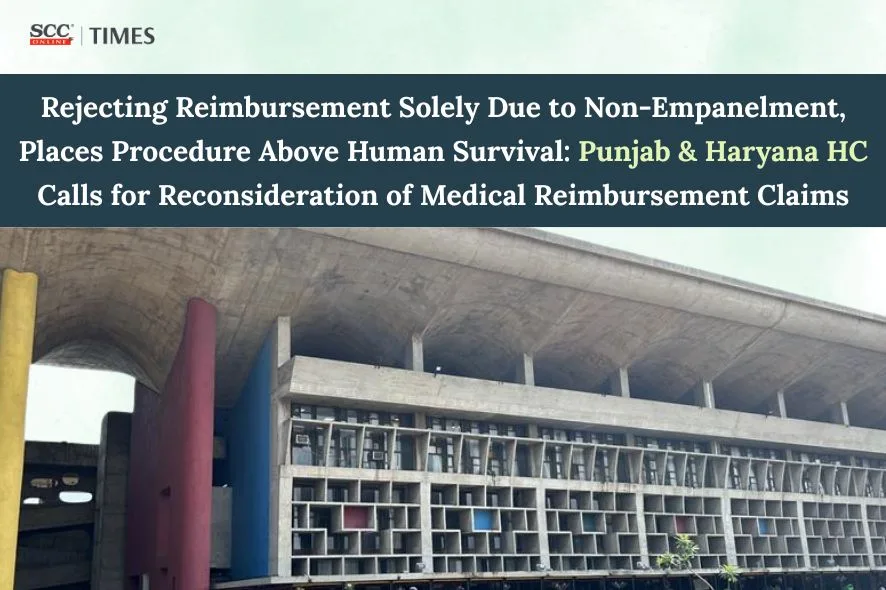
Punjab & Haryana High Court: In a batch of writ petitions concerning denial and inadequate medical reimbursement to State employees and pensioners, involving issues such as treatment in non-empanelled hospitals, reimbursement restricted to Postgraduate Institute of Medical Education and Research, Chandigarh (PGI) rates, and outdated policy conditions, the Single Judge Bench of Sandeep Moudgil, J., held that medical reimbursement policies, being instruments of social welfare and an extension of the right to health under Article 21 must be interpreted in a humane and purposive manner and not in a way that defeats genuine claims on technical grounds. Noting that the State was revisiting the policy framework, the Court directed the Competent Committee to reconsider each petitioner’s claim independently and pass a reasoned decision within 4 weeks, with any amount found payable carrying interest at 6 per cent per annum.
The Court observed that,
“In such circumstances, to reject reimbursement solely on the ground of non-empanelment would amount to placing policy procedure above human survival.”
Background
The petitioners challenged various aspects of the State’s medical reimbursement policy, including denial of reimbursement for treatment obtained from non-empanelled private hospitals, restriction of reimbursement to PGI rates despite policy provisions permitting higher reimbursement in certain cases, the condition disentitling dependants earning more than Rs 3500 per month from medical benefits, and the continued application of outdated package rates and treatment modules despite rising healthcare costs and advancements in medical science.
Analysis and decision
At the very threshold the Court observed that the right to health and medical care is firmly recognised as an integral facet of the right to life guaranteed under Article 21 of the Constitution of India as recognised in State of Punjab v. Mohinder Singh Chawla, (1997) 1 SCT 716. The Court noted that
“Public health and hospitals” being a State subject in the State List (Entry 6, List II) under VII Schedule of the Constitution, the State bears the paramount obligation of safeguarding the
health and well-being of its citizens and more particularly those who have spent the prime years of their lives serving the State machinery itself, as a welfare entity governed by constitutional morality.
The Court observed that medical reimbursement policies are intended to give effect to the constitutional promise of dignity and social security and to ensure that employees are not reduced to financial distress due to illness. The Court noted that while the State’s reimbursement framework is largely based on PGI rates, constitutional adjudication cannot proceed divorced from live realities, particularly in medical emergencies where factors such as overcrowding, long waiting periods, lack of beds, and urgency of treatment often compel patients to seek care at the nearest available hospital. “In such circumstances, to reject reimbursement solely on the ground of non-empanelment would amount to placing policy procedure above human survival.”
The Court opined that medical reimbursement policies must be interpreted through a humane and welfare-oriented lens, consistent with the country’s foundational values, and should be applied in a manner that furthers human welfare rather than allowing genuine claims to be defeated on technical grounds.
“The constitutional promise of a welfare state draws strength from the enduring civilisational ethos of this country, encapsulated in the ancient Sanskrit principle of “सर्वे भवन्तु सुखिनः, सर्वे सन्तु निरामयाः”— may all be happy; may all be free from illness.”
The Court observed that the health and dignity of individuals are integral to societal well-being and form a core principle of governance. Medical reimbursement schemes, being social welfare measures, should be interpreted in a humane and purposive manner consistent with the constitutional vision of a just and caring society.
Disposing all the writ petitions, the Court directed the respondents to consider each petitioner’s claim independently and sympathetically in light of the principles laid down in Shiva Kant Jha v. Union of India, (2018) 16 SCC 187, State of M.P. v. M.P. Ojha, (1998) 2 SCC 554, Rama Kant Sharma v. State of Haryana, CWP-257-2019 amongst others.
Noting the State’s submission that a committee comprising the Additional Director Health Services, the Deputy Director (Medical Reimbursement Branch), and the Nodal Officer (Empanelled Hospitals) had been constituted, the Court directed the Committee to examine each case individually and pass a conscious and well-reasoned decision within 4 weeks from receipt of the certified copy of the order.
The Court held that any amount found payable to the petitioners upon reconsideration of their claims shall carry interest at the rate of 6 per cent per annum from the date it became due till its actual realisation. Accordingly, the batch of writ petitions and all pending miscellaneous applications were disposed of.
[Swati Yadav v. State of Haryana, 2026 SCC OnLine P&H 13335, decided on 29-5-2026]
Advocates who appeared in this case:
For the petitioner: Sunil K. Nehra, Sr. Advocate, Viren Nehra, Ms. Poorvi Sharma, Advocate, Mr. Manish Soni, Advocate, Rishi Pal Chaudhary, Chaman Deep, Ivneet Singh Pabla, P.R. Yadav, Vikas Singh Chawra, Parvinder Moar, Tejas Ahlawat, P.K. Chugh, Suryaveer Singh Surjewala, Diwan S. Adlakha, Saurav Verma, Anshul Pareek, Deepak Sonak, Riya Kangra, Sandeep Thakan.
For State: Deepak Balyan
Buy Constitution of India HERE