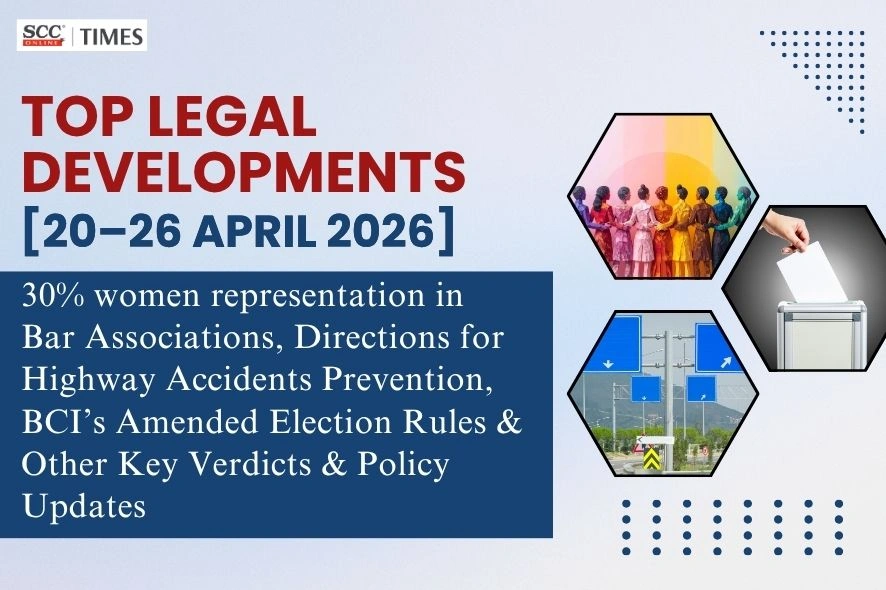
This roundup of weekly legal developments India covers the most significant Supreme Court and High Court rulings, including 30% women representation mandatory for Bar Associations, Nationwide Interim Directions for Prevention of Highway Accidents, SC Approval of BCI’s Amended Election Rules, Approval of Enhanced ECC Rates for commercial vehicles, Mandate of High-Powered Committee constituted in Suhas Chakma (2026), Pawan Khera Anticipatory Bail, Toprankers Edtech clat topper identity case, Kartik Aaryan’s Personality Rights, Rahul Gandhi Citizenship Case judge recusal, NSE Trademark and others
TOP STORIES OF THE WEEK
SC Recognises Commuter Safety as Integral Facet of Article 21; Issues Nationwide Interim Directions for Prevention of Highway Accidents
In Phalodi Accident, In re, 2026 SCC OnLine SC 646 the Court in continuation of the suo motu cognizance of systemic negligence and catastrophic infrastructure failures, that led to tragic loss of 34 lives in road accidents in Rajasthan and Telangana in November 2025; the Supreme Court recognised that safety of the commuter is an integral facet of the right to live with dignity as a constitutional obligation under Article 21 of the Constitution. With the recognition of commuter’s safety as an important component under Article 21 of the Constitution, the Court therefore, issued certain interim directions aiming at addressing the root causes behind tragic accidents at National highways. Read more about Directions for Prevention of Highway Accidents HERE
30% women representation mandatory for Bar Associations; failure may lead to suspension| Supreme Court
In an application assailing non-compliance with the order dated 13 March 2026, pan-India 30 per cent women representation in Bar Associations mandate in Deeksha Amrutesh v. State of Karnataka, 2026 SCC OnLine SC 472, a three-Judge Bench issued a word of caution and a stern warning that wherever the Bar Associations have failed to comply with, or shall be found to have defied, the directions issued hereinabove, such Bar Associations shall be liable to be suspended through a judicial order and fresh elections shall be directed to be conducted. Read more about mandatory women representation for Bar Associations HERE
SC Approves BCI’s Amended Election Rules Allowing Bar Association Office-Bearers to Contest State Bar Council Polls with Post-Selection Choice
In Shyam Lal Thakur v. Bar Council of India, 2026 SCC OnLine SC 667, in a significant development concerning the electoral framework of State Bar Councils, a Division Bench of the Supreme Court has approved the amended Chapter III of the Bar Council of India Uniform Rules and Mandatory Guidelines for Elections of Bar Councils, 2016. Read more about SC’s approval of BCI’S amended election rules HERE
SUPREME COURT HIGHLIGHTS OF THE WEEK
Anticipatory Bail| High Court Cannot Direct Surrender While Rejecting Anticipatory Bail
In Om Prakash Chhawnika v. State of Jharkhand1, assailing the Jharkhand High Court order, during an anticipatory bail hearing, directing the petitioner to surrender before the court and then seek a regular bail, the Court held that the High Court order was “wholly without jurisdiction” and stated that, “If the Court wants to reject the anticipatory bail, it may do so but the Court has no jurisdiction to say that the petitioner should now surrender.” Read more HERE
Arbitration| Use of Expression “Can” in Arbitration Clause Indicates Mere Possibility, Not Binding Agreement to Arbitrate
In NagreeKa Indcon Products (P) Ltd. v. Cargocare Logistics (India) (P) Ltd., 2026 SCC OnLine SC 630 the Supreme Court while deciding as to whether use of the word “can” in an arbitration clause in the contract, necessitate the reference of all disputes to arbitration or recourse to other dispute resolution mechanisms, including that of the civil court, open for the parties, dismissed the appeal, holding that use of expression “can” in Clause 25 of the arbitration agreement indicates merely the future possibility of referring disputes to arbitration and as such, it cannot be said to be a binding arbitration agreement. The Court further held that such an agreement can only come into existence when both parties agree to the same. Read more about Use of Expression “Can” in Arbitration Clause HERE
Discharge| Discharge by criminal court bars subsequent disciplinary action; honour of dismissed Air Force Officer restored
In Ex. Sqn. Ldr. R. Sood v. Union of India, 2026 SCC OnLine SC 590, the Court while deciding appeals arising out of dismissal from service of an Indian Air Force Officer in connection with a 1987 desert incident involving the alleged death of a General Reserve Engineer Force (GREF) driver, allowed the appeal and set aside the order of dismissal. The Court held that once the competent authority had elected to proceed before a criminal court instead of a court martial and the accused had been discharged, initiation of subsequent administrative action on the same set of facts was legally impermissible and non est in law. Read more about honour of dismissed Air Force Officer restored HERE
Environment Law| Approval of Enhanced ECC Rates with Annual 5% Increase for Commercial Vehicles Entering Delhi
In M.C. Mehta v. Union of India, 2026 SCC OnLine SC 635, while hearing a long-standing environmental litigation regarding enhancement of the Environment Compensation Charge (ECC) levied on commercial vehicles entering Delhi to curb vehicular pollution, a 3-Judge Bench of Supreme Court approved the proposed revised ECC rates and the recommendation for 5 per cent annual increase in ECC rates, with clarification that such enhancement shall take effect from 1 April 2026. Read more about increase in ECC rates HERE
Eviction| Occupation of Residential Premises at Sujan Singh Park not governed by DRC Act
In Union of India v. Sir Sobha Singh & Sons (P) Ltd., 2026 SCC OnLine SC 658, the Court had to determine whether the nature of Union of India’s (appellant) occupation of residential premises at Sujan Singh Park, New Delhi is governed by the provisions of Section 3, Government Grants Act, 1895 (GG Act) or whether the appellant became amenable to eviction proceedings under Section 14(1)(a), Delhi Rent Control Act, 1958 (DRC Act) for non-payment of rent. The Court pointed out that the legal character of such a grant made under GG Act does not derive its content from the ordinary incidents of a landlord-tenant relationship under the general law but instead flows from the sovereign grant and the conditions embodied therein. Whereas the DRC Act being a legislation intended to regulate conventional tenancies arising under the general law, does not extend to nor govern a holding originating in and regulated by a government grant. Read about Occupation of Residential Premises at Sujan Singh Park HERE
Prisoners’ Rights| Mandate of High-Powered Committee constituted in Suhas Chakma (2026) to Examine Institutional Safeguards expanded
In Sathyan Naravoor v. Union of India, 2026 SCC OnLine SC 650, while considering a matter concerning the rights and conditions of detention, and institutional safeguards available to prisoners with disabilities within prison systems across the country, the Court noted that the matter necessitated closer scrutiny of the extent to which the mandate of the Rights of Persons with Disabilities Act, 2016 (RPwD Act) and the constitutional guarantees are being effectively realised in custodial settings or not. Therefore, the Court opined that issues of the present proceedings can be more appropriately, effectively, and comprehensively addressed by the High-Powered Committee constituted by the Court in Suhas Chakma v. Union of India, 2026 SCC OnLine SC 317, for reform and governance of open correctional institutions (OCIs). The Court also issued several new directions emphasising on the need for an effective, structured, and uniform mechanism to address the issues highlighted in the present matter. Read more about court’s directions on disabled prisoner’s rights HERE
Regularisation Policies| Haryana Regularisation Policies partly upheld
In Madan Singh v. State of Haryana, 2026 SCC OnLine SC 628 while deciding a batch of appeals arising out of the judgment dated 31 May 2018 passed by the Punjab and Haryana High Court concerning regularisation of contractual, ad hoc and daily wage employees in Group “B”, “C” and “D” posts, the Court partly allowed the appeals and modified the impugned judgment. The Court upheld the validity of the Notifications dated 16 June 2014 and 18 June 2014, holding that they were in continuation of an earlier valid policy and did not violate the principles laid down in State of Karnataka v. Umadevi, while striking down the Notifications dated 7 July 2014 as arbitrary and illegal for seeking to regularise employees not appointed through any transparent process. Read more HERE
Title| Municipal Records Do Not Confer Title
In Pawan Garg v. South Delhi Municipal Corporation, 2026 SCC OnLine SC 644, the Court held that the High Court erred in travelling beyond the limited scope of adjudication in the de-reserved land layout plan dispute by entering into questions of title and public purpose, despite a final and binding civil court decree protecting the appellants’ possession. Emphasising that a mere entry in municipal records does not confer title and that de-reserved land cannot be retrospectively treated as earmarked for public purpose, the Court restored the order of the Single Judge directing the Municipal Corporation to consider the appellants’ application for incorporation of the plots in the layout plan within a stipulated period. Read about de-reserved land layout plan dispute HERE
Also Read: Ex Parte Suits: Framing Issues not mandatory but omission can vitiate trial: SC | SCC Times
Also Read: SC: Unauthorized Re-Categorisation of Public Utility Land Renders Pattas Void Ab Initio | SCC Times
MAJOR HIGH COURT RULINGS THIS WEEK
Anticipatory Bail| Anticipatory Bail denied to Congress Leader Pawan Khera in FIR Lodged by Assam CM’s Wife
In Pawan Khera v. State of Assam2, anticipatory bail application filed by Congress leader Pawan Khera, in connection with an FIR lodged by Riniki Bhuyan Sarma, the wife of the Chief Minister of Assam, alleging defamatory accusations based on purported documents, the Court refused to grant anticipatory bail, holding that custodial interrogation was necessary in the case to find out who had collected those documents for Pawan Khera, and the manner and source of their procurement. Read more HERE
Conversion| Disturbing trend of third persons filing FIRs under U.P. Conversion Act
In Mohd. Faizan v. State of U.P., 2026 SCC OnLine All 2799 while hearing a petition filed by a Muslim man seeking quashing of FIR filed against him alleging forceful conversion by him of a girl, the Allahabad High Court directed the Additional Chief Secretary (Home), Government of U.P., to file an affidavit stating actions taken against the disturbing trend of FIRs being lodged by third persons falsely under the Uttar Pradesh Prohibition of Unlawful Conversion of Religion Act, 2021 (UP Conversion Act). The Court also directed that State security shall be provided to the couple and their relatives. Read more HERE
Custody| Father’s Forceful Custody of Minor Does Not Amount to Illegal Detention
In Anjali Devi v. State of U.P., 2026 SCC OnLine All 2865, where a habeas corpus writ petition was filed seeking production of children alleging forceful custody by father, the Allahabad High Court dismissed the petition and held that such petitions are not maintainable in ordinary inter-parental custody disputes unless the custody is shown to be illegal or without authority of law. Read more HERE
Defamation| “Toprankers Edtech”protected from Defamatory Campaign by Edtech Rival Platform
In Toprankers Edtech Solutions (P) Ltd. v. LPT Edtech (P) Ltd., 2026 SCC OnLine Del 1772, whereby an application was filed by the plaintiffs, Toprankers Edtech Solutions (P) Ltd., seeking ex-parte ad-interim injunction against the defendants, LPT Edtech (P) Ltd., who had launched blatant and malicious campaign plaintiffs thereby tarnishing their goodwill and reputation, the Court held that the plaintiffs had made out a case for grant of interim injunction. Read more about restraint on misuse of CLAT 2026 Topper’s Identity HERE
Motor Accident Compensation| HRA, CCA, HDA and other Allowances Must Count in Income for Motor Accident Compensation
In Priyanka v. Swarn Singh3, while considering an appeal filed by the appellant-wife of deceased person, under Section 173, Motor Vehicles Act, 1988 against the judgment and award passed by the Additional District & Sessions Judge (Add. D&SJ) and the Motor Accident Claims Tribunal (Tribunal) by which the claim petition filed by the claimants was partly allowed, a Single Judge Bench of Rajasthan High Court held that higher duties allowance (HDA), city compensatory allowance (CCA), washing allowance, house rent allowance (HRA), other allowances are part of the income of the deceased, for the purpose of calculating compensation towards loss of dependency. Read more about allowances in Motor Accident Compensation HERE
Personality Rights| Kartik Aaryan’s Personality Rights and Trademark protected
In Kartik Aaryan v. Vinsm Globe (P) Ltd., 2026 SCC OnLine Bom 2648 , whereby an application was filed by Kartik Aaryan, seeking to protect his personality rights, against unauthorised use of his registered trade mark “Kartik Aaryan” and AI-generated content, the Bombay High Court held that the plaintiff was entitled to an ad interim injunction and further directed the removal of infringing content within 36 hours. Read more about Kartik Aryan Personality Rights HERE
Recusal| Allahabad HC Judge Recuses from Hearing the Rahul Gandhi Citizenship Case
In S. Vignesh Shishir v. Rahul Gandhi, 2026 SCC OnLine All 3003, wherein a petition was filed in the Rahul Gandhi citizenship case, Subhash Vidyarthi, J., recused himself from the matter, noting that the petitioner in his social media posts had cast aspersions on the Court for not uploading the order as dictated in open court due to the later discovery of a contrary precedent. The Allahabad High Court also noted that the counsels and the petitioner had misled the Court on the point of law that it had sought assistance on. Read more about judge’s recusal in Rahul Gandhi citizenship case HERE
Trade Mark| Misuse of NSE Trademark on Social media platforms restrained
In National Stock Exchange of India Ltd. v. John Doe S. Ashok Kumar, 2026 SCC OnLine Bom 2516, the Bombay High Court granted interim relief to NSE, restraining Defendant 1 and others from misusing the mark “NSE” and directed social media platforms and YouTube were directed to remove infringing accounts or channels within 36 hours, once NSE provides evidence. Read more about NSE Trademark suit HERE
TRIBUNAL UPDATES OF THE WEEK
Audit| CAG Audit of Delhi DISCOMs Impermissible Without Compliance of Section 20 Conditions
In Suo-Moto action under Section 121 of the EA v. Central Electricity Regulatory Commission4, the Tribunal set aside the approval for entrustment of audit of Delhi DISCOMs to the Comptroller and Auditor General (CAG) of India, holding that the same was in violation of statutory requirements under Section 20, Comptroller and Auditor-General’s (Duties, Powers and Conditions of Service) Act, 1971 (CAG Act). The Tribunal further rejected the request of the Delhi Electricity Regulatory Commission (DERC) for extension of time to commence liquidation of regulatory assets and directed initiation of recovery within a fixed timeline. Read more about CAG Audit of Delhi DISCOMs HERE
Judgement Review| Power to review judgement or order under Section 114 and Order 47 CPC can’t be exercised suo moto
In U.P. Jal Vidyut Nigam Ltd. v. CERC5 while deciding an appeal filed by Uttar Pradesh Jal Vidyut Nigam Ltd. (UPJVNL), the Tribunal partly allowed the appeal and set aside the impugned order dated 11 July 2018 passed by Central Electricity Regulatory Commission (CERC) to the extent it modified its earlier order dated 12 October 2017 and held that CERC exceeded its review jurisdiction by issuing fresh directions on an issue neither raised in the review petition nor argued by the parties, thereby violating principles of natural justice. Read more about Power to review judgement or order under Section 114 and Order 47 CPC HERE
THIS WEEK’S KEY LEGISLATIVE UPDATE
-
Cabinet Approves Additional 2% DA/DR from Jan 2026 | SCC Times
-
Delhi Jan Vishwas (Amendment of Provisions) Act, 2026 | SCC Times
-
ECI Regulates social media during Elections 2026 | SCC Times
-
RBI issues guidelines to facilitate faster cross-border inward payments | SCC Times
-
Odisha Repeals Levy of Professional Tax from April 2026 | SCC Times
-
Promotion and Regulation of Online Gaming Act 2025 Enforced | SCC Times
-
RBI notifies Digital Payments — E-mandate Framework, 2026 | SCC Times
-
Companies (Registration Offices and Fees) Amendment Rules, 2026 | SCC Times
-
Promotion and Regulation of Online Gaming Rules, 2026 | SCC Times
-
All India Services (Implementation of NPS) Rules, 2026 | SCC Times
OTHER DEVELOPMENTS OF THIS WEEK
OP.ED.
-
Does Article 224-A Need to be Woken Up from its Slumber? by Shayan J. Bisney
-
How Indian Startups Can Use Madrid Protocol for Global Brand Expansion? by Avesh Kayser
-
Women Workers under India’s New Labour Codes: Continuity or Dilution of Statutory Protection? by Aakash Singh and Aniket Singh Tomar
-
Anomalies Around Notice Period in Employment Contract for Non-Workmen by Beauty Gupta
-
Illegally Acquired Property and the Six Year-Embargo: The Hidden Faultline in NDPS Forfeiture by Srinivasan Gopal
-
Decoding the Ministry’s Latest Clarifications: A Thematic Analysis of the Additional FAQs on the Four Labour Codes Answered by Ministry of Labour & Employment by Abhishek Shivpuri
KNOW THY JUDGE
Know Your Judge| Supreme Court of India: Justice K. Vinod Chandran
Also Read:
1. SLP(Crl.) No.16221 of 2025
2. AB, 804 of 2026
3. S.B. Civil Miscellaneous Appeal No. 6406 of 2011
4. O.P. 1 of 2025
5. App No. 309 of 2018