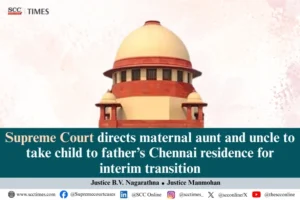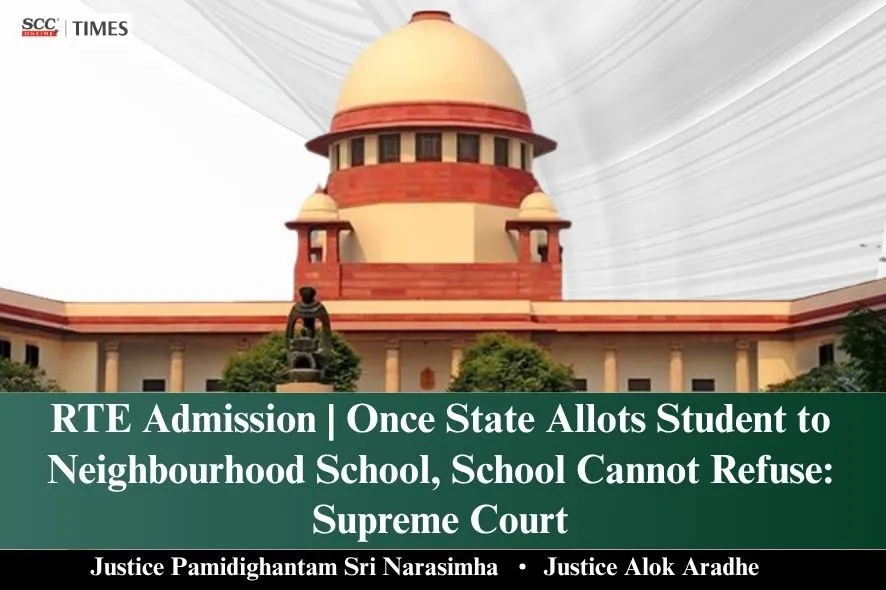
Supreme Court: In a special leave petition arising out of denial of admission to a student under the statutory framework of the Right of Children to Free and Compulsory Education Act, 2009, a Division Bench of Pamidighantam Sri Narasimha and Alok Aradhe, JJ., dismissed the petition and upheld the judgment of the High Court directing grant of admission. The Court held that once a student is allotted to a school by the State authorities under the prescribed procedure, the school is bound to admit the student and cannot sit in appeal over such decision.
Emphasising that the right to education under Article 21-A of the Constitution must be implemented in its true letter and spirit, the Court reiterated that the statutory scheme, including Section 12 of the Act and the U.P. Right of Children to Free and Compulsory Education Rules, 2011 (U.P. RTE Rules, 2011) leaves only a limited scope for schools to raise objections, without delaying admission. Reaffirming the transformative objective of neighbourhood schooling and reliance on Dinesh Biwaji Ashtikar v. State of Maharashtra, the Court underscored the corresponding duties of all stakeholders and held that immediacy in granting admission is essential to realise the constitutional guarantee of free and compulsory education.
Also Read: Technicalities Cannot Defeat a Child’s Fundamental Right to Education: Rajasthan High Court
Background
Respondent 5 (student) applied to the Basic Education Department, State of Uttar Pradesh, seeking admission to the pre-primary class for the academic session 2024—2025 under the procedure prescribed by the U.P. RTE Rules, 2011. Pursuant to the selection process conducted by the State authorities, the student was duly selected and her name was included in the published allotment list forwarded to the petitioner School for admission.
Upon such allotment, the student approached the petitioner School to complete the admission formalities. However, the school denied her admission and did not permit her to attend classes, citing uncertainty regarding her eligibility despite her selection by the competent authority.
Aggrieved by the denial of admission, the student filed a writ petition before the High Court seeking directions to the State authorities and the petitioner School to grant her admission. The High Court allowed the writ petition, holding that the school could not sit in appeal over the decision taken by the State Government in allotting the student for admission.
Also Read: Students as Consumers of Educational Services under the Consumer Protection Act
Analysis
The Court observed that there is no gainsaying that the right to education under Article 21-A of the Constitution will remain an empty promise if the mandate of the Right of Children to Free and Compulsory Education Act, 2009 is not worked out in its letter and spirit. The Court noted that under the statutory scheme, particularly Section 12 of the Act read with the U.P. RTE Rules, 2011, once the Government has assessed and allotted a student for admission, the school is bound to act in furtherance of such decision, with only a limited window to raise objections before the competent authority.
Further, the Court observed that the regulatory framework, founded on the concept of neighbourhood schools, is a deliberate statutory mechanism to operationalise equality of status and promote social integration by mandating admission of at least twenty-five per cent children from weaker and disadvantaged sections. Placing reliance on Dinesh Biwaji Ashtikar v. State of Maharashtra1, the Court reiterated that the right to elementary education entails corresponding duties upon all stakeholders, including the State, local authorities, schools, parents, and teachers. It was emphasised that schools cannot sit in appeal over the decision of the State and are obligated to grant admission to the allotted student, even if any representation is made against such allotment.
Decision
Holding that effective implementation of the Act is a national mission and that immediacy in granting admission is essential to realise the constitutional guarantee, the Court declined to interfere with the impugned judgment and dismissed the special leave petition.
[Lucknow Public School v. State of U.P., 2026 SCC OnLine SC 723, decided on 28-4-2026]
Buy Constitution of India HERE

1. 2026 INSC 56.