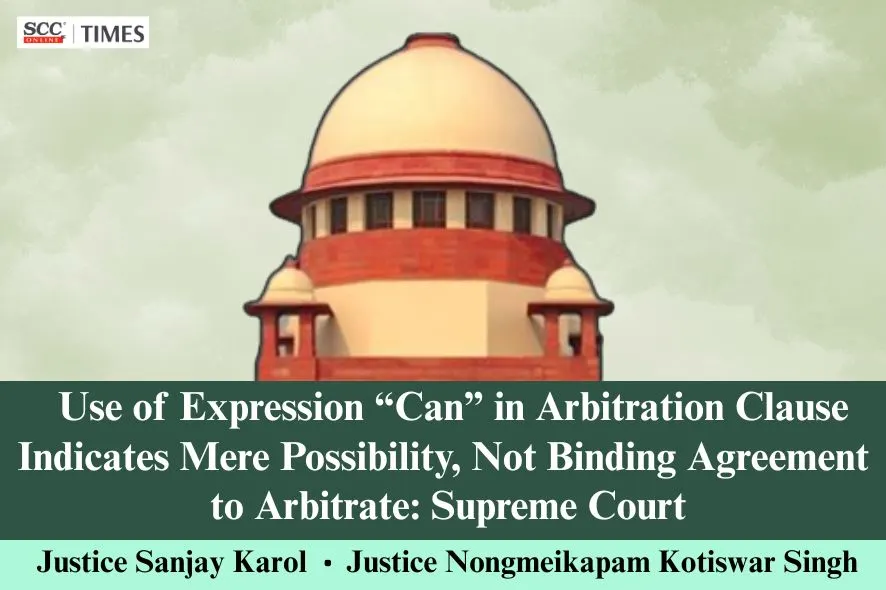
Supreme Court: In an appeal raising short but significant issue as to whether use of the word “can” in an arbitration clause in the contract, necessitate the reference of all disputes to arbitration or recourse to other dispute resolution mechanisms, including that of the civil court, open for the parties, the Division Bench of Sanjay Karol* and Nongmeikapam Kotiswar Singh, JJ., dismissed the appeal, holding that use of expression “can” in Clause 25 of the arbitration agreement indicates merely the future possibility of referring disputes to arbitration and as such, it cannot be said to be a binding arbitration agreement. The Court further held that such an agreement can only come into existence when both parties agree to the same.
Factual Matrix
The appellant, engaged in manufacturing aluminium foil containers and kitchen rolls, had secured an order from M/s American Alupack Industries for supply of corrugated boxes. For transportation of the goods to South Carolina, USA, the appellant entered into a contract with the respondent logistics company for a consideration of Rs 2,23,550, inclusive of freight and related charges.
The consignment consisted of 6 containers. 4 containers were delivered without dispute. However, upon delivery of the 5th container, a controversy arose. The respondent delivered the goods to the consignee despite the latter failing to produce the original bill of lading or make payment. This delivery allegedly caused financial loss to the appellant amounting to USD 28,064.86.
When the appellant raised the issue, the respondent denied liability, asserting that delivery without production of the original bill of lading was consistent with prior practice between the parties.
The bill of lading contained Clause 25 titled “Arbitration”, which provided that disputes “can be settled by arbitration” in India or a mutually agreed place. Invoking this clause, the appellant issued a notice seeking arbitration. The respondent opposed the invocation, contending that the clause did not create a binding obligation to arbitrate.
The appellant approached the Bombay High Court under Section 11, Arbitration and Conciliation Act, 1996 (the Act), seeking appointment of a sole arbitrator. The Single Judge dismissed the application, holding that the clause using the word “can” did not make arbitration mandatory and that, in absence of mutual consent, arbitration could not be imposed. Aggrieved, the appellant filed the present appeal before the Supreme Court.
Issue for Determination
Whether a dispute resolution clause stating that disputes “can be settled by arbitration” constitutes a binding arbitration agreement or merely an optional provision requiring further consent of the parties?
Also Read: Trailblazing Indian Arbitration: Insights from Senior Advocate Naresh Markanda
Analysis
The Court emphasised that arbitration is fundamentally based on mutual consent and party autonomy. It reiterated that the jurisdiction of an Arbitral Tribunal flows from the agreement between the parties, and absent such consensus, arbitration cannot be imposed.
The Court noted that at the stage of appointing an arbitrator, the inquiry is limited to examining the prima facie existence of an arbitration agreement. The courts are not required to undertake an exhaustive adjudication but must ensure that a valid agreement exists.
The Court devoted a substantial part to interpretation of the word “can” and observed that “can” denotes possibility or capability, not obligation and in contrast, “shall” indicates a mandatory requirement and “may” typically indicates discretion. Thus, the Court held that the use of “can” in the clause signified that arbitration was merely one of the possible modes of dispute resolution and not the exclusive or mandatory one.
With regards to the principles of contractual interpretation, the Court reiterated that the words chosen by the parties are the most reliable indicators of their intention. Courts must interpret contracts in their contextual setting and cannot impose obligations not contemplated by the parties.
Referring to established precedents in K.K. Modi v. K.N. Modi, (1998) 3 SCC 573; Bihar State Mineral Development Corpn. v. Encon Builders (I) (P) Ltd., (2003) 7 SCC 418; Alchemist Hospitals Ltd. v. ICT Health Technology Services India (P) Ltd., 2025 SCC OnLine SC 2354 and M.P. Rajya Tilhan Utpadak Sahakari Sangh Maryadit v. Modi Transport Service, (2022) 14 SCC 345, the Court outlined that a valid arbitration agreement must reflect a binding intention to arbitrate, provide for adjudication of disputes by a tribunal and indicate enforceability of the decision. The Court emphasised that a clause indicating only a future possibility of arbitration does not satisfy these requirements.
Applying the above principles, the Court held that Clause 25 of the arbitration agreement merely suggested that disputes may be settled by arbitration, required fresh consent of both parties for arbitration to take place and did not create a binding obligation. Such a clause was characterised as an agreement to agree in future, not a present arbitration agreement.
Also Read: Forged Arbitration Agreement Not Arbitrable: Supreme Court Clarifies Scope of Sections 8 & 11 A&C Act
Decision
The Court held that “the possibility of arbitration being used to settle disputes is open however, for the disputes to be settled by arbitration, further agreement between the parties would be required and needless to add, such an agreement can only come into existence when both parties agree to the same”.
The Court upheld the impugned judgment of the Bombay High Court and dismissed the appeal as being devoid of merit.
[NagreeKa Indcon Products (P) Ltd. v. Cargocare Logistics (India) (P) Ltd., 2026 SCC OnLine SC 630, decided on 17-4-2026]
*Judgment by Justice Sanjay Karol
Advocates who appeared in this case:
Mr. Krishan Kumar, Counsel for the Appellant
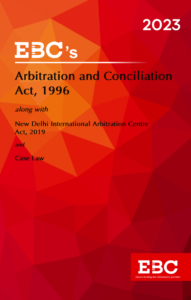
Buy Arbitration and Conciliation Act, 1996 HERE