HIGH COURT MAY 2025 WEEKLY ROUNDUP | Stories on OYO v. Zostel; Arjun Rampal’s Tax Evasion; Kota Student’s Suicide; and more
A quick legal roundup to cover important stories from all High Courts this week.

Bringing you the Best Analytical Legal News


A quick legal roundup to cover important stories from all High Courts this week.
The Court clarified that only in cases involving a gross lack of competence, inaction, or a wanton disregard for the patient’s safety, stemming from gross ignorance or gross negligence, can a doctor be made to face criminal charges.
“The solemn obligation of the legal system is to distinguish between misfortune and culpability, and to ensure that human suffering, however profound, does not substitute for proof required under the law.”
“While it is acknowledged that doctors are expected to apply a reasonable level of expertise and exercise due diligence in their practices, their conduct must not be judged against preconceived notions of a specific procedure or outcome.”
“When reasonable care, expected of the medical professional, is extended or rendered to the patient unless the contrary is proved, it would not be a case for actionable negligence.”
The report submitted by the Committee nowhere suggests that prescription of irrational combination of medicines by applicant is responsible for brain hemorrhage and consequential death of complainant’s wife.

The Commission held that reliance on old CT scan report; invalid consent & unjustified delay in conducting Laparotomy, constituted Medical Negligence and directed the surgeon to pay compensation of Rs. 4 Lakhs.
NCDRC pointed out that the Fortis hospital and the assigned doctor ignored the condition of the patient’s lungs and started angioplasty, thereby resulting in severe pulmonary edema within half an hour of beginning the procedure leading up to further complications.
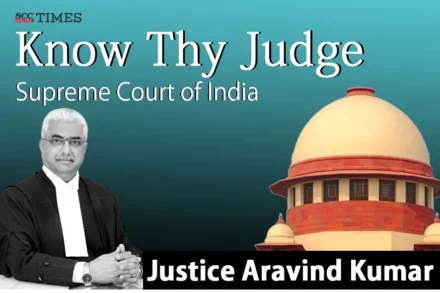
Prior to his elevation to the Supreme Court, Justice Aravind Kumar, as Chief Justice of Gujarat High Court initiated steps to tackle pendency of cases and initiated conversion of roadways buses into schools for poor children.
The Court stated that allowing the proceedings to continue will amount to an abuse of the process of law.
This 24-year-old matter revolved around a sixth-generation leading jeweller of Hyderabad who in 2002 underwent coronary surgery at Care Hospital but developed life threatening complications after the operation.
When the Court suggested it was not inclined to entertain the writ petition due to territorial jurisdiction, the petitioner’s counsel sought permission to withdraw the petitions. The Court granted this request, allowing the petitioner to take appropriate legal steps.
Supreme Court said that the Compensation by its nature must be just, and described the compensation awarded to the appellant as ‘paltry’.
Constitution of India — Arts. 136 and 142 — Uncompoundable offences: Quashing of criminal proceedings on basis of compromise petition, when permissible,
The Calcutta High Court observed that the benchmark for determining negligence in professional cases is the ‘reasonable standard’, fixed by the law of averages.
DCDRC was of the view that the manner of conducting the mock drill by the hospital was not only a severe deficiency in service but also as an extreme type of unfair trade practice.
The opposite parties denied her admission or operation in the clinic and also refuted the removal of rusted nut and bolt by claiming that they ought to be stainless steel material for medical use.
“For applying the principles of Res Ipsa Locutor, it is necessary that a ‘Res’ is present to establish the allegation of negligence.”
The Commission stated that the treating doctor is the best judge in a case where multiple options/ tests are available in respect of a particular ailment.
The Supreme Court held that the IAF and the Indian Army were vicariously liable, jointly and severally, as the former was Veteran’s immediate employer and the latter was the organization controlling and in charge of the Military Hospital