Supreme Court Collegium recommends 9 Advocates as Judges of Jammu & Kashmir and Ladakh High Court
The High Court has 11 vacancies against a sanctioned strength of 25 Judges, according to the Department of Justice figures as on 6 October 2026.

Bringing you the Best Analytical Legal News


The High Court has 11 vacancies against a sanctioned strength of 25 Judges, according to the Department of Justice figures as on 6 October 2026.
The Jammu & Kashmir and Ladakh High Court quashed an FIR registered against revenue and municipal officials pursuant to directions issued by a Judicial Magistrate, holding that the Magistrate had given a criminal colour to a purely administrative dispute relating to land in possession of a Court and had failed to follow the procedure governing exercise of powers under Section 156(3) J&K CrPC.
The Jammu & Kashmir and Ladakh High Court dismissed a habeas corpus petition filed by the father of a major woman seeking her recovery, holding that where an adult woman voluntarily leaves her parental home, marries a person of her choice and resides with him out of her own free will and volition, no case of illegal or unlawful detention is made out.
The petition challenged the Trial Court’s order allowing the plaintiff to amend the plaint under Order VI Rule 17 CPC to include a claim for mesne profits at the rate of ₹50,000 per month.
The Jammu & Kashmir and Ladakh High Court ruled that maternity benefits cannot be curtailed based on the nature of employment and that withholding salary during maternity leave unfairly penalises motherhood.

The High Court holds that confiscation is a matter to be considered at the conclusion of trial and that, pending such determination, the court is empowered to grant interim custody of the seized vehicle under Section 497 BNSS.

The High Court held that constitutional guarantees under Article 21 cannot be defeated by the gravity of allegations under the UAPA, and that the mandate of day-to-day trial under Section 19 of the NIA Act reflects a legislative intent that serious prosecutions cannot be allowed to linger indefinitely.

“Where a ruling by a Single Judge has held the field for a significant duration without being disturbed or reversed, it attains the character of a settled position of law and should not ordinarily be unsettled, as doing so would undermine judicial stability, unless the decision is demonstrably per incuriam or palpably erroneous.”

At the hearing, it was contended that the said clause was permissive in nature and does not constitute a binding arbitration agreement within the meaning of Section 7.

“As per Section 87, RP Act, any provision of CPC that is inconsistent with Section 82, RP Act, which specifies the persons to be impleaded in an election petition, cannot be invoked to implead a person who is otherwise not liable to be joined as a respondent under Section 82, RP Act.”

“Since there were contrary claims raised by the parties, unless the respondents established their title through competent civil court, they were not entitled to pass the eviction order exercising the powers conferred under the 1971 Act, which was summary in nature, thereby rendering the same without jurisdiction.”

“The husband’s girlfriend was neither related to him by blood, marriage or adoption, nor was she residing in the matrimonial home or subjected the wife to harassment or intimidation. The continuation of the criminal proceedings in the case would amount to abuse of the process of law and defeat the ends of justice.”

“Courts in exercise of criminal jurisdiction to consider a bail plea cannot embark upon a ‘mini trial’ to resolve factual disputes, and therefore, whether the word ‘chinal’ was caste-based, gender-specific, or a religious symbol could only be decided during a full-dressed trial and cannot be considered in a bail plea.”

“After the mother’s death due to a fatal illness, the minor continued to reside in India with his father and repeated applications were submitted to the authorities seeking extension of the child’s stay and grant of Indian citizenship on compassionate grounds. However, neither was the minor declared an Indian citizen nor was his visa extended.”

“The guiding factor is the nature of duty imposed upon the person or body against whom a writ is being sought. If the nature of duty imposed on a body is public in nature, it is amenable to writ jurisdiction under Article 226 of the Constitution but if the rights sought to be enforced are purely of a private character, a writ cannot be issued against such body.”
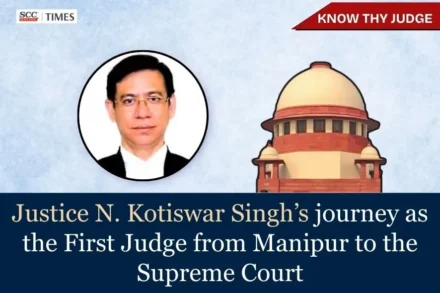
Justice Nongmeikapam Kotiswar Singh served as the Chief Justice of Jammu & Kashmir and Ladakh High Court, prior to being elevated as Judge of the Supreme Court of India on 18-7-2024.

“While the co-accused were acquitted on 19-8-2013, the absconders surrendered on 25-1-2014 and were subsequently formally charged. Since the co-accused were acquitted, the impugned order merged into the final judgment, and the revision petition was rendered infructuous.”

“The rights arising in favour of candidates participating in the selection process are private rights, which cannot be enforced against an institution that is neither a State nor an instrumentality of the State by way of a writ petition.”

“If the employee’s father was allegedly found to be involved in an offence under Section 5 of the 2006 Act, the same did not mean that the employee was to be perceived, projected, painted and put to bad treatment by passing the impugned suspension order.”