Judicial Intervention in Arbitral Proceedings
Case BriefsHigh Courts

Articles 226 and 227 should ordinarily not be used to correct interlocutory procedural orders of an Arbitral Tribunal unless there is a patent jurisdictional defect or exceptional perversity.
substitution of the Investigating Officer
Case BriefsHigh Courts

The Court emphasised unless a clear case of mala fides, demonstrable bias, lack of jurisdiction or abuse of process is made out before a competent court, the person under investigation cannot insist that the investigation be conducted by an officer of his choice.

CCTV in police stations
Case BriefsHigh Courts

“The object of the enquiry shall not merely be to identify lapses in the present case but to ensure that such lapses do not occur in any police station in the State in future. The monitoring system shall move from a complaint-based approach to a real-time, automated and accountable mechanism, so that prolonged failures do not go unnoticed.”

paperweight assault
Case BriefsHigh Courts

It would only be appropriate to apply nexus test to overt acts and determine, if they are wholly or reasonably connected to discharge of official function by accused and by taking note of fact that Section 170 Karnataka Police Act, 1963 extends statutory protection even to reasonable excesses.

Khaitan & Co. Multiplex Association of India
Law Firms NewsNews

Karnataka HC Quashed Show Cause Notices on 2% Cinema Cess

Husband cannot force wife to do household chores
Case BriefsHigh Courts

The Court held that a woman has got fundamental and absolute right to make decisions concerning her career, finances, etc. and a husband cannot compel or coerce her to live according to his wishes and expectations.

Gen-Z lingo alone not voyeurism
Case BriefsHigh Courts

The High Court held that a solitary Instagram compliment, however inelegant, cannot be forced into the statutory mould of voyeurism, stalking, or insult to a woman’s modesty without proof of the essential ingredients of those offences.

CID probe attempt to rape
Case BriefsHigh Courts

The Court observed that the allegations do not merely portray an assault; they prima facie depict an attempt to commit rape, interrupted not by any voluntary desistance on the part of the accused but by the relentless resistance offered by the victim herself.

Subvention scheme T.M.A. Pai Foundation
Case BriefsSupreme Court

Supreme Court reiterated that a declaration of law by the Supreme Court has retrospective effect unless expressly stated otherwise. The prospective protection contemplated in T.M.A. Pai Foundation case was held to apply only to statutory provisions inconsistent with the judgment and did not preserve executive schemes such as the subvention scheme.

motor accident compensation enhancement
Case BriefsHigh Courts

“The Court held that the salary certificate and pay slip, corroborated by the oral testimony of the dependants and co-workers, constitute reliable and corroborative proof of the income of the deceased and cannot be rejected merely on the ground that the author of such documents was not examined.”

person resident in India
Case BriefsHigh Courts

The Court held that the respondents-firm were “persons resident in India” and several FEMA Regulations relied upon by the Directorate of Enforcement became inapplicable. Since these Regulations govern transactions involving persons resident outside India, they could not be invoked against respondents who were legally resident in India under FEMA.

Interim maintenance for financially independent wife
Case BriefsHigh Courts

In the case at hand, the wife disclosed a monthly income of ₹1,00,000, her TDS records showed ₹1,64,285. Her husband earned ₹60,000. However, the trial court awarded her ₹20,000 in interim maintenance.

Computation of loss of dependency under Motor Vehicles Act
Case BriefsHigh Courts

The Court Enhanced the Motor Accident Compensation from ₹15 Lakhs to ₹30 Lakhs.

Mandatory reporting of POCSO offence
Case BriefsHigh Courts

“The statutory mandate under Section 21, POCSO Act admits of no dilution, no hesitation, and no delay. The duty to report an offence against a child is not a matter of institutional discretion but an imperative cast by the statute, the breach of which itself constitutes a distinct offence.”

fish vendor motor accident compensation
Case BriefsHigh Courts

In the case at hand, a 25-year-old fish vendor sustained grievous injuries after a car driven at a high speed and in a rash and negligent manner collided with his motorcycle.

hassan-arsikere railway project
Case BriefsHigh Courts

Can an enhanced compensation award stand despite the exemplar judgments forming its basis being later set aside? The Karnataka High Court addressed this question in a dispute concerning land acquired for the Hassan-Arasikere Railway Project,

Enhanced compensation in motor accident
Case BriefsHigh Courts

The Court enhanced the compensation for the claimants while deciding the case on motor accident, taking into consideration the prospects and dismissed the issue raised by the United India Insurance Co. Ltd. (the Company) as they failed to prove any fraud on the claimant’s part.

Assault by Employer Not Accident
Case BriefsHigh Courts

The instant matter revolves around the applicability of Section 3(1), Employees’ Compensation Act, 1923 for claiming the compensation arising out of an accident at the workplace.

hysterectomy parens patriae intellectual disability India
Case BriefsHigh Courts

“Disability, by itself, can never constitute a ground either to authorise the removal of a reproductive organ or to deprive a person of reproductive autonomy. Any such approach would be inconsistent with the constitutional guarantees recognised by the Supreme Court and with the dignity accorded to persons with disabilities under the Constitution and the statutory framework governing their rights.”

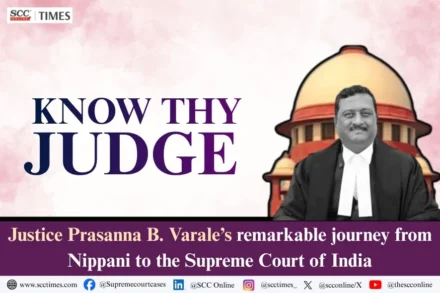
Justice Prasanna B. Varale
Know thy Judge

Justice Prasanna Bhalachandra Varale’s journey from the small town of Nippani to the Supreme Court of India is a story of dedication, perseverance, and legal brilliance.