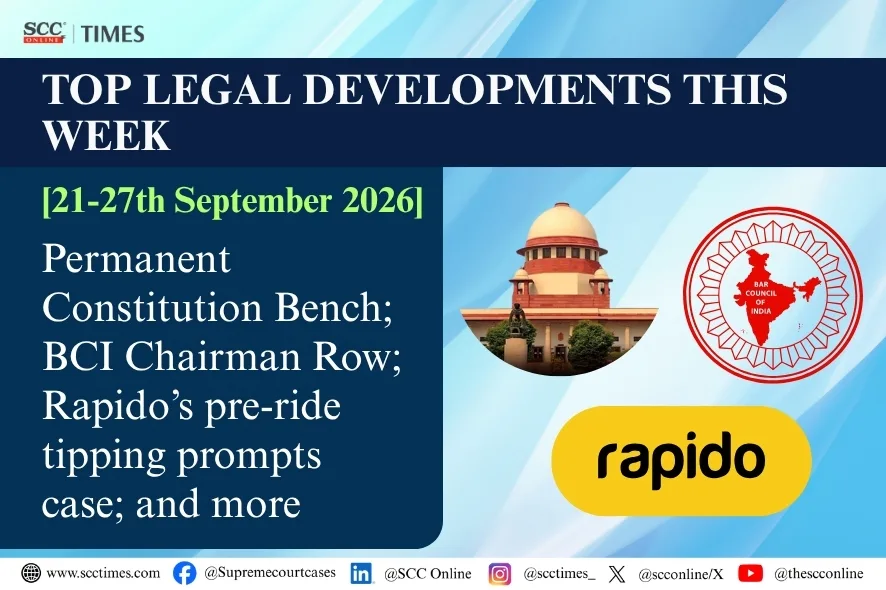
Catch up on the top legal developments this week (21—27 September 2026), including EC Act challenge split verdict, Re-arrest after Article 22 violation, international cyber fraud targeting foreign nationals, guardianship for person with mental illness, custom duty on gold, Commercial Mediation Conclave India 2026, Nyaya Nirmaan 2026, and more.
STORY OF THE WEEK
ELECTION LAW | Split verdict on referring EC Act challenge to larger bench; Permanent 5-Judge bench for constitutional issues, pitched
In a case titled Jaya Thakur v. Union of India, 2026 SCC OnLine SC 1980, while considering the challenge to various provisions of the Chief Election Commissioner and other Election Commissioners (Appointment, Conditions of Service and Term of Office) Act, 2023 (2023 Act), especially Section 7 of the 2023 Act which deals with composition of Selection Committee for the appointment of Chief Election Commissioner (CEC), the Supreme Court delivered a split verdict over referring this matter to a larger bench for consideration.
Read more HERE
SUPREME COURT HIGHLIGHTS
CRIMINAL LAW | Re-arrest after Article 22 violation requires judicial imprimatur; Additional safeguards laid down
While dealing with a question of “wide constitutional import” in a case titled Jaskaran Jeet Singh Deol v. State of Punjab, 2026 SCC OnLine SC 1939, i.e., whether an accused who has suffered breach of both Article 22(1) and (2) of the Constitution can thereafter be re-arrested for the same offence; and, if so, under what circumstances and through what procedure, the Supreme Court held that re-arrest after illegal arrest/detention requires judicial imprimatur and provided additional safeguards for re-arrest after Article 22 violation in addition to the ones in Mihir Rajesh Shah v. State of Maharashtra, (2026) 1 SCC 500.
Read more HERE
CIVIL LAW | Once trial commences on all issues, one issue cannot subsequently be tried as preliminary under Order 14 Rule 2(2) CPC
In a civil appeal titled John Mathew v. Santha Paul1, arising out of a suit for declaration, recovery of possession and consequential reliefs, the Supreme Court examined the scope and application of Order 14 Rule 2, Civil Procedure Code, 1908 (CPC), particularly the stage at which an issue of law relating to jurisdiction or a statutory bar may be tried as a preliminary issue. The Court held that while the framing of all issues does not, by itself, exhaust the power under Order 14 Rule 2(2), the statutory occasion to direct an issue to be “tried first” ceases once the Court has embarked upon the trial of the issues generally. The Court emphasised that the provision contemplates a prospective ordering of trial and does not authorise the Court to retrospectively sever an issue from an ongoing composite trial.
Read more HERE
HIGH COURT HIGHLIGHTS
STREET VENDING | Prior vendor survey and vending plan by Town Vending Committee and local authority mandatory for declaring vending zones
A contempt petition titled Mahavir Jain v. Amit Yadav, 2026 SCC OnLine Del 6494, was filed alleging wilful disobedience of common orders. The Delhi High Court, while considering the judgment of the Division Judge Bench, wherein, it interpreted Street Vendors Act, 2014 and gave binding directions, found no fault in the NDMC’s action in removal of the petitioners’ goods from no-vending area. Hence, the present petition was dismissed and contempt notice was discharged.
Read more HERE
CRIMINAL LAW | Director or Vice-President cannot institute complaint for company without Board authorisation; Proceedings against employee, quashed
In a case titled Nilesh Suryakant Jangam v. State of Maharashtra, 2026 SCC OnLine Bom 12575, the Bombay High Court quashed criminal proceedings against an employee and held that a Director or Vice-President cannot institute complaint for company without Board authorisation. The Court observed that the complaint itself had been instituted without proper authorisation and that no prima facie case was disclosed against the employee. Accordingly, the FIR and the consequential proceedings were quashed insofar as the applicant was concerned.
Read more HERE
CYBER CRIME | “Detrimental to confidence and trust of foreign nationals”: Relief denied to accused persons in large-scale international cyber fraud targeting foreign nationals
In a writ petition titled Karolyn v. State of U.P., 2026 SCC OnLine All 31160, filed by several accused persons in a large-scale international cyber fraud against their arrest, the Allahabad High Court dismissed the petition, holding that it was filed on misconceived grounds, as the accused persons were furnished grounds and reasons for arrest through the recovery memo, and phone calls were made to the nominated persons.
Read more HERE
CRIMINAL LAW | Disclosures by co-accused cannot by itself justify continued custody; Parity and absence of specific role favour grant of bail
In a case titled Shantanu v. State of H.P., 2026 SCC OnLine HP 5782, involving offences under Sections 103, 127(2), 125(2), 61(2) and 3(5), Nyaya Sanhita, 2023 (BNS), the Himachal Pradesh High Court held that disclosures by co-accused while in police custody cannot by itself be used against another co-accused to justify continued custody. The Court further held that, where similarly placed co-accused had already been granted bail, no specific role had been attributed to the applicant, and the trial was likely to take considerable time to conclude, continued incarceration would amount to pre-trial punishment, thereby entitling the applicant to be enlarged on bail.
Read more HERE
Also read: Mere Apprehension of bias insufficient to seek substitution of Investigating Officer: Karnataka HC
ADVOCATES | Advocate-client privilege protects communications, not advocate’s unlawful or independent conduct; GST search of Advocate’s office upheld
The instant writ petition titled Puneet Batra v. Union of India, 2026 SCC OnLine Del 7236, was filed by an advocate (petitioner) challenging the search conducted by the respondents (GST Department) at the premises of M/s Bass Legal LLP (Bass Legal), including the cabin being used by the petitioner, and the consequential seizure of his CPU and other documents, and the Delhi High Court was called to decide the extent to which advocate-client privilege can operate when the Advocate himself becomes the subject of investigation. The Court dismissed the writ petition, holding that the search was carried out pursuant to a valid authorisation under Section 67(2), Central Goods and Services Tax Act, 2017 (CGST Act) subject to the protection attached to genuinely privileged communications and unrelated third-party client material.
Read more HERE
FAMILY AND PERSONAL LAW | Technical barriers cannot defeat guardianship for person with mental illness
In a case titled Nibedita Dutta Chaudhuri v. State of W.B., 2026 SCC OnLine Cal 12781, the Calcutta High Court held that a person suffering from chronic schizophrenia with 65 per cent certified disability cannot be excluded from consideration for legal guardianship. Applying the Rights of Persons with Disabilities Act, 2016 alongside the National Trust Act, 1999, the Court directed authorities to consider the sister’s guardianship application expeditiously.
Read more HERE
Also Read: Invoice branding not enough: Calcutta HC upholds Vanaspati Exemption
ELECTION LAW | Husband and wife are separate legal entities; Spouse cannot be compelled to clear public official’s dues for electoral participation
In a writ petition titled Ramlaxman Meena v. State of Rajasthan, 2026 SCC OnLine Raj 5583, seeking direction to the respondents to issue No -Dues Certificate to the petitioner for the purpose of contesting the upcoming Panchayati Raj elections for Gram Panchayat at Falenda, Rajasthan, the Rajasthan High Court held that the petitioner could not be compelled to clear the dues recoverable from his wife, an erstwhile Sarpanch, as a condition for obtaining the certificate and contesting the election. The Court observed that the petitioner was neither a surety nor a guarantor for the dues owed by his wife and that there was no provision under the Rajasthan Panchayati Raj Act, 1994 or the Rajasthan Panchayati Raj Rules, 1996 authorising recovery of such dues from the family members of a Sarpanch.
Read more HERE
CUSTOMS | Failure to redeem confiscated gold bars within stipulated period cannot be attributed to petitioner where Customs failed to quantify applicable duty
In a case titled Prikshith Jhaver v. Commr. of Customs, 2026 SCC OnLine Del 7204, concerning the redemption of 12 confiscated gold bars seized from the Petitioner at the Indira Gandhi International Airport, New Delhi, the Delhi High Court directed the Customs Authorities to quantify and communicate the applicable duty to the petitioner, observing that the petitioner had approached the respondents within the prescribed period seeking such quantification, but the respondents had failed to respond. The Court held that, in the facts of the case, the failure to exercise the option of redemption within the stipulated period could not be attributed solely to the petitioner, as the applicable duty had never been quantified despite his request, and accordingly directed release of the confiscated gold bars upon payment of the applicable duty, redemption fine, penalty and interest.
Read more HERE
ADVOCATES | BCI Chairman row: Plea seeking FIR over alleged Advocate assault dismissed
In a case titled Kunal Yadav v. Manan Kumar Mishra2, concerning a petition seeking registration and investigation into an alleged assault of advocates at the premises of the Bar Council of India, the Delhi High Court held that the writ petition was not maintainable in view of the availability of an alternate efficacious remedy under the Nagarik Suraksha Sanhita, 2023 (BNSS). The Court observed that the petitioners had not approached the DCP concerned or the jurisdictional Magistrate under Section 223 BNSS and had not established any negligence or inaction on the part of the SHO. The Court further held that the allegations, at the highest, disclosed the offence of causing hurt under Section 114, Nyaya Sanhita, 2023 (BNS), which was non-cognizable, and consequently, in view of Section 174 BNSS, the appropriate remedy lay before the Magistrate concerned. Accordingly, the Court declined to issue a mandamus directing registration and investigation of the case and dismissed the petition as not maintainable.
Read more HERE
ADVOCATES | State Bar Council directed to identify advocates who have not qualified AIBE since 2021 and continue review of defaults
While considering a public interest litigation (PIL) titled Amarnath Joshi Surendiran v. Bar Council of Kerala,3 concerning advocates who had not qualified the All India Bar Examination (AIBE), the Calcutta High Court directed the Bar Council of Kerala to update the list of such advocates from 2021 onwards within 8 weeks, continue reviewing defaults in qualifying the AIBE, publish the list of advocates who have qualified in the meantime, and ensure that the District Judiciary is informed through the prescribed mechanism.
Read more HERE
TRIBUNALS AND COMMISSIONS
CENTRAL CONSUMER PROTECTION AUTHORITY | Rapido’s pre-ride tipping prompts misleading and unfair; ₹10 lakh penalty imposed
While taking cognizance of a representation against Rapido4 (Roppen Transportation Services Pvt. Ltd.) concerning pre-ride tipping prompts displayed on its ride-hailing platform, the Central Consumer Protection Authority (CCPA) examined whether such prompts amounted to misleading advertisements, unfair trade practices, unfair contracts and prohibited dark patterns under the Consumer Protection Act, 2019. The CCPA held that the impugned prompts created a misleading impression in the minds of consumers that paying an amount over and above the quoted fare would improve the likelihood and speed of ride confirmation, thereby violating Sections 2(28), 2(46) and 2(47) of the Consumer Protection Act, 2019 and the Dark Patterns Guidelines, 2023. Accordingly, to safeguard the interest of the consumers, the authority directed Rapido to discontinue the impugned prompts including the interface designs and imposed a penalty of ₹10 lakh.
Read more HERE
CENTRAL INFORMATION COMMISSION | Examination evaluation records are “information” under S. 2(f), RTI Act; Confidentiality or fiduciary claim can’t be invoked mechanically
While considering the scope of disclosure in Rishabh Mishra v. CPIO5, under the Right to Information Act, 2005 (RTI Act) in relation to the evaluation of law semester examination answer scripts at the Faculty of Law, University of Delhi, the Central Information Commission held that while the Central Public Information Officer (CPIO) could not be required to create information which did not exist, existing records could not be denied merely because they concerned the examination or evaluation process.
Read more HERE
FOREIGN COURTS
SINGAPORE INTERNATIONAL COMMERCIAL COURT | Idonesian bankruptcy proceedings of Sritex entities, recognised; Relief granted to Curators
In an application titled Re PT Sri Rejeki Isman Tbk and others6, under the UNCITRAL Model Law on Cross-Border Insolvency (Model Law), as adopted in Singapore through Section 252 and the Third Schedule of the Insolvency, Restructuring and Dissolution Act 2018, the SICC concluded that the requirements for granting recognition had been satisfied. The Court found that the Indonesian Bankruptcy Proceeding was a foreign proceeding under the Model Law, that the Curators were foreign representatives, and that the centre of main interests of the debtor companies was Indonesia. Therefore, the Court recognised the Indonesian Bankruptcy Proceeding as a foreign main proceeding and granted the additional relief sought, including extended stay relief, investigative relief and administrative relief, subject to a condition that no assets or proceeds thereof could be repatriated out of Singapore or distributed without leave of the Court.
Read more HERE
OTHER UPDATES
NEWS
LEGISLATIONS
-
Pharmacies may be required to retain CCTV footage for 3 months under Draft Drug Rules
-
What changes under Delhi High Court’s 2026 senior advocate designation rules?
-
Passport rules for children below 15 years just changed: Here’s what you need to know
-
Relief for households as crude edible oil import duties are reduced
ALSO READ
1. SLP (CIVIL) No. 34086 of 2025, decided on 21-9-2026
2. W.P.(CRL) 2850 of 2026
3. WP (PIL) No. 147 of 2026
4. In the matter of: Misleading advertisement, unfair trade practices and use of dark patterns by Rapido (Roppen Transportation Services Private Limited), Case No: CCPA-2/53/2025-CCPA
5. File No: CIC/UODEL/A/2025/641908
6. [2026] SGHC(I) 16