


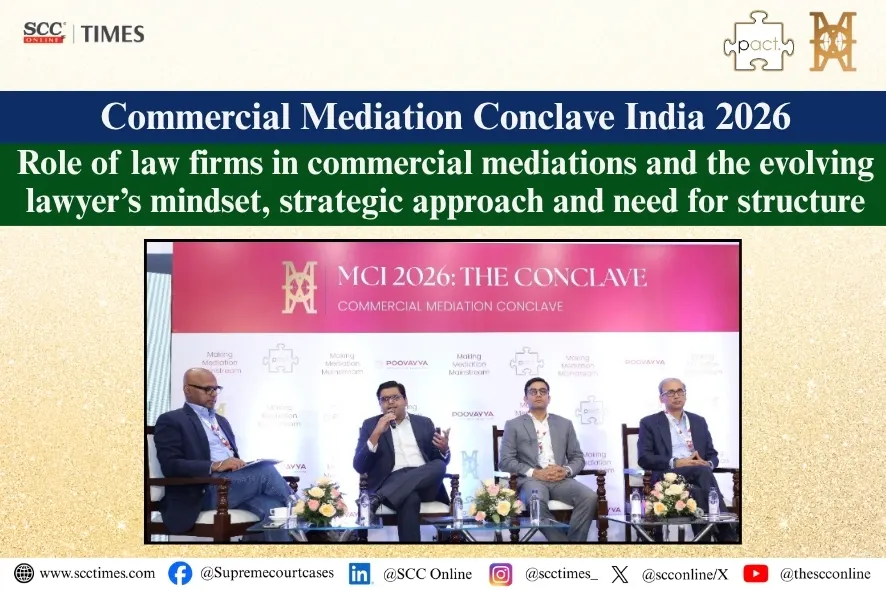
The Commercial Mediation Conclave India 2026, themed “Making Mediation Mainstream”, was held on 18 September 2026 at the India International Centre, New Delhi. Curated and Hosted by the PACT, the conclave brought together judges, mediators, lawyers, general counsel and other stakeholders from the dispute-resolution ecosystem to deliberate on the evolving role of mediation and its potential as an effective mechanism for resolving commercial disputes.
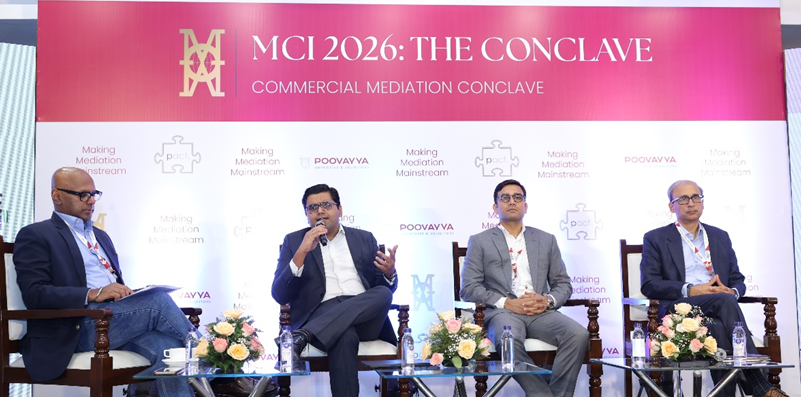
[In picture: Mr Ajay Thomas, Mr Sonal Kumar Singh, Mr Rishi Anand and Mr Dinesh Pardasani]
One of the key sessions, “Role of Law Firms in Commercial Mediations”, examined the evolving role of lawyers and law firms in shaping clients’ approach to mediation and facilitating the effective use of the process. Moderated by Mr Ajay Thomas, Independent Arbitrator and Mediator, the session featured Mr Dinesh Pardasani, Partner, DSK Legal, Mr Rishi Anand, Partner, DSK Legal, and Mr Sonal Kumar Singh, Senior Advocate, Delhi High Court. Mr Jonathan Rodrigues, Mediator and Founder, The PACT, also shared his insights during the discussion. The session explored the need for a shift in the traditional litigation-oriented mindset, the strategic role of lawyers in advising clients on settlement, and the importance of training and structured processes in strengthening commercial mediation.
Mediation requires a shift in mindset
Opening the discussion, Mr Ajay Thomas observed that the passage of the Mediation Act, 2023 had placed mediation among the core pillars of India’s dispute-resolution ecosystem. He emphasised that law firms have a significant role because they advise clients on their legal options and are therefore well placed to explain when mediation may be appropriate.
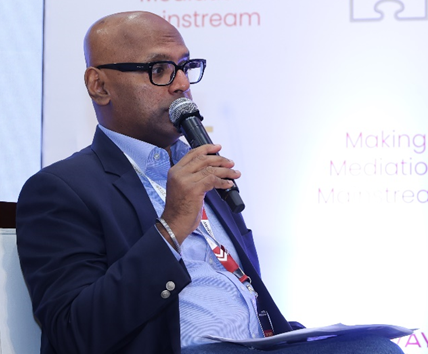
[In picture: Mr Ajay Thomas]
He raised the question of how the role of a lawyer change when moving from litigation or arbitration to mediation and what law firms can do to encourage clients to consider mediation.
Mr Sonal Kumar Singh stated that the issue fundamentally involved a mindset shift. He observed that lawyers traditionally trained in litigation and arbitration often adopt an adversarial approach, whereas mediation requires a different set of skills.
“But mediation, I think, is a different ballgame altogether. I think you need to be a good listener when you’re a mediator.”
Mr Singh explained that mediation requires lawyers to listen to the other side, understand the client’s realistic prospects and help the client arrive at a commercially workable solution. Unlike litigation, where the lawyer’s role is primarily to advance the client’s case, mediation requires consideration of both sides’ positions and the possibility of settlement.
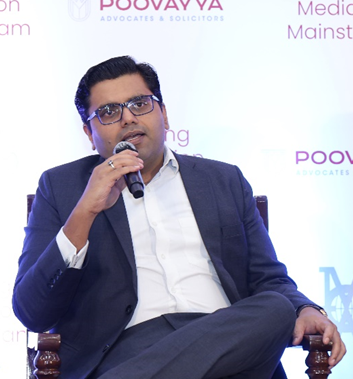
[In picture: Mr Sonal Kumar Singh]
He further emphasised that lawyers must be able to tell clients what they can realistically obtain and what they may have to compromise on. This requires an understanding of the client’s strengths and weaknesses and the ability to manage expectations. According to him, lawyers need to understand that mediation requires a different skill set from litigation and that training would be necessary to facilitate this transition.
Mediation as a relief-oriented process
Mr Rishi Anand observed that the increasing volume of litigation and arbitration had created a need for alternative mechanisms capable of delivering effective relief. He stated that mediation could provide a more relief-oriented approach to dispute resolution, as opposed to a process centred on an adversarial contest between parties. He also highlighted the importance of awareness among lawyers and other practitioners regarding the kinds of disputes that are suitable for mediation.

[In picture: Mr Rishi Anand]
Mr Anand, however, identified the binding nature and enforceability of outcomes as areas that require greater attention. He observed that parties may agree to participate in mediation but subsequently withdraw, creating uncertainty for clients and lawyers. He stressed that greater awareness among practitioners and clients would be essential for mediation to develop as a meaningful part of commercial dispute resolution.
Mediation as a strategic decision for law firms
Mr Dinesh Pardasani explained that his firm does not follow a rigid mediation policy applicable to every dispute. Instead, mediation is treated as a strategic decision, depending upon the circumstances of each matter and the interests of the client.
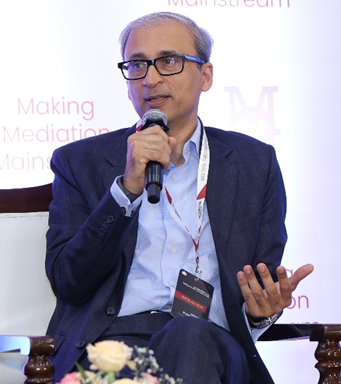
[In picture: Mr Dinesh Pardasani]
He explained that where a dispute could be settled at an early stage, the firm may encourage mediation. At the same time, in some matters, litigation or arbitration may initially be pursued before the parties move towards settlement.
“…I consider mediation also to be a strategic decision. Not every matter has to go for litigation and arbitration.”
Mr Pardasani emphasised that the objective should be to achieve the outcome that is beneficial for the client rather than pursuing litigation merely because a dispute has arisen. He noted that the appropriate strategy could vary from client to client and from one dispute to another.
Mr Anand added that long-standing relationships between law firms and clients provide lawyers with an understanding of the client’s mindset, risk appetite and commercial priorities. This enables lawyers to advise clients on the stage at which settlement may be commercially appropriate. He also highlighted the importance of coordination between corporate and dispute-resolution teams within law firms. The corporate team may possess detailed knowledge of the history and commercial background of a transaction, while the dispute team may handle the ensuing controversy. Sharing this information can help lawyers formulate a more informed mediation strategy.
Mediation clauses and coordination with corporate teams
The discussion also considered the use of multi-tier dispute-resolution clauses providing for mediation followed by arbitration or litigation.
Mr Pardasani stated that the firm generally does not favour excessively layered dispute-resolution procedures. Instead, the firm’s approach is to have one stage of mediation or conciliation followed, where necessary, by arbitration or litigation.
“One layer of mediation, conciliation, whatever you call it and then straightaway arbitration or litigation is what we always suggest.”
He explained that the firm’s dispute and corporate teams consult each other on dispute-resolution clauses and on the practical functioning of those mechanisms. This ensures that the experience gained from disputes is reflected in contractual drafting.
Internal training and sensitisation within law firms
The panel also discussed the responsibility of law firms to sensitise their lawyers to the benefits and practical use of mediation.
Mr Anand explained that the firm conducts regular internal training and knowledge sessions, including sessions concerning mediation. These programmes are not restricted to partners but also involve associates who are closely involved in drafting and handling matters. He stated that the firm conducts regular knowledge sessions for senior and principal associates and that such training forms part of the firm’s internal professional-development process.
The discussion highlighted that making mediation mainstream requires awareness not only among clients but also within the legal profession itself. Lawyers need to identify suitable cases and understand when mediation may provide a commercially preferable route.
The lawyer’s role in mediation differs from litigation
Mr Singh returned to the question of the lawyer’s mindset and explained that lawyers accustomed to adversarial proceedings must make a substantial adjustment when entering mediation.
He observed that in litigation and arbitration, lawyers are trained to put forward their client’s strongest case, including where the client’s position may have weaknesses. Mediation, by contrast, requires lawyers to listen and understand the concerns of the other side.
“There is a lot of training which may be required for that shift… from being a litigator to a mediator.”
He stated that lawyers must be prepared to assess the client’s case realistically, identify its strengths and weaknesses, manage expectations and work towards a settlement that may not provide everything the client originally sought but may nevertheless be preferable to prolonged litigation or arbitration. He described this as an approach where a party may have to accept a compromise in order to achieve a broader commercial objective.
Role of senior advocates in mediation
The panel also discussed whether senior advocates, traditionally associated with courtroom advocacy, have a meaningful role in mediation.
Mr Singh stated that senior advocates can contribute significantly to mediation through their experience, credibility and ability to provide clients with an informed assessment of their position.
Mr Pardasani similarly observed that the involvement of a senior counsel or retired judge can influence the parties’ willingness to consider settlement, particularly where the assessment comes from a professional whose experience gives the advice additional credibility.
The discussion therefore highlighted that mediation does not necessarily reduce the importance of experienced legal counsel, rather, it may require counsel to use their experience differently.
Protecting the client’s interests while maintaining settlement momentum
Mr Thomas also asked how lawyers should deal with situations where clients are making concessions during mediation.
Mr Pardasani explained that mediation strategy should be considered from the outset. Lawyers must understand what the client is prepared to concede and what remains outside the scope of settlement He noted, however, that the ultimate objective of mediation is to resolve the dispute and enable the parties to continue their commercial relationship. Therefore, the lawyer’s role should not become an obstacle to settlement.
“The whole objective is for you to achieve an objective for a client which is to solve a dispute, resolve a dispute and continue their business.”
The discussion emphasised that the lawyer must balance protection of the client’s interests with the practical objective of achieving a settlement.
Need for a structured mediation process
A significant part of the discussion concerned the manner in which mediation itself is conducted.
Mr Pardasani observed that mediation proceedings in India can sometimes lack a defined structure. He contrasted this with mediation practices in Singapore, where the process follows a more organised format, with the parties given defined opportunities to present their respective positions. He stated that a structured process enables the mediator and parties to understand the progress of the mediation and prevents proceedings from becoming an open-ended discussion.
“There has to be a structured way of doing mediation. You can’t just go and sit in a room and try settling it.”
He further referred to the use of categorisation and professional experience in Singapore when selecting mediators, as well as the expectation that mediations may be completed within a concentrated period where parties are authorised to settle. According to him, India could benefit from greater structure and appropriate incentives for mediators, particularly where successful mediation results in significant savings of time and costs compared with prolonged litigation or arbitration.
Structured mediation can make progress visible
The discussion was further expanded by mediator Jonathan Rodrigues, who observed that court-annexed mediations in India can sometimes be scheduled back-to-back, leaving limited time for a structured process.
Drawing on his experience of mediation in the United Kingdom, he emphasised that structured mediation allows progress to be measured. He observed that when parties and lawyers can see that the process is progressing towards defined outcomes, they are more likely to perceive mediation as a meaningful investment of time and resources.
The discussion also highlighted the development of private institutional mediation in India, where institutions may provide a more structured framework for conducting mediation.
Section 12A mediation and the problem of non-starters
The panel subsequently examined experiences with Section 12A, Commercial Courts Act, 2015 (Commercial Courts Act), which provides for pre-institution mediation in specified commercial disputes.
Mr Singh observed that the effectiveness of the process was closely connected to the mindset of lawyers and clients. He noted that parties may seek to bypass the mediation process where they believe that the dispute will ultimately have to be resolved by a court. He emphasised that all stakeholders in the mediation ecosystem have a role in making mediation more acceptable.
Mr Pardasani stated that mediation should not become a purely forceful exercise and suggested that parties must understand when mediation is appropriate.
Mr Anand added that litigating lawyers could play an important role in changing the approach towards settlement by advising clients on whether mediation should be considered in a particular dispute.
Improving the effectiveness of Section 12A
Mr Thomas referred to government statistics discussed during the session concerning applications under Section 12A, Commercial Courts Act and the number of settlements recorded.
The discussion also highlighted that a significant proportion of Section 12A, Commercial Courts Act matters are non-starters, where the parties do not meaningfully enter the mediation process.
Mr Jonathan Rodrigues suggested that instead of making participation itself compulsory, the framework could require parties to explore mediation and understand the process before deciding whether to continue.
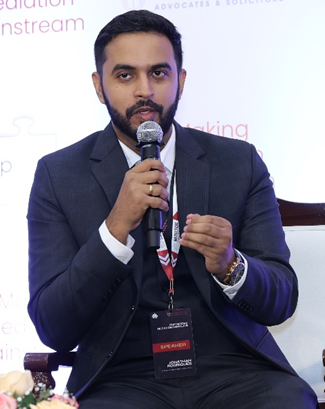
[In picture: Mr Jonathan Rodrigues]
“So, if we can change that from mandatory participation to mandatory exploration, it might just fix this.”
The distinction between mandatory participation and mandatory exploration was presented as one possible way of addressing resistance to mediation while still ensuring that parties are exposed to the process. The discussion also noted that where parties do not even commence mediation, settlement statistics may not accurately reflect the effectiveness of mediation itself.
Closing Remarks
The discussion on the “Role of Law Firms in Commercial Mediations” highlighted that law firms occupy a central position in India’s transition towards a stronger mediation ecosystem. Their role extends beyond representing clients during mediation to advising clients on whether mediation is commercially appropriate, drafting suitable dispute-resolution clauses, coordinating corporate and dispute teams, training lawyers and helping clients develop realistic expectations. The panellists also emphasised that mediation requires a different professional mindset from litigation and arbitration.
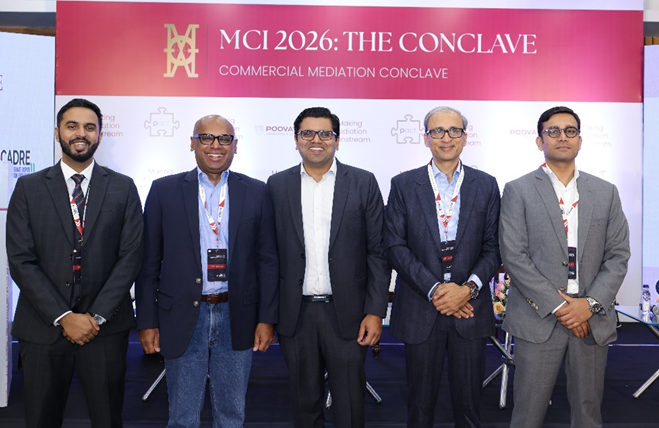
[In picture: Mr Jonathan Rodrigues, Mr Ajay Thomas, Mr Sonal Kumar Singh, Mr Dinesh Pardasani and Mr Rishi Anand]
At the institutional level, the discussion pointed to the need for better-trained mediators, structured processes, greater awareness and reforms that encourage parties to genuinely explore mediation. The experience of other jurisdictions, particularly in relation to structured mediation and professionalisation, was also discussed as a reference point for strengthening India’s mediation framework.
Ultimately, the discussion underscored that making mediation mainstream will depend not only on statutory recognition but also on the ability of lawyers and law firms to make mediation a meaningful strategic option for clients and to build confidence in the process through effective and professionally conducted mediations.





