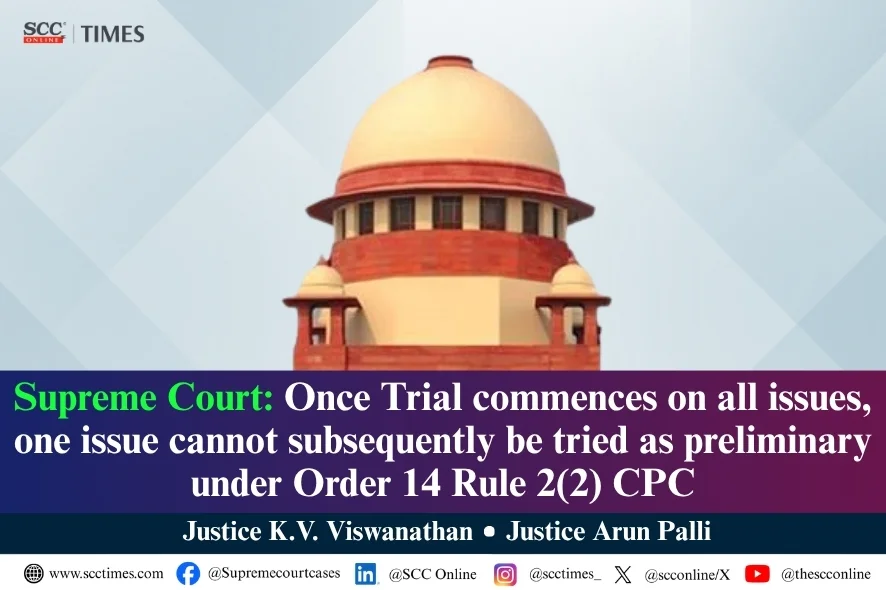
Supreme Court: In a civil appeal arising out of a suit for declaration, recovery of possession and consequential reliefs, a Division Bench of K.V. Viswanathan and Arun Palli*, JJ., examined the scope and application of Order 14 Rule 2, Civil Procedure Code, 1908 (CPC), particularly the stage at which an issue of law relating to jurisdiction or a statutory bar may be tried as a preliminary issue. The Court held that while the framing of all issues does not, by itself, exhaust the power under Order 14 Rule 2(2), the statutory occasion to direct an issue to be “tried first” ceases once the Court has embarked upon the trial of the issues generally. The Court emphasised that the provision contemplates a prospective ordering of trial and does not authorise the Court to retrospectively sever an issue from an ongoing composite trial.
The Court further clarified the scope of the Full Bench decision in Prithvi Raj Jhingta v. Gopal Singh, 2006 SCC OnLine HP 25, and the observations in Sathyanath v. Sarojamani, (2022) 7 SCC 644, holding that a qualifying issue may be triked first even where all issues have already been framed, provided the trial of the issues generally has not commenced. Applying the above principles, the Court noted that in the present case the plaintiff had already concluded his evidence and the defendants had entered upon theirs when the application seeking determination of limitation as a preliminary issue was filed. Accordingly, Issue 5, relating to limitation, was already part of an ongoing trial and could not thereafter be segregated and “tried first”. Setting aside the orders of the courts below, the Court restored the suit to the trial court and directed that the question of limitation, including the applicability of Article 59 or Article 65 of the Limitation Act, 1963 and the legal character of the impugned transaction, remain open for determination on merits.
Background
The plaintiff, instituted the suit on 10 June 2013 seeking, inter alia, a declaration that Sale Deed No. 1663/2005 dated 25 May 2005, executed by Defendant 1, in favour of Defendant 2, in respect of the suit property, was void, along with declaration of title and recovery of possession with mesne profits. The plaintiff’s case was that he had executed a General Power of Attorney (GPA) dated 21 May 2005 in favour of Defendant 1 for management and improvement of the agricultural property, but the GPA did not authorise him to settle the terms for sale, create a charge upon the property, or execute the conveyance. It was alleged that Defendant 1, without authority, fraudulently conveyed the property to Defendant 2 without the plaintiff’s consent and without payment of consideration, rendering the sale deed void ab initio. The plaintiff claimed that he came to know of the alleged unauthorised conveyance on 22 May 2009 and thereafter revoked the GPA on 20 July 2009. The defendants denied the allegations of fraud and contended that the sale deed was validly executed with the plaintiff’s consent and knowledge for a consideration of ₹ 4,00,000 and that the suit was barred by limitation. The trial court, vide order dated 3 November 2018, held that the suit was governed by Article 59, Limitation Act, 1963 and was barred by limitation, as the plaintiff had admittedly acquired knowledge of the sale deed on 22 May 2009 but instituted the suit only on 10 June 2013. The appellate court, by judgment dated 29 January 2024, affirmed the finding and modified the order as one of rejection of plaint under Order 7 Rule 11(d) CPC. In regular second appeal, the High Court held that the question of limitation involved mixed questions of fact and law and could not have been determined as a preliminary issue without first examining whether the sale deed was void for want of authority under the GPA. The High Court further held that, since the plaintiff’s case was that the sale deed was fraudulent and void ab initio, Article 59 was inapplicable and the claim for recovery of possession was governed by Article 65, prescribing a period of 12 years. Accordingly, the High Court held the suit to be within limitation, set aside the orders of the courts below and remitted the matter to the trial court for decision on merits.
Analysis
The Court examined the scheme of Order 14 Rule 2 CPC in light of Order 20 Rule 5 and Order 41 Rules 24 and 25, and held that the provision, in its present form, makes adjudication of all issues the general rule, while retaining a discretionary exception for an “issue of law only” relating to the jurisdiction of the Court or a statutory bar, where determination thereof is capable of disposing of the suit or a part thereof. The Court emphasised that “issue of law only” cannot involve adjudication of disputed facts, and that limitation may, depending upon the facts, constitute either a pure question of law or a mixed question of law and fact. The Court further clarified that the power to “try that issue first” is distinct from the discretion to postpone settlement of the remaining issues, the latter being expressly optional. Thus, merely because all issues have already been framed does not exhaust the power under Order 14 Rule 2(2). The relevant dividing line is whether the Court has already embarked upon the trial of the issues generally. Once the issues have entered a common trial and evidence has been adduced upon them, one issue cannot thereafter be severed and characterised as an issue to be “tried first”, as Rule 2(2) contemplates a prospective ordering of trial and not a retrospective reordering of a trial already underway.
The Court accordingly clarified the scope of the Full Bench decision in Prithvi Raj Jhingta, holding that it is correct to the extent that once all issues have been taken up for trial together, the Court cannot subsequently sever one of them for prior adjudication. However, the wider proposition that Rule 2(2) is available only where the qualifying issue alone was framed at the outset and settlement of the remaining issues was postponed, was held to be inconsistent with the statutory language. The Court also clarified the observations in Sathyanath, holding that the said decision reaffirmed the general rule under Order 14 Rule 2(1) in a case where the issue of res judicata did not qualify under Rule 2(2), and did not extinguish the statutory exception permitting a qualifying preliminary issue to be tried first. Accordingly, the Court held that an issue may be tried first under Order 14 Rule 2(2) where it is an issue of law relating to jurisdiction or a statutory bar, capable of disposing of the case or a part thereof without adjudication of disputed facts; and where such an issue has been validly tried first and disposes of the suit, the remaining issues need not be tried merely because they had already been framed.
Application in present case
Applying the above principles to the facts of the present case, the Court noted that all issues in OS No. 337 of 2013 had been framed on 8 July 2015, with limitation forming Issue 5, and that the suit had thereafter proceeded to trial. The plaintiff had concluded his entire evidence and the defendants had already entered upon their evidence when IA No. 2647 of 2018 was filed seeking determination of limitation as a preliminary issue. Thus, this was not a case where all issues had merely been framed or where the suit had only been fixed for evidence; the trial had already progressed substantially and Issue 5 was already undergoing trial along with the remaining issues. Consequently, the statutory occasion to direct that Issue 5 be “tried first” had passed. Order 14 Rule 2(2) contemplates a prospective ordering of trial and does not authorise the Court retrospectively to sever from an ongoing composite trial one issue and deem it to have been tried first. The invocation of Section 151 CPC could not alter the position, as inherent power could not be invoked to circumvent the conditions, sequence or temporal limits governing the power expressly conferred by Order 14 Rule 2.
The Court further held that the trial court had failed to consider whether, at the stage when IA No. 2647 of 2018 was moved, Issue 5 could at all be detached from the ongoing trial. The first appellate court also failed to rectify this error and proceeded to affirm the determination on limitation, while further modifying the disposal into rejection of the plaint under Order 7 Rule 11(d) CPC. The High Court, despite framing the substantial question as to whether the courts below were justified in determining limitation as a preliminary issue, did not examine the significance of the stage which the trial had already reached. Having held that Issue 5 could not have been segregated from the ongoing trial, the Court observed that the applicability of any particular provision of the Limitation Act, the legal character of the impugned transaction and the ultimate answer to Issue 5 must remain entirely open. Consequently, the observations of the High Court on Article 59 or Article 65, Limitation Act, 1963 could not govern the further proceedings.
Decision
Accordingly, the Court held that the orders passed by the trial court, the judgment of the first appellate court and the decision of the High Court were unsustainable and set them aside. IA No. 2647 of 2018 was dismissed and OS No. 337 of 2013 was restored to the file of the Munsiff Court, Kottarakara, with a direction to resume proceedings from the stage immediately before the interruption caused by the said application. The trial court was requested to decide the suit within 3 months from receipt of the judgment. The interim order dated 8 December 2025 staying the proceedings was vacated, the civil appeal was disposed of with no order as to costs, and it was clarified that the judgment would not constitute an expression of opinion on the merits of either party’s case, which were to be decided by the trial court independently and in accordance with law.
[John Mathew v. Santha Paul, 2026 SCC OnLine SC 1940, decided on 21-9-2026]