








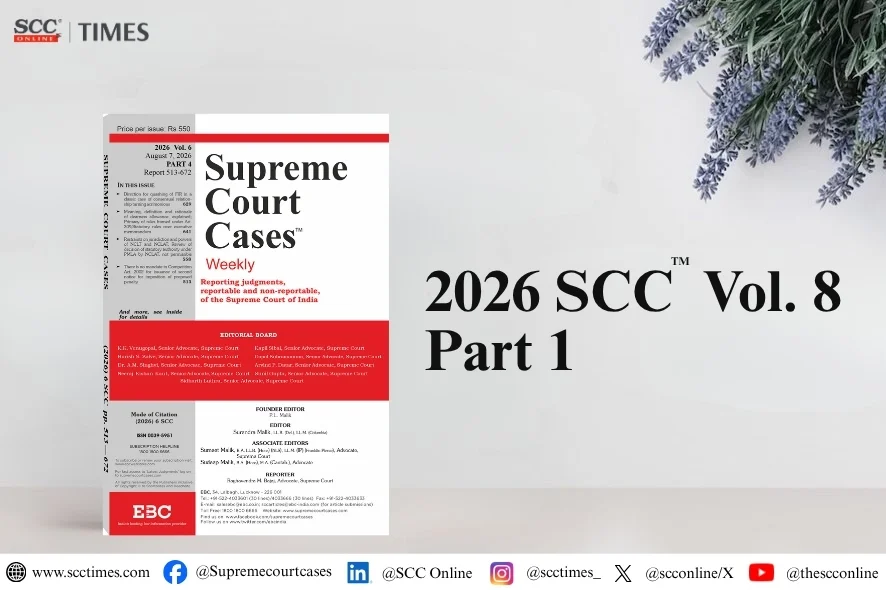
Constitution of India — Art. 21 r/w Sch. VII List II — Constitutional distribution of powers in relation to prisons and persons detained therein — Determination and effect of failure to give effect to legal frameworks: Under Sch. VII List II, the subject of “prisons and persons detained therein”, held, falling exclusively within the legislative domain of the States. Therefore, the primary responsibility for framing, adopting and effectively implementing laws and policies in respect of prison, held, rests with the respective State Governments and Union Territory Administrations, [National Legal Services Authority v. Union of India, (2026) 8 SCC 52]
Environment Law — Environmental Clearance/NOC/Environment Impact Assessment (EIA) — Prior environment clearance/Ex post facto grant/Regularisation/Ratification — Manufacturing units: Direction for closure of manufacturing units on ground of non-obtaining of prior environment clearance (“EC”), not sustainable when ex post facto EC found the right recourse in order to rectify the mistake, [Neetu Solvents v. Vineet Nagar, (2026) 8 SCC 35]
Insolvency and Bankruptcy Code, 2016 — Ss. 7, 30 and 31 — Enforcement of claims by operational creditors: Enforcement of claims by operational creditors regarding past dues by way of civil suit/arbitration, subsequent to approval of resolution plan, not permissible, [Tata Steel Ltd. v. Varsha, (2026) 8 SCC 13]
Nagarik Suraksha Sanhita, 2023 — Ss. 187(2) & (3) — Grant of police custody: Law clarified on legality and workability of conditions imposed during police custody period, [State of A.P. v. Suda Suresh Veera Venkata Naga Raju, (2026) 8 SCC 1]
Penal Code, 1860 — Ss. 302 and 498-A — Murder of wife: Husband held liable, when offence occurred inside the privacy of a house and the accused husband not offering requisite explanation, [Gour Acharjee v. State of Tripura, (2026) 8 SCC 149]
Protection of Children from Sexual Offences Act, 2012 — Ss. 19(1), 19(6), 21(1), 21(2), 21(3), 22(3) and 27 r/w Ss. 2(2), 6, 42-A, 43, 44 and 45: What constitutes “knowledge” about commission of offence under S. 19(1) POCSO Act, explained, [AAA v. Linda Sema, (2026) 8 SCC 68]
Scheduled Castes and Scheduled Tribes (Prevention of Atrocities) Act, 1989 — Ss. 3(1)(r) & 3(1)(s) — Essential ingredients of offences under: Charges under SC/ST Act, quashed in absence of requisite ingredients. Expression “a place within public view”, clarified, [Gunjan v. State (NCT of Delhi), (2026) 8 SCC 138]
Sexual Harassment of Women at Workplace (Prevention, Prohibition and Redressal) Act, 2013 — Ss. 11(1), 9, 2(m), 2(f) & 2(o) — Complaint of sexual harassment — ICCs which have jurisdiction: ICC constituted at aggrieved woman’s workplace has jurisdiction over employee of different workplace as fact-finding authority. Scope/Limits of jurisdiction of Internal Complaints Committee (ICC) in POSH Act, explained, [Sohail Malik v. Union of India, (2026) 8 SCC 104]





0 replies