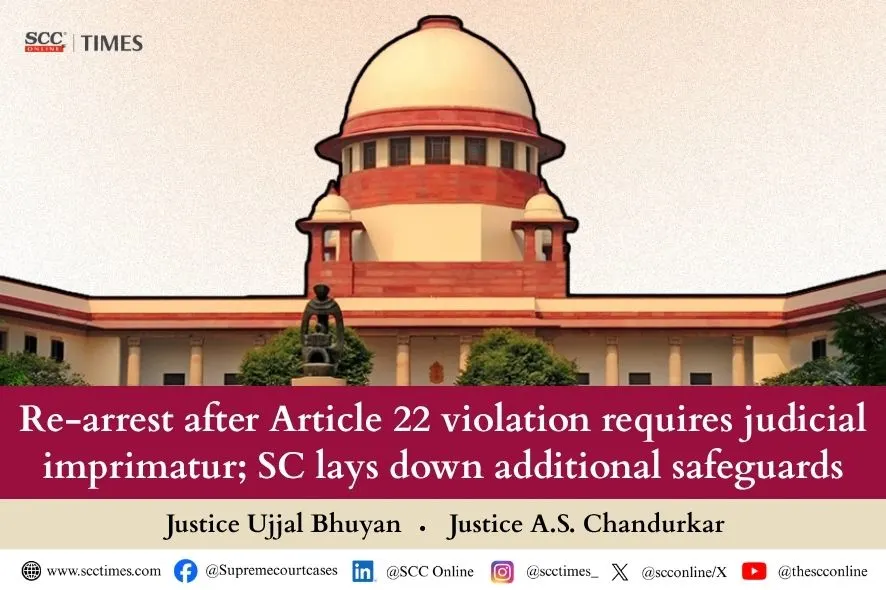
Supreme Court: While dealing with a question of “wide constitutional import”, i.e., whether an accused who has suffered breach of both Article 22(1) and (2) of the Constitution can thereafter be re-arrested for the same offence; and, if so, under what circumstances and through what procedure, the Division Bench of Ujjal Bhuyan* and A.S. Chandurkar, JJ., held that re-arrest after illegal arrest/detention requires judicial imprimatur and provided additional safeguards for re-arrest after Article 22 violation in addition to the ones in Mihir Rajesh Shah v. State of Maharashtra, (2026) 1 SCC 500.
Consequently, the Court, with the aim to strengthen the constitutional architecture governing arrest,held that:
-
Article 22(1) is a mandatory constitutional safeguard and not a mere procedural requirement.
-
Written grounds of arrest must ordinarily be furnished to the arrested person in a language understood by him and “as a matter of course and without exception”.
-
Breach of Article 22(1) renders the arrest unconstitutional and entitles the person to immediate release. Such release is not merely release on bail; it is release from illegal and unconstitutional detention.
-
Subsequent filing of a charge-sheet or taking of cognizance cannot validate an unconstitutional arrest.
-
After release for breach of Article 22(1), the investigating agency cannot itself decide to re-arrest the person. It must first furnish the grounds of arrest and move the Magistrate with reasons and necessity for custody, including an explanation for the earlier failure. The application must carry the endorsement of the immediate superior authority.
-
Re-arrest in such circumstances requires judicial imprimatur.
-
The 24-hour requirement under Article 22(2) is equally mandatory. Detention beyond that period without production before a Magistrate is unconstitutional.
-
Where an accused is released following violation of Article 22(2), the investigating agency must follow the same judicially supervised procedure if it subsequently requires his custody.
-
Compensation may, depending on the facts, be awarded as a public-law remedy for violation of Article 22(2), without prejudice to an appropriate private-law remedy.
-
The jurisprudence concerning re-arrest after grant of default bail does not govern cases where the accused has been released because of violation of fundamental rights under Article 22.
-
The gravity of the alleged offence cannot furnish an independent basis for relaxing constitutionally prescribed safeguards. Personal liberty can be curtailed only in accordance with the procedure established by the Constitution and law.
Factual Matrix
The informant lodged FIR at Mataur Police Station, SAS Nagar, Punjab, alleging that his elder daughter had disclosed physical and sexual abuse allegedly committed by the appellant from October 2024 onwards. The FIR invoked Sections 64, 65(1) and 351, Nyaya Sanhita, 2023 (BNS), read with Section 6, Protection of Children from Sexual Offences Act, 2012 (POCSO Act).
The appellant was arrested at about 7.54 a.m. on 17 May 2026. He was produced before the Judicial Magistrate on 18 May 2026 for police remand. The Magistrate noticed that, although the appellant had been arrested on 17 May 2026, written grounds of arrest had not been furnished to him.
Relying on Mihir Rajesh Shah, the Magistrate held that the investigating agency had failed to comply with the constitutional requirement of furnishing written grounds of arrest. Consequently, the arrest was declared illegal, and the appellant was directed to be released. The Magistrate nevertheless clarified that the investigating agency could proceed in accordance with law and, if necessary, move an application for custody/remand after supplying the grounds of arrest in writing and explaining the earlier non-supply.
On the same day, the Station House Officer (SHO) moved another application seeking custody/remand. The grounds subsequently furnished referred, inter alia, to the seriousness of the alleged offence, the necessity of custodial interrogation, recovery of the mobile phone and video recordings and the proposed potency test.
The Additional Chief Judicial Magistrate, by order dated 22 May 2026, declined to entertain the subsequent application. The Magistrate noted that the grounds of arrest had still not been supplied, and that custody/remand could only be granted after arrest and in the presence of the accused.
The appellant thereafter approached the High Court seeking, inter alia, prohibition against his re-arrest, custody/remand and issuance of warrants of arrest. The High Court dismissed the petition, holding that although the arrest had been declared illegal for non-furnishing of written grounds of arrest, the investigating agency was not precluded from seeking re-arrest provided the subsequent arrest complied with law. It declined to grant the appellant blanket immunity from future arrest.
Aggrieved the appellant approached the Supreme Court.
Issue for Determination
Whether an accused who has suffered breach of both Article 22(1) and (2) of the Constitution can thereafter be re-arrested for the same offence; and, if so, under what circumstances and through what procedure?
Analysis
At the outset, the Court examined Article 22(1) and (2) and noted that Article 22(1) embodies the protection that an arrested person shall not be detained in custody without being informed, “as soon as may be”, of the grounds of arrest and shall not be denied the right to consult and be defended by a legal practitioner of his choice. On the other hand, Article 22(2) provides a clear mandate that every person who is arrested and detained in custody shall be produced before the nearest Magistrate within 24 hours of arrest, excluding journey time, and prohibits detention beyond that period without the authority of a Magistrate. The Court noted that these clauses operate in cases of ordinary arrest and detention and are distinct from the provisions concerning preventive detention.
The Court examined Section 50, Criminal Procedure Code, 1973 (CrPC) [corresponding to Section 47, Nagarik Suraksha Sanhita, 2023 (BNSS)], which requires communication of the grounds of arrest. Likewise, Section 57 CrPC (corresponding to Section 58 BNSS) embodies the 24-hour safeguard contained in Article 22(2). Therefore, the constitutional guarantees in Article 22(1) and (2) found its statutory manifestation in Sections 50 and 57 CrPC, respectively.
Article 22(1) — Judicial Framework
The Court considered Pankaj Bansal v. Union of India, (2024) 7 SCC 576, where it was held that informing an arrested person of the grounds of arrest is a fundamental right. The object of furnishing the grounds is not merely to inform the person why he has been arrested. It enables him to consult counsel, challenge the arrest and seek bail. It was explained that merely reading out voluminous grounds may not satisfy the constitutional objective. Accordingly, it was held that the requirement is that the written grounds of arrest be furnished to the arrested person “as a matter of course and without exception”.
Also Read: “Pankaj Bansal v. Union of India” — The Prospective-Retrospective Conundrum
In Prabir Purkayastha v. State (NCT of Delhi), (2024) 8 SCC 254, the Court had recognised the fundamental and statutory right to be informed of the grounds of arrest in writing. It stressed that the purpose of such information is “salutary and sacrosanct” because it enables the arrested person to consult an advocate, oppose police custody/remand and seek bail. It further recalled that infringement of Article 22(1) vitiates the arrest and remand and a subsequent charge-sheet cannot validate an arrest which was unconstitutional from its inception.
Also Read: Supreme Court sets aside arrest and remand of NewsClick chief editor Prabir Purkayastha in UAPA case
In Vihaan Kumar v. State of Haryana, (2025) 5 SCC 799, the Court had held that the grounds must be effectively and fully communicated in a manner understood by the arrestee. Once arrest curtails the liberty guaranteed under Article 21, therefore, it is necessary that the arrested person must understand why that liberty has been curtailed. It was held that “…if the requirement of Article 22 is not followed while arresting a person or after arresting a person, it will also violate the fundamental right to liberty guaranteed under Article 21, rendering such arrest illegal”.
The Court further relied on Mihir Rajesh Shah, wherein it was held that Article 22(1) imposes a mandatory and unexceptional constitutional duty upon the State to furnish the grounds of arrest. The requirement is not statute-specific and applies to offences under the IPC, BNS and special enactments alike.
The Court had stated that ordinarily, the written grounds must be supplied upon arrest. However, in exceptional situations where immediate written communication is impracticable, oral communication may suffice initially, but written grounds must thereafter be supplied within a reasonable time and, in any event, at least 2 hours before production before the Magistrate for remand. If this requirement is not complied with, the arrest becomes illegal and the arrestee is entitled to release.
Further, the Court in Mihir Rajesh Shah stated that, after such release, if the investigating agency still required custody, it could move the Magistrate with reasons and necessity for custody, together with an explanation for the earlier failure to furnish the grounds. The Magistrate was required to decide such application expeditiously, preferably within a week, following principles of natural justice.
Further, noting that State of Karnataka v. Sri Darshan, 2025 SCC Online SC 1702, and State of Meghalaya v. Sonam Raghuvanshi, 2026 SCC Online SC 1294, did not displace the position laid down in Mihir Rajesh Shah, the Court stated that “it is Mihir Rajesh Shah which sums up the correct legal position and lays down the correct law which is binding. It is in tune with the consistent line of jurisprudence developed over the years by this Court”.
Article 22(1) — Core Principles
Summarised the governing principles on Article 22(1), the Court stated that:
-
The grounds of arrest must be in writing and in a language understood by the accused. A copy must be furnished to the arrested person as a matter of course and without exception at the earliest.
-
Violation of Article 22(1) vitiates the arrest and remand and requires immediate release. Such release is not release on bail; rather, the accused is released from “illegal and unconstitutional detention”.
The Court rejected an approach treating the requirement merely as a procedural safeguard where prejudice must separately be demonstrated and stated that when a constitutional safeguard contained in Article 22(1) is violated, “question of prejudice or demonstrable prejudice does not arise”. Nor can subsequent filing of a chargesheet or an order taking cognizance validate the unconstitutional arrest.
Additional safeguards for re-arrest after Article 22(1) violation
The Court expressly stated that it was bound by Mihir Rajesh Shah but intended to “further stress upon and strengthen the safeguards” relating to re-arrest. Where an accused has been released because of violation of Article 22(1), and the investigating agency still considers custodial interrogation necessary, the following procedure must be followed:
-
The investigating agency must furnish the written grounds of arrest to the accused.
-
It must thereafter file an application before the concerned Magistrate seeking custody.
-
The application must state the reasons and necessity for re-arrest/custody.
-
It must contain an explanation for the earlier failure to furnish the grounds of arrest.
-
The application must carry the endorsement of the immediate superior authority.
-
The Magistrate must consider the application expeditiously, preferably within a week.
-
The Magistrate must follow the principles of natural justice.
The Court introduced the requirement of endorsement by the superior authority to rule out “foul play or collusion” and to ensure institutional accountability for the constitutional violation.
The Court asserted that “the power to re-arrest the accused must not be left to the discretion of the very same authority who had violated” Article 22(1) and therefore held that re-arrest requires “judicial imprimatur”. The Court directed that
-
the Magistrate must be satisfied, first, that there were bona fide reasons why the grounds could not initially be furnished and, secondly, that after their subsequent furnishing, the accused actually needs to be re-arrested.
-
Only upon such satisfaction may the Magistrate permit the investigating agency to re-arrest.
The Court additionally directed that, on the administrative side, the superior authority should entrust the investigation to another officer and initiate departmental enquiry into the constitutional lapse. An adverse departmental finding could entail appropriate disciplinary action, including an entry in the concerned officer’s service record.
Article 22(2) — 24-Hour Rule
In order to answer the second question, whether, after a person has been detained beyond 24-hours without production before a Magistrate, his release for such constitutional violation nevertheless leaves the investigating agency free to re-arrest him without judicial intervention, the Court examined the constitutional jurisprudence and judicial precedents on Article 22(2).
In Bhim Singh v. State of J&K, (1985) 4 SCC 677, the accused had not been properly produced before the Magistrate when remand was obtained. The Court had found a violation of his constitutional rights. Since he was no longer in detention when the matter came before the Court, no order releasing him could be made. Nevertheless, the Court had held that the constitutional violation did not disappear merely because the person had subsequently been set at liberty. It awarded compensation, observing that the invasion of constitutional and legal rights could not simply be “washed away or wished away” by release.
In Manoj v. State of M.P., (1999) 3 SCC 715, the Court had held that it is a constitutional mandate that an arrested person must be produced before the nearest Magistrate within 24 hours. Where the State admitted that the accused had not been produced within that period, the detention beyond 24 hours became unlawful. The Court had described the arrest as “otiose” and stated that the State could not validly seek further detention beyond the constitutionally prescribed period.
The Court referred to a Single Bench judgment of the Gauhati High Court in Kamal Dutta v. Union of India, (2016) 1 GLR 539, where violation of Article 22(2) had resulted in unconstitutional continued detention. The High Court had recognised compensation as a public-law remedy for infringement of fundamental rights.
In Directorate of Enforcement v. Subhash Sharma, 2025 SCC OnLine SC 240, the Court had held that detention beyond 24-hours without production before the Magistrate rendered the arrest completely illegal. Once the constitutional safeguard under Article 22(2) is breached, the accused’s liberty under Article 21 is also implicated. Where fundamental rights under Articles 21 and 22 have been violated, the court is duty-bound to release the accused.
The Court observed that the principles emerging from Bhim Singh, Manoj, Kamal Dutta and Subhash Sharma were in “complete sync with the constitutional jurisprudence” developed over the years. The 24-hour safeguard is not an empty procedural requirement. It is a constitutional limitation on the State’s power to detain a person.
The Court recalled Khatri v. State of Bihar, (1981) 1 SCC 627, where it had strongly urged that the constitutional requirement of producing an arrested person before a Judicial Magistrate within 24-hours must be observed “strictly and scrupulously”. The Court emphasised that, notwithstanding the passage of time, this constitutional mandate remains firm and unshaken.
The Court rejected the State reliance on Sanjay Dutt v. State, (1994) 5 SCC 410 and Rakesh Kumar Paul v. State of Assam, (2017) 15 SCC 67, to contend that release of an accused does not prevent subsequent arrest or re-arrest. It noted that in default-bail cases, the issue is whether an accused who has acquired the statutory right to default bail may subsequently be arrested after release. The jurisprudence in those cases recognises that subsequent arrest may take place on cogent grounds.
However, the Court stated that the present case was fundamentally different. Here, the appellant had suffered violations of fundamental constitutional rights under both Articles 22 (1) and (2) at the threshold of arrest.
The Court held that the procedure prescribed above (in paras 24 to 25.1) for Article 22(1) violations would apply, mutatis mutandis, where there is a breach of Article 22(2) and the investigating agency continues to require the accused’s custody after release. Thus, the investigating agency cannot simply treat the constitutional violation as having been cured by release and proceed to arrest the accused again without following the judicial procedure prescribed by the Court. Additionally, depending upon the facts and circumstances, the High Court may direct payment of compensation as part of the public-law remedy for violation of Article 22(2). The accused would retain liberty to pursue an appropriate remedy under private civil law.
Gravity of the Offence Cannot Override Constitutional Safeguards
The Court emphasised that constitutional guarantees cannot depend upon the nature or gravity of the alleged offence. The Constitution cannot be interpreted in a vacuum or on the basis of “ifs and buts”. Constitutional provisions occupy a position above the statutory threshold and its violation “cannot be countenanced” and must be dealt with strictly.
Relying on Prabhu Dayal Deorah v. District Magistrate, Kamrup, (1974) 1 SCC 103, the Court stressed that the gravity of an alleged evil to the community cannot, by itself, justify invasion of personal liberty except in accordance with the Constitution and law.
“When a certain procedure is prescribed by the Constitution or the laws for depriving a citizen of his personal liberty, it is the duty of the court to ensure that such procedure is rigorously observed, howsoever, strange this might sound to some ears.”
Decision
Applying the above discussed principles, the Court found that the appellant had suffered violations concerning both Article 22(1) and Article 22(2). Allowing the appeal, the Court:
-
set aside and quashed the High Court’s order dated 29 May 2026,
-
quashed the observations made by the Magistrate in the order dated 18 May 2026,
-
directed that, if the respondents considered custodial interrogation of the appellant necessary, they must comply with Mihir Rajesh Shah read with paras 24 to 25.1 of the present judgment and para 36,
-
clarified that the Court had expressed no opinion on the merits of the accusations against the appellant; and
-
directed circulation of the judgment to the Directors General of Police of the States and Union Territories, Registrar Generals of the High Courts and Directors of State Judicial Academies.
[Jaskaran Jeet Singh Deol v. State of Punjab, 2026 SCC OnLine SC 1939, decided on 21-9-2026]
*Judgment Authored by Justice Ujjal Bhuyan
Advocates who appeared in this case:
For the Appellant: Mr. Siddharth Aggarwal, Sr. Adv., Mr. Yoginder Handoo, AOR, Mr. D.S. Sobti, Adv., Mr. Ashwin Kataria, Adv., Mr. Sultan Singh Sangha, Adv., Mr. Karan Dhalla, Adv., Ms. Khushboo Mittal, Adv., Mr. Garvit Solanki, Adv., Mr. Gaurav Vishwakarma, Adv., Mr. Aditya Aggarwal, Adv., Mr. Japman Singh, Adv., Mr. Akshat Patria, Adv.
For the Respondent: Mr. Gopal Sankaranarayanan, Sr. Adv., Mr. Ajay Marwah, AOR, Mr. Uday Jain, Adv., Mr. Rahil Mahajan, Adv., Mr. Aayushman Aggarwal, Adv., Mr. Ms. Indumugi C., Adv., Mr. Swaroopanand Mishra, Adv., Mr. Mrigank Bhardwaj, Adv., Mr. Rajkanwar Singh, Adv., Mr. Prabhjot Singh Waraich, Adv., Ms. Dhriti Sharma, Adv., Mr. Rahul Kumar, Adv., Ms. Shivani Singh, Adv., Mr. Ravideep Badyal, Adv., Mr. Ravi Shandil, Adv., Mr. Sainyam Bhadwaj, Adv., Mr. Rajat Bhardwaj, A.A.G., Mr. Siddhant Sharma, AOR, Mr. Vikram Choudhary, Adv., Mr. Prafull Bhardwaj, Adv., Mr. Dushyant Choudhary, Adv., Mr. Snehil Himanshu, Adv.,