


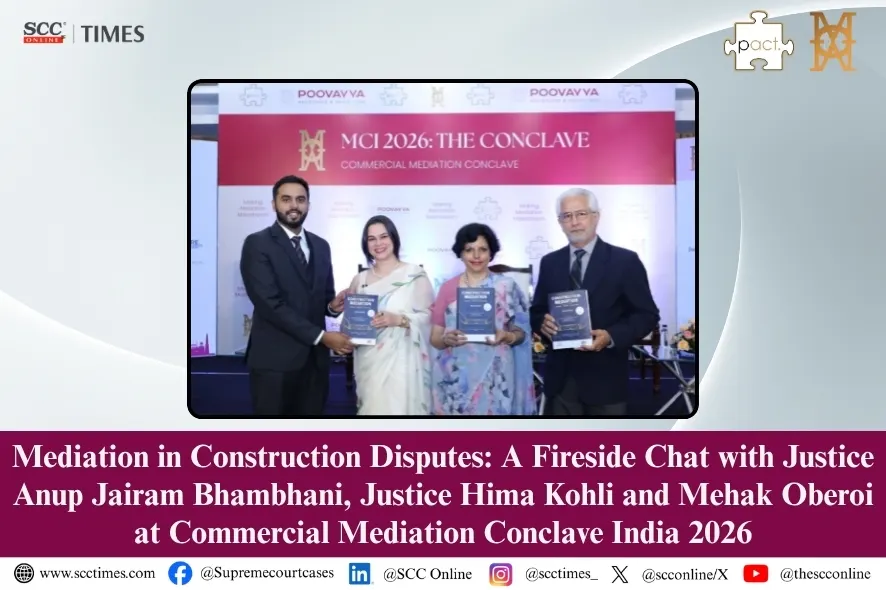
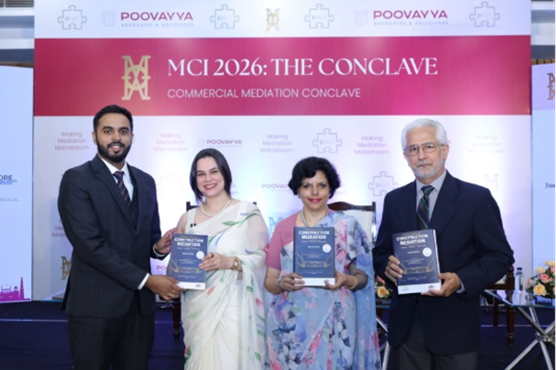
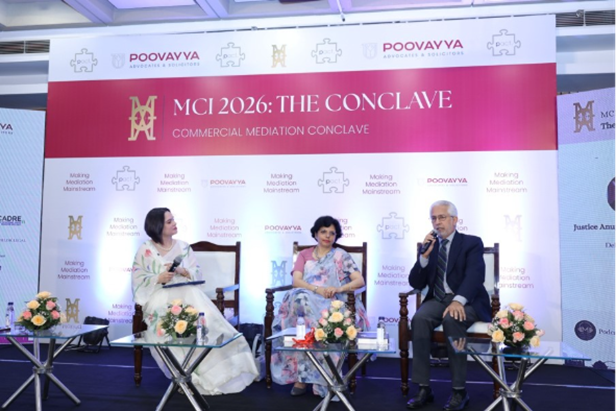
The Commercial Mediation Conclave India 2026, themed “Making Mediation Mainstream,” was held on 18 September 2026 at the India International Centre, New Delhi. One of its sessions combined the launch of Mehak Oberoi‘s book, Mediation in Construction Disputes, with a fireside conversation on the subject. Oberoi, the author, moderated the discussion with Justice Anup Jairam Bhambhani of the Delhi High Court and Justice (Retd.) Hima Kohli, formerly of the Supreme Court of India.
On writing the book she went looking for
Oberoi opened with what she called a confession. She had not set out to write a book on construction mediation. She had set out to find one. She wanted something that would tell her how to handle an employer penalising a contractor who had gone fourteen months without payment, how to deal with the cascading effect of a subcontractor threatening to demobilise a site, or how to manage a government client asking where its funds were even though the project itself was a decade behind schedule. When she could not find that book, she wrote it.
She was careful to distinguish the book from the broader case for mediation. “I did not want to write a book on mediation and about how good mediation is,” she said, adding that India was already doing a reasonably good job of that advocacy. Her book, instead, is about how to actually conduct a mediation in a construction dispute. It is meant to handhold a party, a mediation counsel, a mediator or an in-house lawyer, offering diagnostic frameworks, checklists and tools to work through a dispute from start to finish.
Before the book was unveiled, Oberoi thanked those who had shaped the project, starting with a judge whose early encouragement, she said, had made the book possible. Her longest-standing mentor came next, the one she called her “OG mentor,” who taught her to draft her first contract when she was in her third year of college, and he was Vice President at Pepsi. She also thanked another mentor she credited as central to her journey over the past decade. She described the profession as a craft and said she could not have found two better people to inspire and guide her than Justice Hima Kohli, who “has championed mediation since forever throughout her career,” and Justice Bhambhani, whose “experience with construction disputes and perspectives is so important today with this conversation.” She then invited both judges on stage to unveil the book.
Peeling the onion to find the underlying interest
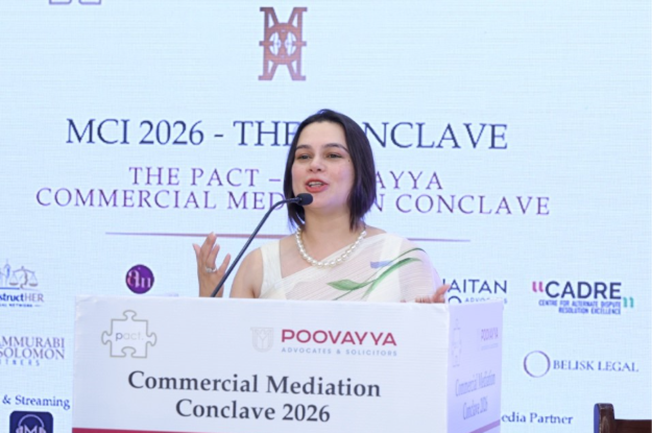
Opening the fireside chat, Oberoi set the tone plainly.
“Construction disputes are messy, and that’s not a criticism. It’s a description of what we face.”
Her first question went to Justice Kohli, who has been closely associated with the Delhi High Court Mediation and Conciliation Centre. Disputes as they appear on paper, Oberoi observed, are often very different from what is actually stopping the parties from settling, so how should a mediator identify the underlying interests, and how far should the mediator push to uncover them?
Justice Kohli welcomed the fact that a conclave was dedicated specifically to mediation, noting that arbitration tends to dominate discussion of ADR mechanisms and expressing hope that platforms of this kind would eventually give mediation a “larger stage” of its own.
On the substance of the question, she described the task as “peeling the onion.” It meant going deeper and deeper into what is genuinely bothering the parties, beyond whatever sits on the surface. That process, she said, does not begin when the parties walk into the room and sit down with the mediator. It can start months earlier, from the moment a mediator is assigned a matter and begins studying what the dispute looks like on the surface and what might lie beneath it.
The real measure of a successful mediation, in her view, is whether the mediator has understood the underlying dispute. That means examining the relationship between the parties.
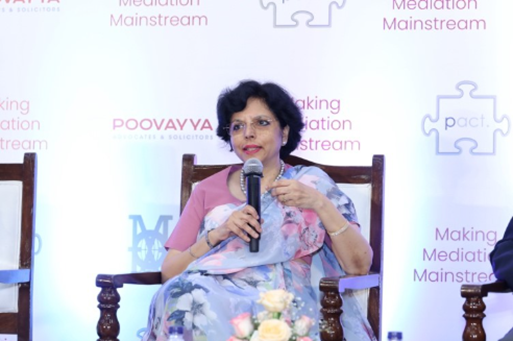
“Where was that knot? How far has that knot busted? Has the thread broken, or is it just stretched enough not to break?”
It also means asking whether the parties would be willing to come to the table because they are connected on other, ongoing platforms besides the specific dispute in front of the mediator. A mediator who looks only at the standalone dispute, she warned, risks missing the wood for the trees.
She applied this directly to construction. Owners and employers, contractors and subcontractors form a comparatively small pool of players who are repeatedly required to meet, tie up commercially and associate with one another. Once that underlying, ongoing commercial interest is surfaced, parties are often willing to move past a dispute that need not derail the whole contract or project. These are not merely relationships in a sentimental sense, she stressed, but commercially valuable ones. Losing a specialist from the field may mean being unable to find another party equally capable of completing the contract. That shared stake in the project’s completion is, in her view, the underlying interest a mediator has to draw out and use to move the parties forward.
There is no such thing as too early or too late
Oberoi’s next question, put to Justice Bhambhani, took up a problem she said she had wrestled with while writing the book. Is there a wrong time to mediate? Too early, at the first disagreement or the first notice of claim, or too late, once a matter has gone into arbitration?
Justice Bhambhani‘s answer was that the right time depends entirely on the dispute, and that forcing parties into mediation prematurely “is always a bad idea.” Parties who have been in litigation for a long time, he observed, often reach a point of battle fatigue, or litigation fatigue, at which it dawns on them that they may have been walking the wrong road. Whether a matter is in arbitration or before a court, there comes a point at which the parties become “ripe.” The relative strengths and weaknesses of each side are on the table and better understood, and relationship considerations of the kind Justice Kohli had just described, particularly in construction contracts where a party cannot simply walk away because no one else is available to complete the project, begin to weigh more heavily.
His conclusion was that there is no such thing as inherently too early or too late. The right time is whenever the parties are open to giving mediation a shot, and that is the moment at which a mediator, or the more appropriate dispute resolution mechanism, should be offered to them.
A domain-agnostic skill
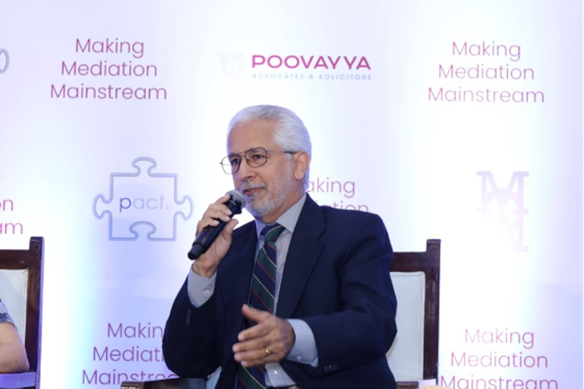
Oberoi’s follow-up asked who should actually mediate a technical dispute of this kind, a trained mediator who can follow a technical conversation, or a trained mediator who is also a construction law expert.
Justice Bhambhani described mediation itself as “a stand-alone and extremely soft and specific skill,” the work of bringing parties to the table, setting the right tone, and building in them a sense of positive communication. In his view, mediation is largely domain-agnostic. A mediator equipped with these skills could resolve a family dispute and, with adequate practice and refinement, could even negotiate a hijack situation. What is necessary, he said, is not domain expertise but an understanding of the pathology of the dispute. In genuinely technical matters, such as patent disputes or construction disputes, the mediator does need to understand what underlies the conflict, and for that purpose a mediator may co-opt someone from the relevant field, much as an arbitrator might call on an expert witness, to work out what the parties are not saying and where the unmasked areas of the dispute lie.
He pushed back, however, on the idea of an “expert construction mediator” as close to a contradiction in terms. An expert in a particular field carries entrenched views from that business, he said, which can sometimes prove counterproductive to the mediation itself. Asked whether basic domain knowledge would nonetheless help, he agreed that it always does, but was careful to locate the mediator’s essential expertise in mediation, not in the subject matter, since the solutions have to come from the parties themselves. What domain familiarity gives a mediator is the ability to nudge parties in a particular direction and press the right buttons, particularly where a contract uses highly specialised terminology.
He drew an analogy with the legal profession’s own history. Civil lawyers, over time, branched into specific areas depending on interest and skill. Mediators, he suggested, are following the same path. A mediator who has handled more construction mediations than most will naturally be better suited to them.
“But he is not a construction expert. He is a mediation expert in the field of construction.”
Tying every loose end
Turning back to Justice Kohli, Oberoi asked what she considered the ingredients of an effective mediated settlement in construction, where multiple parties, multiple layers and cascading impacts make the settlement architecture more complex than in a simple two-party dispute.
Justice Kohli drew on her experience training mediators at Samadhan, the Delhi High Court Mediation and Conciliation Centre. The last, and by her account invariable, lesson in that training concerns how a settlement is actually drafted, and specifically what needs to be plugged and what fine points need to be tied down. A settlement reached in principle but not reduced to writing with precision, she said, will often end up back in court. The agreement needs to be as watertight as the parties can make it.
She illustrated the point with construction-specific examples. A settlement that simply says A will pay B a given amount, without specifying timelines, is “a big no-no.” Even where timelines are specified, failing to provide for what happens if a party defaults creates a fresh problem. Where vendors and sub-vendors sit behind an in-principle settlement without back-to-back contracts addressing them, disputes tend to resurface through those parties later. She connected this to section 19 of the Mediation Act, newly notified, which allows other parties and other disputes not originally referred to mediation to be brought into the settlement, so that the whole collective dispute can be resolved once and for all. Achieving that, she said, requires the mediator to factor in every fine nuance on the parties’ behalf.
She warned that loose ends can be dangerous, citing a matter in which a settlement had been reached and appeared fully resolved, only for one party to later default. The other party went back to court arguing that the settlement agreement had not been honoured, and the matter came close to being pushed back into arbitration on the strength of the underlying arbitration clause. The court, on examining the matter, held that the dispute was over and that there was no question of returning to arbitration, and that the settlement agreement itself had to be implemented, with a decree ultimately passed on that basis. She linked the episode to a lesson she said she had learned the hard way, on the difference between a settlement that is legally binding and one that is legally enforceable.
Willingness cannot be forced
Moving beyond the book, Oberoi asked whether exploring mediation should become mandatory for parties to a dispute.
Justice Kohli pointed to the pre-institution mediation requirement under the Commercial Courts Act, mandatory unless a party needs urgent interim relief. Examined against the numbers, she said, a large proportion of these mandatory mediations had simply failed, because the parties’ willingness was missing. Parties cannot be pushed into mediation. Where there is an underlying commercial relationship worth sustaining, they will go the extra mile, but without that initial willingness the process will not work. She drew a contrast with family disputes, which involve relationships of a different kind, of the heart and of emotion rather than commerce, but which similarly depend on a willingness to give and take.
Speaking from the bench, she observed that when a matter comes back from mediation unsettled, parties will often tell the court exactly where the process broke down, saying that they were willing to go a certain distance, that the other side was willing to meet them partway, and that in reality eighty per cent of the dispute had already been sorted, with only a residual twenty per cent left outstanding. A nudge from a judge, carrying the authority of the court, has resulted in a number of settlements in such cases, and she credited the mediators who reported these mediations as unsuccessful rather than papering over the gap, because a seed had usually already been planted. She drew a sharp distinction between the two roles.
“Mediator can’t nudge. Mediator can only promote them to think in a way that will make them travel that path.”
A court, by contrast, can nudge, and does so only in the interest of the parties.
Justice Bhambhani added a further, more sceptical observation on the same provision. In his experience, roughly seven out of ten matters that come to court are also seeking some form of urgent, ex parte interim relief, which effectively requires the court to waive the pre-institution mediation requirement under section 12A, since a party cannot disclose its case for interim relief through mediation first. The same, he said, would be true of construction disputes. Section 12A sounds sensible in theory, but in practice there is often full justification for parties not even to attempt it. He added, though, that this does not much matter in the end, since courts routinely send parties to mediation once they show willingness in principle, regardless of the formal stage at which the case sits, reinforcing the point that the right time for mediation cannot be prescribed in the abstract.
Closing remarksOberoi closed the session by thanking both judges, calling them an inspiration for having taken mediation to its next level and for helping pave the pathway for others, and invited the audience to read the book for the practical insights it offers.





