


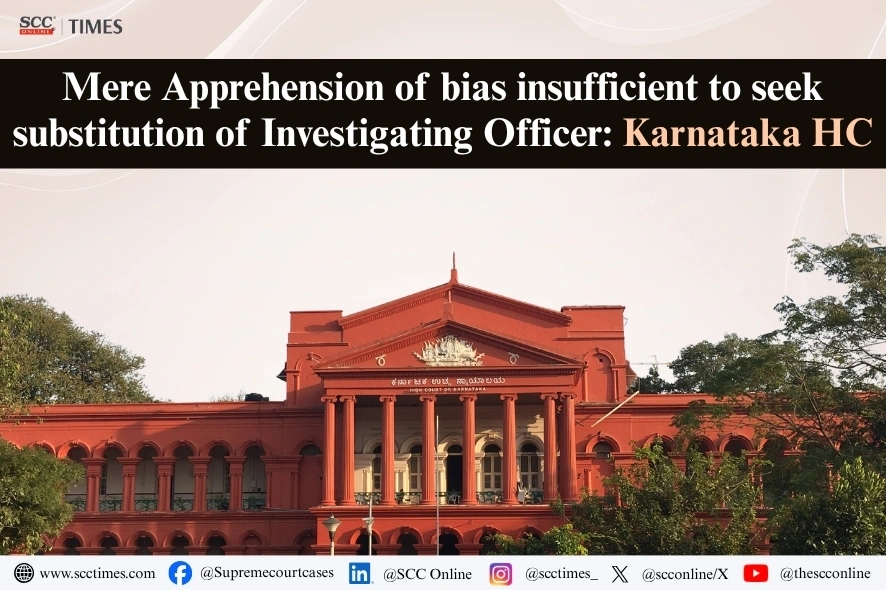
Karnataka High Court: The Single Judge Bench of Suraj Govindaraj, J., rejected the petition seeking substitution of an investigating officer from Enforcement Directorate, holding that subjective apprehension of bias was insufficient in establishing mala fides or demonstrable bias, without cogent material. The Court also deprecated representations sent to constitutional authorities and imposed costs of ₹1,00,000 on the petitioner.
The Court emphasiszed that substitution of an iInvestigating oOfficer cannot be claimed as a matter of right merely because the person under investigation is dissatisfied with the investigation. Unless a clear case of mala fides, demonstrable bias, lack of jurisdiction or abuse of process is made out before a competent cCourt, the person under investigation cannot insist that the investigation be conducted by an officer of his choice.
Background
The dispute arose from the proceedings being undertaken by the Directorate of Enforcement against the petitioner. He alleged that the investigating officer was not impartial and that his continued involvement would prevent a fair investigation. On 25 July 2026, the petitioner submitted a representation requesting that the investigating officer concerned recuse himself and that the matter be entrusted to another independent officer who had not previously been involved in the events of 18 April 2026 or the subsequent proceedings.
The petitioner also sought preservation and production of CCTV footage from Kempegowda International Airport covering the period between 11.00 p.m. on 17 April 2026 and 11.00 p.m. on 18 April 2026. According to the petitioner, this footage was relevant to the arrival, interception, movement, detention and exit of himself and another individual. The petitioner had also requested that coercive action not be taken against him until the representation was considered and an appropriate decision was taken by the competent authority.
The petition was filed under Article 226 of the Constitution of India by the petitioner against the Union of India, the Directorate of Enforcement and other authorities connected with the investigation and security arrangements at Kempegowda International Airport. The petitioner approached the High Court principally seeking the substitution of the investigating officer on the ground that he had a reasonable apprehension that the officer was biased and prejudiced against him.
Decision and Analysis
The Court did not find sufficient substance in the petitioner’s allegation of bias and observed that a person against whom an investigation is being conducted does not possess a vested right to choose, nominate or seek substitution of the investigating officer merely because he has a subjective apprehension regarding the manner in which the investigation is being conducted. Investigating agencies are entitled to conduct investigations through officers appointed in accordance with law. The Court emphasised that substitution of an investigating officer cannot be claimed as a matter of right merely because the person under investigation is dissatisfied with the investigation. The intervention may become justified where a clear case of mala fides, demonstrable bias, lack of jurisdiction or abuse of process is established before the competent court. In the absence of such circumstances, a person under investigation cannot insist that the investigation be conducted by an officer of his choice.
The Court found that the petitioner had made only a general allegation that the investigating officer was prejudiced against him. No material had been placed before the Court that could prima facie establish that the investigation was actuated by mala fides or that the investigating officer was incapable of conducting a fair investigation. The Court held that mere apprehension or dissatisfaction, even if strongly expressed, could not by itself constitute a legal ground for directing the substitution of an investigating officer. The manner in which the petitioner had chosen to ventilate his grievance was equally objectionable. The Court noted that the representation dated 25 July 2026 was not confined to the competent authorities within the Directorate of Enforcement. Copies had also been forwarded to the Union Finance Minister, the Secretary of the Department of Financial Services, the Chief Vigilance Officer of the Directorate of Enforcement, the Chief Justice of the High Court of Delhi and the Chief Justice of India. The Court was also informed that communications had been sent to the official email addresses of the Delhi High Court and the Supreme Court of India.
The Court strongly deprecated this course of conduct. It observed that constitutional courts do not entertain administrative representations relating to pending investigations through letters or emails addressed to the Chief Justices. If a person has a grievance concerning the legality or fairness of an investigation, the appropriate course is to invoke the jurisdiction of the competent court through the procedure established by law. Sending representations concerning pending investigations to constitutional authorities who are neither statutory decision-makers nor responsible for conducting the investigation was held to serve no legitimate legal purpose. The Court further observed that such conduct could create an impression that an attempt was being made to obtain intervention outside the established judicial process. It also stressed upon permitting the persons under investigation to routinely mark such representations to constitutional authorities would encourage a practice inconsistent with established judicial procedure.
It observed that such conduct could warrant exemplary costs as a deterrent against similar attempts in the future. Nevertheless, the Court refrained from imposing exemplary costs and instead the petitioner was directed to pay ₹1,00,000 as costs to the Karnataka State Legal Services Authority within 15 days from receipt of a copy of the order. It made clear that repetition of such conduct could result in more serious consequences, including exemplary costs. The Court rejected the request for substitution of the investigating officer because the petitioner had failed to establish mala fides, demonstrable bias, lack of jurisdiction or abuse of process. It also recorded that the CCTV footage sought by the petitioner had already been overwritten after the expiry of the 30-day retention period. In case of non-payment, the Member Secretary of the Karnataka State Legal Services Authority was authorised to recover the amount as arrears of land revenue.
[Fair Vakkayil John v. Union of India, 2026 SCC OnLine Kar 11878, decided on 5-8-2026]
*Judgment authored by: Justice Suraj Govindaraj
Advocates who appeared in this case:
For the Petitioner: Sandesh J. Chouta, Senior Advocate, Mahesh Y.L., Advocate
For the Respondent: Anuparna Bordoloi, ASG, Manu Kulkarni, J. Hudson Samuel Advocates





