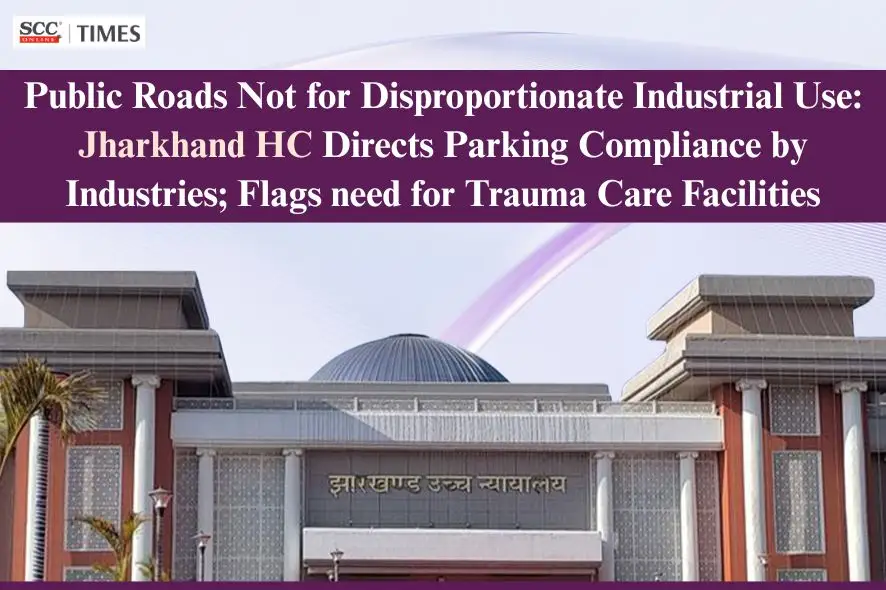
Jharkhand High Court: In a public interest litigation (PIL) concerning the disproportionate use of public roads by heavy vehicles connected with the Chaliyama Steel Plant (CSP) and the absence of adequate medical facilities in the region, the Division Bench of M.S. Sonak,* CJ., and Rajesh Shankar, J., emphasised that the right to health is an essential facet of Article 21 of the Constitution and that industries such as CSP cannot disproportionately use public roads for their commercial gain. The Court, hence, directed strict compliance with statutory parking requirements under the Jharkhand Building Bye laws, 2016 and also directed the State to take policy decision on establishment of trauma care facilities near the steel plant and highway corridor.
Background
The dispute arose from allegations of systemic operational negligence and disregard for statutory mandates in the management of the steel plant. Petitioners submitted that inadequate parking facilities forced trucks to use public roads, creating hazards for commuters and workers. They also highlighted the absence of adequate medical facilities in the vicinity, with the nearest hospital being 12 kms away.
The respondents, through affidavits, pointed to facilities already provided and offered suggestions to address the concerns. They contended that congestion was a cumulative effect of regional industrial activity and not solely attributable to the steel plant. They also noted that a 20-acre parking area had been developed within the plant premises, capable of accommodating 800 to 1000 vehicles, with facilities for rest, sanitation, and food outlets.
Analysis
The Court emphasised that the right to health, particularly in the context of workers and other downtrodden persons, has been consistently recognised as an integral facet of the right to life under Article 21 of the Constitution. The Court referred to precedents such as Consumer Education & Research Centre v. Union of India, (1995) 3 SCC 42 and Bandhua Mukti Morcha v. Union of India, (1984) 3 SCC 161, wherein the Supreme Court held that the State is constitutionally obliged to ensure adequate health care, sanitation facilities, and fair wages for workers, especially those engaged in hazardous industries.
The Court further relied on Peoples Rights & Social Research Centre (PRASAR) v. Union of India, 2024 SCC OnLine SC 1895, where the Supreme Court reiterated that failure to protect workers from occupational hazards and provide accessible healthcare facilities amounts to a violation of Article 21 read with Articles 39(e) and 42 of the Constitution.
The Court noted that there must be some equity when it comes to the use of public roads, and if big industries like CSP start to disproportionately use public roads without adopting any safeguards, that would not be proper. The Court further observed that CSP vehicles, or the vehicles transacting business with CSP, were no doubt entitled to use the public road along with all others. However, such use had to be reasonable and could not virtually ease out other commuters on the public roads, nor place undue and disproportionate stress on the road infrastructure.
The Court highlighted that CSP was using such roads for its commercial ventures. Though there was nothing wrong with such reasonable use, disproportionate or inequitable use puts great stress on ordinary commuters of such public roads. Ultimately, the Court emphasised that such public roads were built and maintained through taxpayers’ funds. Therefore, there had to be an equitable use of such roads, particularly by industries established for commercial gains.
The Court noted that, no doubt, the report suggested that the resulting congestion was not attributable only to CSP or CSP vehicles but was a cumulative effect of regional industrial activity. However, the report also stated that a parking area of approximately 20 acres had then been developed within the precincts of CSP, and that this developed area had the potential to accommodate about 800 to 1000 vehicles. This area also included functional facilities for rest, sanitation, and food outlets.
The Court noted that the report concluded with several systemic suggestions, such as widening existing roads, constructing dividers, creating designated heavy-vehicle parking zones, and installing enhanced street lighting and speed-monitoring devices. In the Court’s view, these recommendations from the General Manager, District Industries Centre, Chaibasa deserved due consideration by the respondents, since they directly addressed the traffic issues highlighted by the petitioners and even acknowledged by the respondents. If acted upon, the Court observed, these measures could substantially resolve the concerns raised in the petition.
The Court further observed that inadequate medical facilities affected not only CSP workers but also members of the public injured in road accidents. Referring to the General Manager’s suggestion of establishing a Trauma Centre near the National highways, the Court emphasised that the right to health under Article
The Court also held that CSP should contribute to such a facility under its corporate social responsibility obligations, while maintaining proper vigilance and statutory compliance in providing internal parking facilities so that public roads were not disproportionately used by CSP vehicles.
Decision
Accordingly, the Court allowed the petition and issued a series of directions. The Court mandated strict enforcement of Rule 41, Jharkhand Building Bye-laws, 2016 to ensure internal parking facilities within the steel plant premises, and required consideration and implementation of the District Industries Centre’s report within specified timelines. The Court directed that unauthorised roadside parking by heavy vehicles be prevented, and that highways be upgraded with lighting, speed monitoring, and traffic control systems.
The Court further ordered the establishment of designated heavy-vehicle parking zones within 18 months, and required the State to take a policy decision within 3 months on trauma care facilities, with operationalisation within 18 months. The Court also directed exploration of corporate social responsibility (CSR) participation by the steel plant in strengthening medical infrastructure.
Clarifying that these directions were issued to ensure statutory compliance and did not preclude additional measures in accordance with law, the Court stressed continuous vigilance to prevent disproportionate use of public roads.
Also Read: Heavier Loads, Higher Costs: Key Changes under Fourth Amendment to National Highways Fee Rules
[Nageshwar Acharya v. State of Jharkhand, 2026 SCC OnLine Jhar 522, decided on 16-4-2026]
*Judgment authored by: Chief Justice M.S. Sonak
Advocates who appeared in this case:
For the Petitioners: Anupam Anand, Pranav Kumar, Advocate
For the Respondents: Piyush Chitresh, A.C. to A.G.