Disclaimer: This has been reported after the availability of the order of the Court and not on media reports so as to give an accurate report to our readers.
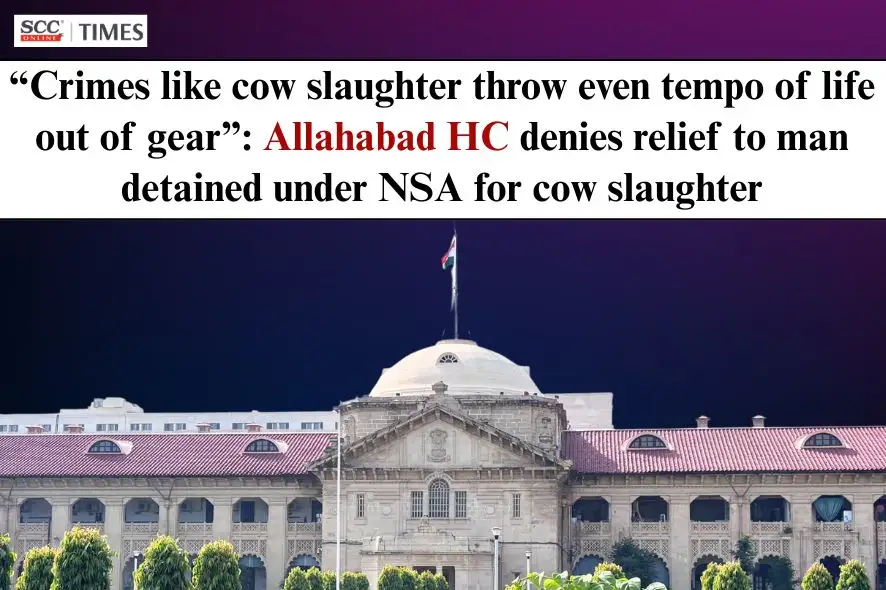
Allahabad High Court: In a habeas corpus petition filed by a man detained for cow slaughter, the Division Bench of J.J. Munir* and Sanjiv Kumar, JJ., dismissed the petition, holding that there was no infirmity in the impugned order. The Court also stated that crimes like cow slaughter evoke strong emotions and violent reactions for obvious injury to the religious beliefs of a large section of society. It has immediate and widespread ramifications in society, almost always leading to widespread violence that throws even the tempo of life out of gear. The Court observed that,
“There are some issues, where the community is sensitive to the extent that if they surface, there is an inherent potentiality of creating widespread ripples in society that would affect the even tempo of life. One of them is cow slaughter. The slaughtering of a cow, whenever reported or detected, spontaneously evokes strong emotions and violent reactions for obvious injury to religious beliefs of a large section of the society.”
Background
A police party was on routine inspection when they found remains of cows’ progeny in a field, including 11 dismembered feet, four tails, parts of the head, and skin. The police called a Veterinary Medical Officer, who identified the remains as cows’ progeny. Subsequently, an FIR was registered under Sections 3 and 8, Uttar Pradesh Prevention of Cow Slaughter Act, 1956 (U.P. Cow Slaughter Act). The police noted in the FIR that the incident led to unrest among the Hindu population due to it happening around Holi.
A crowd gathered at the place of occurrence, which was livid about the incident and included representatives of various organisations, such as the Rashtriya Bajrang Dal, the Pashchimi Uttar Pradesh Sanyukt Udyog Vyapar Mandal, the Shiv Sena Mandal Saharanpur Unit, and the Akhil Bharatiya Pradhan Sangthan. Members of these organisations were shouting slogans and demanding the immediate arrest of the offenders responsible for the crime. This crowd blockaded the Jhinjhana-Thana Bhawan Road, leading to a long queue of vehicles on both sides of the blockade. This jamming of the road on account of the blockade lasted for long hours, in consequence of which public order in the area was torn asunder. Police had to pacify the crowd and surveil the villages to ensure the reinstatement of law and order.
Thereafter, the investigating officer discovered that there were five accused involved in the incident, including the accused herein, and they were arrested for slaughtering and selling cows. The present accused, 20 years old, was arrested with an illicit knife; hence, he was charged with Sections 4 and 25, Arms Act, 1959, as well.
The District Magistrate passed a detention order under Section 3(3) read with Section 3(2), National Security Act, 1980 (NSA), directing the accused herein to be detained in District Jail, Muzaffar Nagar. Since his representation against his detention to the Advisory Board was rejected, the State Government, in exercise of its powers under Section 12(1), confirmed the detention order, directing the accused to be detained for a year with effect from 15 May 2025.
Aggrieved, he filed the present habeas corpus writ petition.
Analysis
1. Detention order made without application of mind
At the outset, the Court stated that there was copious consideration of not only the crime disclosed in the FIR, but the circumstances of the occurrence and its impact in the local community, where the offence was committed, vis-à-vis the issue of public order.
The Court added that it was not a case where there was a mechanical recital of the fact alone that the offence constitutes a violation of public order, but shows due application of mind to the offence and its impact in the locality on the maintenance of public order. It was also not the case that the detaining authority (DA) proceeded to pass the detention order without application of mind to the requirements of the law; the DA held it to be an act that vitiated public order. The DA remarked, based on material before it, that it was subjectively satisfied that the accused was attempting to secure his release on bail and there was a likelihood of his being released on bail. The material further showed that the accused intended to repeat the offence by capturing stray cows, which, if done, would again lead to the public order being prejudicially affected.
Thus, the Court rejected this ground, holding that all these features, which are mentioned in the grounds of detention, made it evident that this was not a case where the order of detention was passed without application of mind.
2. The incident was merely a violation of law and order and did not require the invocation of the NSA
The Court stated that in the genesis of every infraction of the public order or its vitiation, there is some crime punishable by law, which can always be termed as a violation of law and order. The violation of law and order is to be punished in accordance with law after prosecuting the offender, but this does not mean that every infraction of the law and order, that spins out of its trouble spot and widely affects the even tempo of life, is to be regarded as a violation of law and order alone.
“Whether a violation of the law and order would be just that and no more or have a cascading effect, unsettling the even tempo of life in the locale, or even far and wide, is dependent upon the circumstances, the time, the place, and the situation, where the infraction is committed.”
In this regard, the Court referred to Ram Manohar Lohia v. State of Bihar, 1965 SCC OnLine SC 9, as well as Arun Ghosh v. State of W.B., (1970) 1 SCC 98, where the concept of public order, as distinguished from law and order, was eloquently explained.
The Court remarked, “There are some issues, where the community is sensitive to the extent that if they surface, there is an inherent potentiality of creating widespread ripples in society that would affect the even tempo of life. One of them is cow slaughter. The slaughtering of a cow, whenever reported or detected, spontaneously evokes strong emotions and violent reactions for obvious injury to the religious beliefs of a large section of society.”
The Court added that history was replete with instances of profusion of emotions and violence that an incident of this kind entails. Violent reactions against cow slaughter are so well-reputed that no one can feign ignorance of the fact, regardless of the law apart. Thus, the particular act of slaughtering a cow has immediate and widespread ramifications in society, almost always leading to widespread violence that takes a toll on a tranquil society and throws life out of gear.
“Public order is, after all, not about what the intention of the individual was, or what law he has violated. It is about the impact that his act generates. If the act in question is such that it is not confined to one, two, or a few individuals, but disturbs the even tempo of life in the locale or may be beyond, in larger areas, prejudiced to public order, it is certainly there.”
Furthermore, the Court referred to Shaukat Ali v. Union of India, 2002 SCC OnLine All 1435, and Guddu Panchhi v. District Magistrate, Kanpur Nagar, 2004 SCC OnLine All 1847, to illustrate that there are a series of decisions which acknowledge the fact that cow slaughter foments communal tension, brings disharmony, and results in a situation that leads to disturbance of public order. The Court also referred to Wasi v. State of U.P., 2017 SCC OnLine All 1880, regarding the offence of cow slaughter and its bearing on the disturbance of public order.
On the facts of the case, the Court noted that the incident had an impact on not just the affected village but also 11 adjoining villages as there was a pubic blockade and a complete traffic jam. The even tempo of life was thrown out of gear, necessitating the summoning of additional forces from adjoining police stations. The Court further noted that it was after very sensitive and trained persuasions by officers of the police that public order could be restored. The locals of the village and adjoining villages had to be assured about their safety and security, as well as that of their animals.
The Court stated that it is the disturbing effect of an incident on a serene and tranquil life that determines if it is indeed a violation of public order or a mere breach of law and order. It is not necessary that there should be actual violence, loss of human life, and property before an incident can be termed as a disturbance of public order. It is a disturbance of the daily and ordinary movements of life in the locale, which are the index of the vitiation of public order.
Thus, the Court held that this was a case where public order was prejudicially affected in consequence of the offence committed by the accused.
3. No objective material to show that the accused would again indulge in the same offence if enlarged on bail
The Court stated that the question involved here was part of a wider principle, which related to preventive detention of persons, already in jail, in connection with the crime that had given rise to the preventive detention order or some other crime. In this regard, the Court relied on Kamarunnissa v. Union of India, (1991) 1 SCC 128, wherein the Court laid down the principles for subjective satisfaction of the detaining authority for preventive detention of a man already in jail. The Court stated that the aforesaid principles applied to the present case since it was not seriously disputed or urged that the DA was unaware that the accused was actually in custody.
The Court noted that in the grounds of detention, it was mentioned that two Head Constables registered a complaint that while in jail, the accused had sent information through persons close to him that he was about to be released on bail by the Court, and upon being set free, he would indulge in cow slaughter, and the police could not harm him. This information was investigated by a Sub-Inspector and found to be true. There was also a report dated 29 April 2025, given by the Local Intelligence Unit, which affirmed the fact that the constables had reported the information.
Noting the aforesaid, the Court stated that this was certainly reliable material based on which the DA could form subjective satisfaction that the accused, if released on bail, would in all probability indulge in the activity prejudicial to the maintenance of public order.
The Court remarked that the offence committed by the accused was not an offence of the ordinary violent kind that affected the life of one individual or a group of them, unconcerned with the stable life of the community, which would go on unruffled by his actions. He had committed an act that aroused public outrage amongst a large section of the population in the area, whose religious feelings were hurt. This kind of an offence, if repeated again, about which the DA had material to believe that it could be committed by the accused upon his release, would certainly imperil the even tempo of life of the locality and public order.
The Court stated that the offence committed by the accused produces almost spontaneous violence and resentment from one section of the community, and, therefore, the DA was absolutely justified in thinking that the accused could repeat it upon his release.
Thus, the Court rejected this contention as well.
4. Inordinate delay in the decision of his representations by the State Government and the Advisory Board, which vitiated his detention
Noting the timelines of events, the Court stated that the accused did not point out where the unexplained delay occurred, which might vitiate the detention order.
Decision
Accordingly, the Court dismissed the petition, holding that there was no infirmity in the impugned order.
[Sameer v. State of U.P., 2026 SCC OnLine All 2898, decided on 16-4-2026]
*Judgment authored by: Justice J.J. Munir
Advocates who appeared in this case:
For the petitioner: Brijesh Kumar Yadava, Narendra Kumar
For the respondent: Manish Pandey, G.A. Deepak Mishra