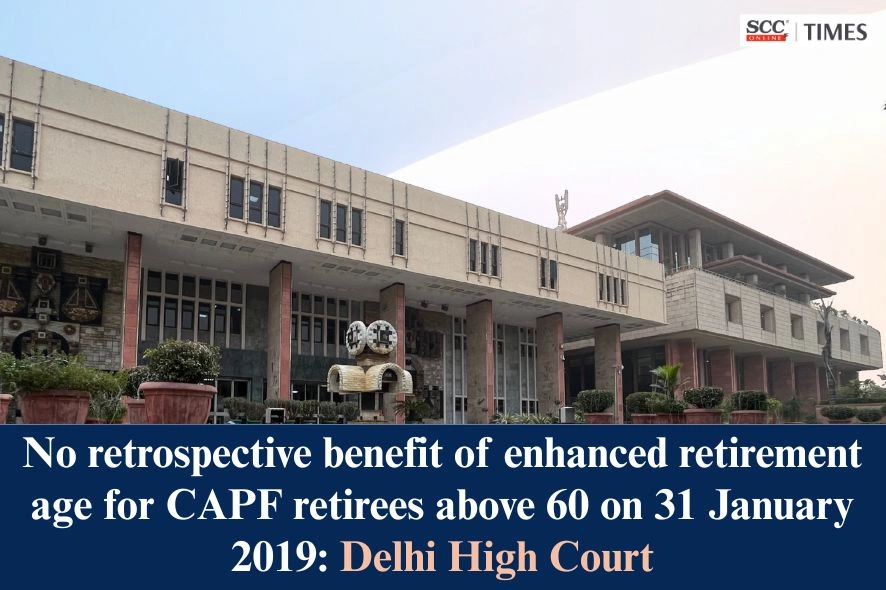
Delhi High Court: In a batch of writ petitions and review petitions concerning the entitlement of Central Armed Police Forces (CAPF) personnel to consequential pensionary benefits pursuant to enhancement of the age of superannuation, a Division Bench of Anil Kshetarpal* and Amit Mahajan, JJ., held that such benefits could not be extended to personnel who had already crossed the age of 60 years as on 31 January 2019. The Court clarified that while the benefit flowing from Dev Sharma v. Indo-Tibetan Border Police 2019 SCC OnLine Del 6797, was not confined to the original petitioners and could extend to similarly situated personnel, the same was subject to the condition that such personnel had not crossed the age of 60 years as on the cut-off date.
The Court further observed that the petitioners, having retired prior to 2016 and having crossed the age of 60 years before 31 January 2019, were not entitled to continuation in service or consequential monetary benefits. Emphasising the doctrine of “no work, no pay” and settled principles of service jurisprudence, the Court held that enhancement of the retirement age does not confer retrospective financial benefits in the absence of actual service. Accordingly, finding no merit in the claims, the Court dismissed the writ petitions and review petitions and declined to grant any relief arising from the judgment in Dev Sharma case or the Office Order dated 19 August 2019.
Background
The present batch of writ petitions and review petitions arises from a common grievance concerning the entitlement of personnel of the CAPF, including the Border Security Force (BSF), Central Reserve Police Force (CRPF), Indo-Tibetan Border Police (ITBP) and Sashastra Seema Bal (SSB), who retired between 2011 and 2016, to consequential pensionary benefits pursuant to the enhancement of the age of superannuation from 57 to 60 years.
The controversy has its genesis in the disparity in retirement ages within CAPF, whereby personnel up to the rank of Commandant were required to retire at 57 years under Rule 43(a), CRPF Rules, 1955 and analogous provisions, whereas officers above that rank continued till 60 years. In contrast, forces such as the Assam Rifles and Central Industrial Security Force (CISF) had a uniform retirement age of 60 years across all ranks. This led to the institution of multiple writ petitions from 2012 onwards, the lead matter being Dev Sharma v. Indo-Tibetan Border Police1, during the pendency of which several petitioners had already superannuated at 57 years.
By judgment dated 31 January 2019, the Court held that prescribing differential retirement ages within the same force was violative of Article 14 and struck down the relevant provisions, directing the prescription of a uniform retirement age. In compliance, the Ministry of Home Affairs issued an Office Order dated 19 August 2019 fixing the age of superannuation at 60 years for all CAPF personnel, followed by implementation and clarificatory orders. However, by order dated 11 September 2019 and subsequent communications, the benefit of rejoining service or grant of three additional increments was restricted to personnel who had retired between 31 January 2019 and 19 August 2019, while those who had retired earlier were denied such benefits and their pensions were regulated accordingly. Representations submitted by earlier retirees seeking notional service benefits and revision of pension were rejected through communications including those dated 29 November 2019. Aggrieved thereby, and alleging discrimination amongst similarly situated pensioners, the petitioners instituted the present proceedings seeking extension of consequential retiral and pensionary benefits on parity.
Analysis
The Court, in the present batch of writ and review petitions, examined whether personnel of the CAPF who were not parties to the earlier decision in Dev Sharma case could nonetheless claim extension of benefits arising from enhancement of the age of superannuation on the ground of parity. Addressing this issue, the Court placed reliance on its subsequent rulings in Bharat Singh v. Union of India 2019 SCC OnLine Del 12201, and Rajender Singh v. Union of India 2021 SCC OnLine Del 2911, which had clarified and circumscribed the scope of relief flowing from Dev Sharma. It reiterated that while the benefit of the judgment was not confined to the original petitioners and could extend to similarly situated personnel, such extension was subject to a crucial limitation—only those who had retired prior to 31 January 2019 and had not crossed the age of 60 years as on that date would be eligible for consequential benefits. Those who had already crossed 60 years as on the cut-off date stood excluded.
On facts, the Court noted that the present petitioners had retired on or before 2016 and had admittedly crossed the age of 60 years prior to 31 January 2019. Their claims, therefore, were squarely covered by the ratio laid down in Rajender Singh case, disentitling them from seeking continuation in service or any consequential monetary benefits. The Court further invoked the settled principle of “no work, no pay”, observing that service benefits, including salary and pensionary advantages, are ordinarily contingent upon actual discharge of duties. It held that mere enhancement of the retirement age does not operate retrospectively to confer financial benefits upon those who had already retired and rendered no service during the extended period.
The Court also underscored that the petitioners had accepted their retirement at the relevant time and had neither challenged the same nor sought continuation in service when the issue was pending adjudication. In such circumstances, permitting notional continuation or grant of financial benefits would amount to conferring advantages without corresponding service, contrary to settled principles of service jurisprudence. Holding that the issue stood concluded by binding coordinate Bench decisions, the Court found no merit in the present petitions.
Decision
Accordingly, it held that the petitioners were not entitled to any benefit arising from the judgment in Dev Sharma case or the subsequent Office Order dated 19 August 2019. The writ petitions and review petitions were therefore dismissed, with all pending applications disposed of.
[Charanjit Lal v. Union of India, 2026 SCC OnLine Del 1755, decided on 15-4-2026]
*Judgment authored by: Justice Anil Kshetarpal
For the Petitioner: Shanker Raju, Sanjiv Kumar Saxena, Ramneek Mishra, Mukesh Kumar Tiwari, Vijay Kumar, Vidhik Kumar, Advocates and Nishant Mankoo, Advocate through V.C.
For the Respondent: Satya Ranjan Swain, CGSC, Farman Ali, CGSC, Amit Tiwari, CGSC, Meeraj, CGSC, Ripudaman Bhardwaj, CGSC, N K Aggarwal, Senior Panel Counsel, Amit Kumar Rana, Usha Jamnal, Kautilya Birat, Ayushi Srivastava, Ayush Tanwar, Arpan Narwal, Kushagra Malik, Ujjwal Tyagi, with Soumyadip Chakraborty, Advocates, Ajay Pal, Law Officer with Insp Athurv, Ramniwas Yadav CRPF.
1. W.P.(C) 1951 of 2012.