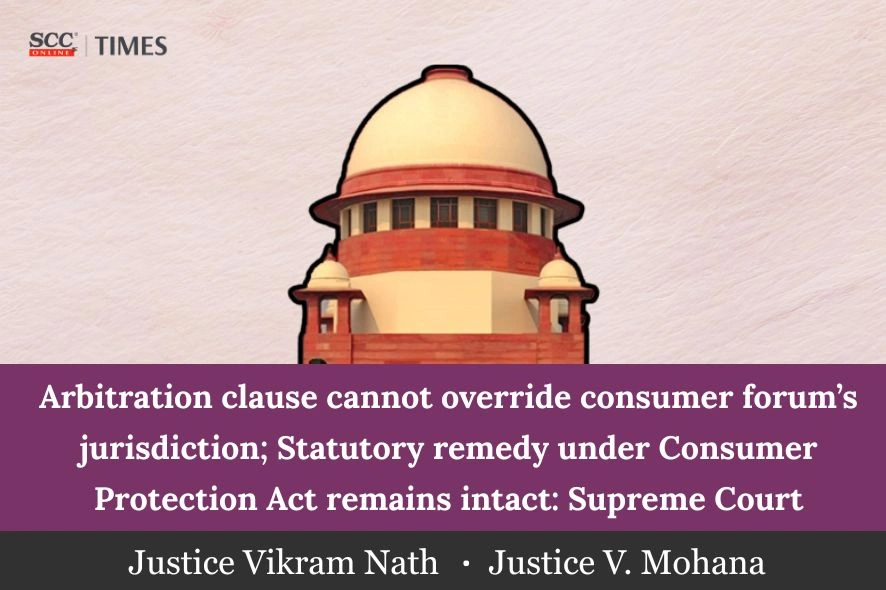
Supreme Court: In a civil appeal arising from a dispute concerning delayed delivery of a residential flat, the Division Bench of Vikram Nath* and V. Mohana, JJ. held that the existence of an arbitration clause in an agreement does not oust the jurisdiction of consumer fora under the Consumer Protection Act, 1986. The Court reiterated that consumer remedies are statutory, additional, and independent of other remedies available under law. The Bench further held that once a consumer complaint has been admitted, it cannot be transferred to arbitration or any other forum by virtue of the proviso to Section 12(4), Consumer Protection Act, 1986. Clarifying the scope of the term “consumer”, the Court ruled that an allottee does not lose the right to seek compensation for delayed possession merely because possession of the flat has subsequently been delivered. Consequently, the Court set aside the orders of the consumer fora below and restored the complaint for adjudication on merits.
Background
The appellant became a member of the respondent housing society in January 2003 and paid the full consideration amount for the allotment of a flat. Subsequently, Flat No. 232 was allotted to him, and an agreement was executed between the parties on 27 February 2004. Alleging that there was an unreasonable delay in handing over possession of the flat, the appellant filed a consumer complaint before the District Consumer Forum, New Delhi, on 8 August 2005, seeking compensation for deficiency in service. In response, the respondent society invoked Section 8, Arbitration and Conciliation Act, 1996, contending that the dispute should be referred to arbitration in accordance with the arbitration clause contained in the agreement. Although the District Forum initially rejected the application, holding that the remedy under the Consumer Protection Act, 1986 was an additional remedy and not barred by the arbitration agreement, the matter was remanded by the Delhi High Court for reconsideration. Upon reconsideration, the District Forum referred the dispute to arbitration. This decision was subsequently affirmed by both the State Consumer Commission and the National Consumer Disputes Redressal Commission (NCDRC). Additionally, the NCDRC held that the appellant could not be regarded as a “consumer” because he had already taken possession of the flat. Aggrieved by these findings and the referral of his complaint to arbitration without adjudication on merits, the appellant approached the Supreme Court by way of the present appeal.
Issue
Whether a consumer complaint could be referred to arbitration solely because the parties had entered into an arbitration agreement, whether an admitted consumer complaint could be transferred to another forum in light of the provisions of the Consumer Protection Act, 1986, and whether a person who had taken possession of a flat could still maintain a claim for compensation arising from delayed possession.
Analysis and Decision
The Court examined Sections 2(1)(d), (o), 3, and 12(4), Consumer Protection Act, 1986. The Court emphasised that the Act is a beneficial legislation enacted to provide consumers with a simple, speedy, and inexpensive remedy. Referring to Section 3, the Court reiterated that the remedies available under the Act are in addition to and not in derogation of remedies available under any other law. Consequently, the existence of an arbitration clause does not automatically oust the jurisdiction of consumer fora.
“The fact that the agreement between the parties contained an arbitration clause could not, by itself, be treated as sufficient to non-suit the appellant before the consumer forum.”
The Court relied upon several earlier decisions, including Fair Air Engineers (P) Ltd. v. N.K. Modi, (1996) 6 SCC 385, Thirumurugan Coop. Agricultural Credit Society v. M. Lalitha, (2004) 1 SCC 305, National Seeds Corpn. Ltd. v. M. Madhusudhan Reddy, (2012) 2 SCC 506, and Emaar MGF Land Ltd. v. Aftab Singh, (2019) 12 SCC 751 all of which affirmed that consumer fora retain jurisdiction despite the existence of arbitration agreements.
The Court also placed significant reliance on the proviso to Section 12(4), Consumer Protection Act, 1986, which provides that once a complaint has been admitted by the Consumer Forum, it shall not be transferred to any other court, tribunal, or authority established under any other law. According to the Court, this provision reflects a legislative intention to ensure that consumers are not deprived of the statutory remedy available under the Act after validly invoking the jurisdiction of the consumer forum. A private contractual arrangement, such as an arbitration clause, cannot override a statutory right created by Parliament.
“Existence of an alternative forum or mode of adjudication does not, by itself, exclude the jurisdiction of consumer fora.”
The Court further held that the National Commission had erred in concluding that the appellant ceased to be a consumer merely because possession of the flat had been delivered. The Court observed that the appellant’s complaint was not for possession itself but for compensation arising from the alleged delay in delivering possession. The subsequent receipt of possession could not extinguish the appellant’s right to seek compensation for an earlier deficiency in service. Questions relating to the existence of delay, responsibility for the delay, waiver, acceptance of possession, and entitlement to compensation were factual matters requiring adjudication on merits and could not be dismissed at the threshold.
Accordingly, the Court allowed the appeal and set aside the orders of the District Forum, State Commission, and National Commission. The Court restored the consumer complaint and directed that it be placed before the District Consumer Disputes Redressal Commission, Dwarka, for adjudication on merits after providing both parties an opportunity to lead evidence. Considering that the complaint had been pending since 2005, the Court directed the Commission to make every effort to dispose of the matter within 1 year.
[T.K.A. Padmanabhan v. Abhiyan Coop. Group Housing Society Ltd., 2026 SCC OnLine SC 1160, decided on 4-6-2026]
Judgment Authored by: Justice Vikram Nath
Advocates who appeared in this case:
For Appellant(s): Petitioner-in-person
For Respondent(s): Mr. Chandrachur Bhattacharyya, Adv. Mr. Sahil Tagotra, AOR Ms. Shreya Kasera