At Legal Tech Talk 2026, a panel discussion titled “Creating Strategic Advantage as AI Becomes Mainstream” explored how organisations are approaching artificial intelligence and innovation in legal practice. Moderated by Mr. Dan Hauck, Chief Product Officer at NetDocuments, the session featured Ms. Christel Aguila, Partner and Director of IT at Winckworth Sherwood. Set against the broader theme, The Intersection of Law & Technology: Turning Innovation into Advantage, the discussion focused on practical experiences of technology adoption and the use of AI in legal practice.
Innovation beyond technology
Opening the discussion, Mr. Hauck invited Ms. Aguila to reflect on how the AI conversation fits within broader approaches to innovation and asked how she thinks about it today and what organisations are doing on a day-to-day basis.

Responding to the question, Ms. Aguila observed that the current landscape is fast-paced and relentless and admitted that, from the perspective of an IT director, it can also be quite daunting. Reflecting on developments over the last two decades, she remarked that innovation has always been important because it differentiates firms and businesses. However, she observed that innovation is shifting from building new technologies towards building new capabilities and delivering them faster and more intelligently than competitors.
Turning to AI, Ms. Aguila observed that artificial intelligence is no longer a luxury as access to frontier models has become more widespread and remarked that lawyers are already experimenting with these tools. Reflecting on the experience of medium-sized firms, she observed that they have often watched larger firms adopt or pilot new technologies while deciding whether those tools are suitable for their own practices.
Returning to the subject of innovation, Ms. Aguila observed that innovation for her organisation is never about the technology but always boils down to the problem. Reflecting on conversations with lawyers, she remarked that she always returns to questions such as what the problem is, why a particular course of action is being pursued and how the situation arose in the first place, observing that many innovative solutions emerge from practical problems or chaotic workflows.
Illustrating the point, Ms. Aguila referred to a significant project undertaken by her firm after someone suggested that a particular process could simply be addressed through AI. She observed that, while sophisticated tools are available, it is important to step back and break down the relevant processes by looking at the various tasks and components involved. According to Ms. Aguila, one part of a workflow may involve integrating document management systems, practice management systems and client data, while other parts may involve local automation rather than artificial intelligence. Reflecting on that particular project, she observed that AI could be used for one component but that the overall solution involved a combination of different approaches.
Reflecting on day-to-day practice, Ms. Aguila remarked that, from her perspective, it is all about friction reduction and observed that the fewer clicks lawyers have to make, the better. Looking ahead, she suggested that an agentic environment might allow many processes to happen in the background while acknowledging that there is still much to think about and prepare before reaching that stage.
Solving client problems through innovation
Turning to a practical example, Mr. Hauck referred to an earlier conversation with Ms. Aguila about a competitive tender and observed that, while many participants focused on AI and different tools, her approach remained focused on the actual outcome. He invited her to elaborate on that experience.

Responding, Ms. Aguila recalled that a legal team approached her after being invited to participate in a competitive tender where they were expected to present on innovation. She remarked that the team was uncertain about what to present and observed that many competitors would likely focus on well-known AI products and technologies.
Reflecting on her advice to the team, Ms. Aguila remarked that she asked them to think about their long-standing relationship with the client and identify the biggest stumbling blocks and challenges they faced. Returning to what she described as the basics, she observed that the starting point should always be the problem itself.
According to Ms. Aguila, one of the firm’s senior lawyers identified a significant issue involving twenty years of information stored within the firm’s document management system. She remarked that retrieving information could be difficult because documents had been migrated across different systems, including SharePoint and successive document management platforms, with many records inadequately classified or tagged.
Joining the discussion, Mr. Hauck observed that many such records simply end up being categorised as “Admin” or “Miscellaneous”. Agreeing with the observation, Ms. Aguila remarked that people often choose the default option simply to ensure that documents are filed.
Reflecting on the solution, Ms. Aguila observed that, because the client used SharePoint, the firm developed a self-service SharePoint solution. She remarked that retrieving and organising the relevant information required considerable effort and observed that semantic search capabilities would have made the exercise easier had they been available at the time.
According to Ms. Aguila, the project involved organising and tagging a substantial amount of information, including hundreds of folders classified by geographical location. Reflecting on the outcome, she remarked that the solution received the highest score in the tender process because of the value delivered to the client.
Continuing the discussion, Ms. Aguila observed that lawyers should consider what value a solution delivers to the client and remarked that the technology itself is secondary. According to her, organisations should first identify the problem they are trying to solve and then determine the appropriate technology, observing that the eventual solution may involve a combination of different approaches.
Reflecting further on the presentation, Ms. Aguila remarked that, although the firm discussed AI capabilities available within its document management system, artificial intelligence did not form part of the actual solution delivered to the client. She observed that the discussion was not about the technology itself but about what organisations do with technology and why they are using it.
Building the right foundation for AI
Building on that example, Mr. Hauck observed that, although AI was not part of the immediate solution, future use of AI depends upon being able to locate the right information and understand the relevant documents in context. Referring to rich metadata and document management systems, he observed that organisations increasingly want to retrieve information with a high degree of confidence and invited Ms. Aguila to reflect on how that foundation can be established.

Before addressing the question directly, Ms. Aguila referred to a discussion at a partners’ meeting where she had been asked whether it really mattered if a document management system was disorganised and whether AI was sufficiently sophisticated to locate the right information regardless of the underlying data.
Responding to that suggestion, Ms. Aguila remarked that the familiar IT principle of “garbage in, garbage out” continues to apply. She observed that organisations cannot simply place AI over tens of millions of documents and expect it to produce the right answer, remarking that AI remains probabilistic and should not be expected to provide complete accuracy.
Turning to the practical realities of document management, Ms. Aguila observed that where matter workspaces contain obsolete or duplicated draft documents, cleaner and better organised information will produce better results.
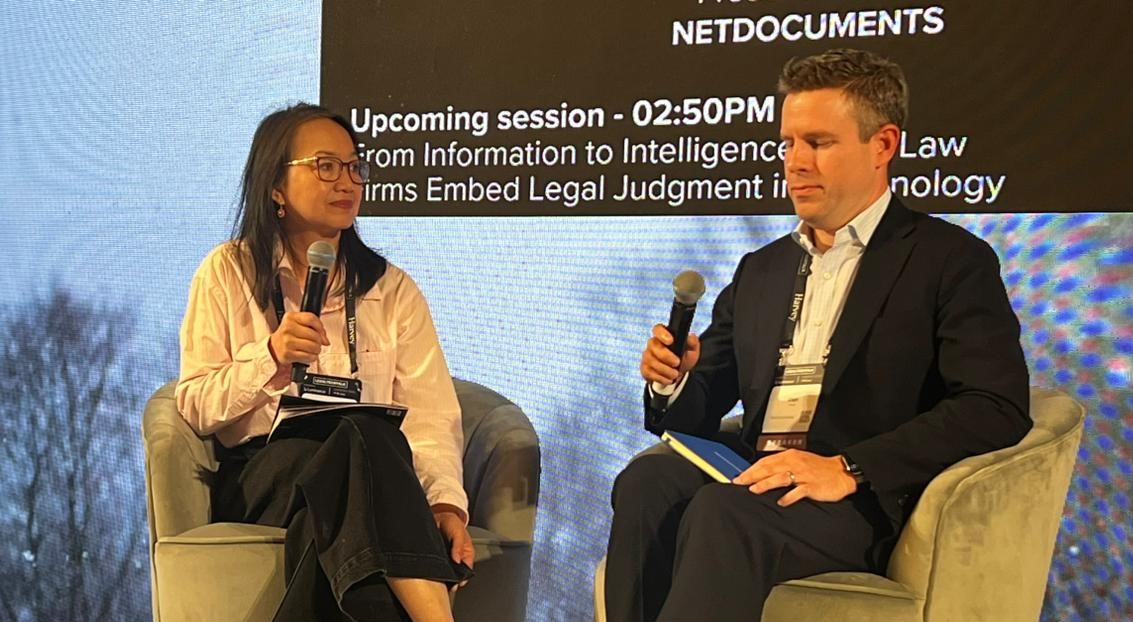
Reflecting on the same issue, Mr. Hauck remarked that he had previously debated whether increasingly sophisticated search technology would reduce the need for structured data. Looking back on that discussion, he observed that practical experience had demonstrated the continuing importance of rich metadata and organised information, remarking that structured data helps direct AI systems towards the appropriate information.
Conclusion
Throughout the discussion, Mr. Hauck and Ms. Aguila reflected on practical experiences of technology adoption and the use of artificial intelligence in legal practice. Returning to a number of recurring themes, Ms. Aguila emphasised the importance of understanding the problem to be addressed before selecting a technological solution and observed that AI may form only one part of a broader process. The discussion also touched upon the practical challenges of managing information and the role of organised data in supporting the use of technology.

The session concluded with an interactive question-and-answer session, during which participants engaged with the speakers on various issues discussed during the panel.
Read More LTT 2026 Coverage:
-
Law Firm Survival in the AI Era: LegalTechTalk 2026 Panel | SCC Times
-
From Information to Intelligence: How Law Firms Embed Judgment in AI | SCC Times
-
Legal Tech Talk 2026: How to Become a Tech-Powered General Counsel | SCC Times
-
How AI is rewiring the in-house legal function: Key takeaways from LegalTechTalk 2026| SCC Times
-
NASA’s Lessons for Law Firms: John Saiz Keynotes LegalTechTalk 2026 | SCC Times