Artificial Intelligence
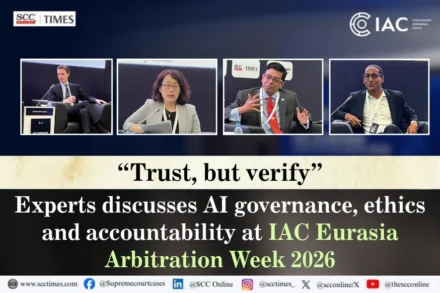
“Trust, but verify”: Experts discusses AI governance, ethics and accountability at IAC Eurasia Arbitration Week 2026
The panel examined the evolving role of artificial intelligence in arbitration, discussing its practical applications, ethical boundaries and the principles that should guide its responsible use.
Fundamental Right to Walk on Footpath, Homemaker’s Unpaid Work and Five New Judges: Supreme Court June 2026 Roundup
Explore Supreme Court judgments from June 2026 covering defining decisions on recognition of a homemaker’s unpaid work, fundamental right to walk, EWS reservation in private colleges etc., and legal developments on appointment of judges, draft AI Regulations and many more stories.
Public Figures Must Tolerate Political Satire, But Not Vulgar AI Deepfakes That Cross the Line Into Defamation; Delhi HC Partly Allows Raghav Chadha’s Defamation Suit
The Court reiterated that “a public figure should not be so thin-skinned so as to complain about any criticism of his decisions and such criticism ought to be viewed with humility”.
Litigation Is sexy now, haven’t you heard?: LegalTechTalk 2026 Panel discusses technology, access to justice and wellbeing in litigation
The panel brought together perspectives from social impact litigation, litigation support services and legal leadership to discuss contemporary developments in litigation. The speakers reflected on technology’s growing role in litigation practice, questions of accessibility and inequality in the use of AI tools, and the importance of wellbeing, leadership and organisational culture within legal teams.
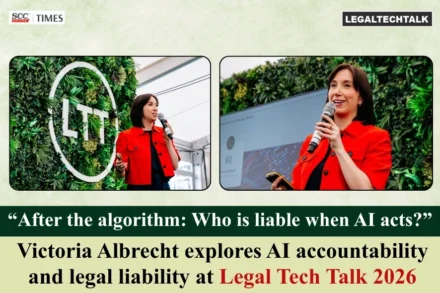
“After the algorithm: Who is liable when AI acts?”: Victoria Albrecht explores AI accountability and legal liability at Legal Tech Talk 2026
At Legal Tech Talk 2026, Ms. Victoria Albrecht examined the accountability challenges arising from autonomous AI systems, discussing questions of personhood, liability, governance, human oversight, attribution frameworks, and AI literacy in legal practice.
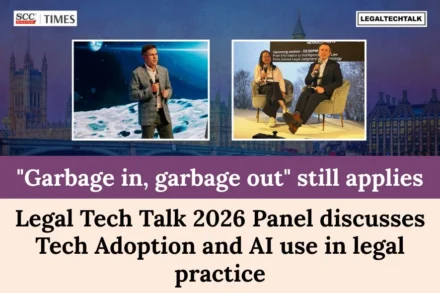
“Garbage in, garbage out” still applies: Legal Tech Talk 2026 Panel discusses Tech Adoption and AI use in legal practice
At Legal Tech Talk 2026, Christel Aguila and Dan Hauck discussed practical approaches to technology adoption and AI in legal practice, focusing on solving client problems, selecting appropriate technology, and the role of structured information in supporting AI tools.
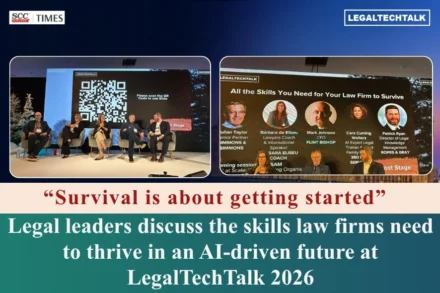
“Survival is about getting started”: Legal leaders discuss the skills law firms need to thrive in an AI-driven future at LegalTechTalk 2026
As artificial intelligence reshapes legal practice, industry leaders at LegalTechTalk 2026 examined why commercial awareness, adaptability, client-centricity, and sound judgement may prove just as important as technological proficiency for the future of law firms.
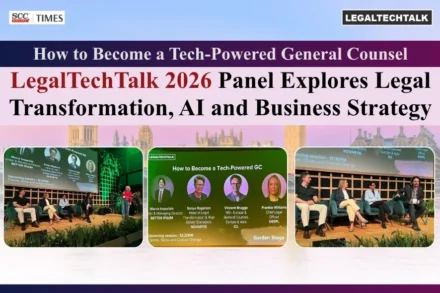
How to Become a Tech-Powered General Counsel: LegalTechTalk 2026 Panel Explores Legal Transformation, AI and Business Strategy
At LegalTechTalk 2026, industry leaders discussed the distinction between legal transformation and business transformation, why technology acquisition alone does not constitute change, and how General Counsel can shape business decisions rather than simply respond to them.
‘Two Nations, One Legal Future’: Panellists Debate Enforcement, BCI Rules on Foreign Lawyers, Mediation and AI at GCAI Conference on India-UK Dispute Resolution
From the opacity of Bar Council rules on foreign lawyers to enforcement gaps and AI’s irreducibly human element, six practitioners discussed what it will take for the India-UK dispute resolution corridor to fulfil its potential.
‘It Is a Great Tool, Not a Master’: Legal Leaders Debate AI’s Growing Influence on the Legal Profession
Artificial intelligence is making lawyers faster, research more accessible and legal services more efficient. But as AI systems become increasingly sophisticated, legal practitioners are confronting a more difficult question: how can the profession embrace technological transformation without surrendering the human judgment, ethics and accountability that lie at the heart of legal practice?
Who Owns the Risk When AI Gets It Wrong? Confidentiality, Governance and Human Judgment at LIDW 2026
From privilege and disclosure risks to AI-assisted arbitrators and the future of legal practice, the second half of this LIDW 2026 discussion explores the governance challenges that will shape the next chapter of international arbitration.
Why Lawyers Keep Getting AI Wrong and Why Human Judgment Still Matters: Insights from LIDW 2026
From fabricated citations to autonomous AI agents, the arbitration community is confronting a new reality. At LIDW 2026, experts debated whether AI is a revolutionary tool for dispute resolution or a risk that demands greater human oversight.
Verify Before You File: UK High Court on AI Hallucinations, Unverified Submissions and Solicitors’ Duty to the Court
The UK High Court observed that while AI can assist, it is an unreliable tool and cannot replace proper research, careful thought, and professional judgment, even for junior lawyers.
Artificial Intelligence (Ethics and Accountability) Bill 2025: Key Provisions, Need & Impact
Artificial Intelligence (Ethics and Accountability) Bill, 2025 introduces a robust framework to ensure ethical AI use in India. It addresses challenges like algorithmic bias, misuse of surveillance, and lack of transparency by establishing an independent Ethics Committee, enforcing strict compliance standards, and prescribing penalties for violations.
Fourth IBA India Litigation and ADR Symposium (Day 2): Spotlight on Emerging Intellectual Property and AI Issues
The session explored how artificial intelligence is reshaping intellectual property law, from data-scraping and authorship debates to personality rights and deepfake misuse. The discussion underscored the need for clearer safeguards, transparency obligations and balanced governance frameworks as AI accelerates real-world disputes.
SCC Online signs an MOU with Data Security Council of India
SCC Online has officially signed a Memorandum of Understanding (MoU) with the Data Security Council of India to collaborate on cybersecurity, data protection, competition, AI and emerging technologies.
Call for Blogs | MNLU Mumbai’s CICTL Invites Submissions for Blog on Technology Law (CBTL)
The theme shall be related to Data Protection, Artificial Intelligence, Fintech, Cybersecurity, and Digital Governance or any theme relevant to the Technology Laws.
Embracing AI in Arbitration: Enhancing Efficiency Without Compromising Justice
by Bhavana Chandak Dhoundiyal* and Shambhavi Upadhyay**