
Inter-faith couple, live-in relationship and Section 376 of IPC: Supreme Court grants bail after 9 months’ jail
Supreme Court also considered the fact that the inter-faith couple had jointly approached the High Court seeking police protection.

Bringing you the Best Analytical Legal News


Supreme Court also considered the fact that the inter-faith couple had jointly approached the High Court seeking police protection.

The Supreme Court clarified that appointments made after the instant judgment would be limited to vacant posts notified under communication of 2006 and could not be extended to vacancies which arose thereafter.

Supreme Court Collegium took note of factors like Seniority, Merit, Integrity, Diversity & Inclusion while recommending the names of Justice Ujjal Bhuyan and Justice S Venkatanarayana Bhatti for elevation.
The allocation of quantities of Raw Pet-Coke (‘RPC’), a residue of the leftover from the refining of petroleum products and sand crude as well as other heavy oils was in issue in the present appeals.
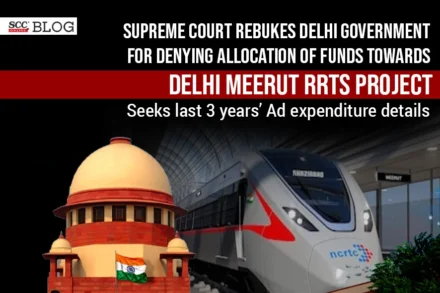
The funds are needed for the construction of a Regional Rapid Transit System that will connect the national capital with Rajasthan and Haryana.

Supreme Court concurred with the Punjab and Haryana High Court that incriminating circumstances were not proved beyond reasonable doubt and chain of evidence was not complete to interfere with a degree of certainty of accused having committed the crime.

The month of June was a vacation month for the Supreme Court. The Vacation Benches, nevertheless, assembled to pass some orders in important and urgent matters. The retiring judges of the Supreme Court also delivered some important judgments. This roundup covers reports on these judgments and orders and some special posts on the Judges, the Never reported Judgments, interesting cases from SCC Archives, and more.

The Supreme Court of India has taken a step ahead on its path towards technological advancement of the institution. All the Advocates,
Merely because a provision is described as a clarification or an explanation, the Court is not bound by the said statement in the statute itself but must proceed to analyse the nature of the amendment.

This report covers the Supreme Court’s Never Reported Judgment dating back to the year 1950 on Hyderabad Limitation Act, 1322 Fasli and Sections 14 and 15 of the Limitation Act, 1908.

Supreme Court commented that “The situation is indeed disquieting, viewed from the perspective of the decree holders, but the law, as it stands, has to be given effect whether the court likes the result or not.”

The Supreme Court directed the Circular to be provided to Supreme Court Bar Association and Supreme Court Advocates-on-Record Association, and further requested them to display it on the Notice Boards for information to the Members of the Bar.

The process of bidding takes place in a situation where large number of people show their willingness to buy a particular product or a service and auction is a process that involves buying and selling goods and services by offering them for bids, taking bids and selling the item to the highest bidder.
Supreme Court reiterated that to examine whether a particular transaction is sale of capital assets or business expense, multiple factors like frequency of trade and volume of trade, nature of transaction over the years etc., are required to be examined.

In August 2021, Justice J.K. Maheshwari became the first Chief Justice from Sikkim High Court to be elevated to the Supreme Court.
In the case at hand, the Delhi High Court had referred the disputes for arbitration without conclusively deciding the issue of the existence and validity of an arbitration agreement and had left it to be decided by the arbitral tribunal.
If the notifications are bad in law and they are liable to be quashed, the subsequent selection procedure that has been undertaken would also suffer from the same vice.

The Supreme Court set aside the Karnataka High Court verdict wherein it was held that the State failed in its obligation to inform the respondent about the existence of the vacancy that has arisen.

The Supreme Court was of the view that the High Court ought to have interfered with the conviction when it found one of the links in circumstantial evidence missing and not proved, respecting the settled law in this regard.
In the case at hand, the Security was a ‘shop’, which was not owned by the surety, but by the Municipal Corporation, Lucknow.