Decoding Section 7 of IB Code for admitting an application for Corporate Insolvency Resolution Process
by Ankit Parhar† and Rashi Srivastava††
Cite as: 2023 SCC OnLine Blog Exp 55

Bringing you the Best Analytical Legal News


by Ankit Parhar† and Rashi Srivastava††
Cite as: 2023 SCC OnLine Blog Exp 55
As the service tax needs to be computed in terms of Rule 2A of the Service Tax (Determination of Value) Rules, 2006 and as the assessee has not opted for the composition scheme, the matter is remitted back to the CESTAT for re-computation of the demands.
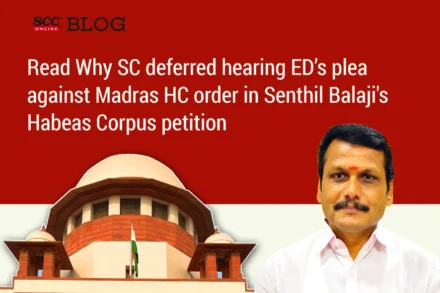
S Megala, wife of V. Senthil Balaji, who has been arrested by the Directorate of Enforcement in a money laundering case, filed a habeas corpus petition, wherein the Madras High Court agreed to an urgent hearing, leading to the present SLP by ED before the Supreme Court.
“The huge and unexplained delay of over 60 years in initiating dispute with regard to the ownership of the land, and the criminal case being lodged only after failure to obtain relief in the civil suits, coupled with denial of relief, reeked of malafide on the part of the complainant.”
This report covers the Supreme Court’s Never Reported Judgment, dating back to the year 1950, on Section 5 of the Electricity Act, 1910.
Supreme Court asked the State Election Commission that why it is concerned with the source of the forces, as its primary concern must be free and fair elections
Supreme Court also reiterated that the grant of sanction is nowhere contemplated under Section 167 of the CrPC.
The Court said that allegations of fraud require special pleadings in terms of Order VI, Rule 4 CPC, 1908.
by Shubham Priyadarshi*
Supreme Court expressed that “We fail to understand as to how the theft could be said to be in any way a deficiency in service by the Railways.”
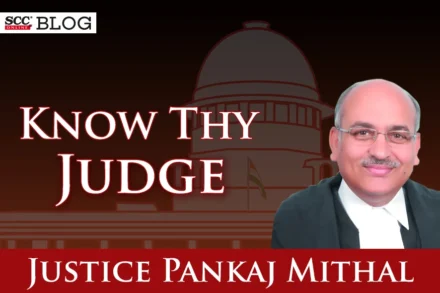
Sitting Judge of the Supreme Court of India, Justice Pankaj Mithal is a third- generation lawyer, a second-generation Judge and is also a writer of note.
The Supreme Court said that it cannot adopt a doctrinaire approach. Some sacrifices have to be always made for the greater good, and unless such sacrifices are prima facie apparent and ex facie harsh and unequitable as to classify as manifestly arbitrary, these would not be interfered with by the court. Thus, no priority can be given to workers’ dues after liquidation of the company under the IBC.
The action came following the Supreme Court’s decision, wherein the Court allowed the appeals arising out of the order for de novo investigation and set aside the directions issued in the original petition for de novo investigation. Further, the Court allowed the ED to continue its investigation.
‘Passenger’ would include a person who has purchased a valid ticket for travelling by a train carrying passengers on any date or a valid platform ticket and becomes a victim of an untoward incident.
The Supreme Court further held that when the actions of a Committee constituted by Cabinet are validated by the Council of Ministers and the rest of the Council, it ensures that the Rules of Business were followed by the State Government in the course of decision-making process.
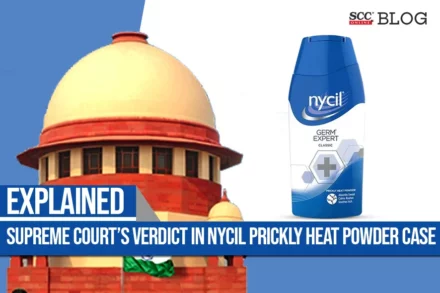
Supreme Court said that the legislative intent was that all kinds of talcum powders, which contained medications irrespective of the proportion, or at any rate, not containing predominant proportions should necessarily be treated as cosmetics, falling under Entry 127.
Following the arrest, Senthil Balaji complained of chest pain and was taken to Government hospital for a medical checkup.
The Delhi Government had come up with a ban on 2-wheeler taxis in the National Capital, which was stayed by the Delhi High Court. In a recent development, the Supreme Court reversed the High Court’s order and brought the stay on bike taxis back.
The main concern of the women lawyers is over shrinking of the space or facilities allocated to them in the Nilgiris court complex.
Supreme Court said that the entry of the appellant over part of the suit property is simply as a licencee of the respondent. He does not continue to occupy it in the capacity of the owner. Thus, the licence having been terminated, he has no right to remain in possession but to restore possession to the person having rightful possessory title over it.