Supreme Court scraps point-based system for senior advocate designations, directs High Courts to revise rules
The Bench directed all the High Courts to amend the existing rules in accordance with the Judgment within four months.

Bringing you the Best Analytical Legal News


The Bench directed all the High Courts to amend the existing rules in accordance with the Judgment within four months.
The Court also held that the auction purchaser was not entitled to either ownership or leasehold rights in respect of the plot and could not claim to be a lessee as the lease in terms of the lease agreement entered into by the DDA was never executed.
“The accused persons had no knowledge that by asking the two employees to work on the sign board as part of the work of decoration of the frontage of the shop, such an act was likely to cause the death of the two deceased employees.”
“Even if the suicide note is taken as correct and genuine, there was no act of incitement on the part of the accused persons proximate to the date on which the deceased committed suicide.”
Supreme Court said that according to the prosecution, the convicts had committed the murder of the deceased. Therefore, it is for the prosecution to connect the convicts to the murder by producing credible and legally admissible evidence.
“When one of the three circumstances was disbelieved and discarded by the High Court, then the chain of circumstantial evidence could not have been held to be complete and proved and on that basis to hold the accused guilty of the offence.”
“The circumstances taken cumulatively must be so complete that there is no escape from the conclusion that, within all human probability, the crime was committed by the accused and none else. While there is no doubt that conviction can be based solely on circumstantial evidence, great care must be taken in evaluating circumstantial evidence.”
“We expected the State to put on record reasons for detaining 270 foreign nationals in the transit camp and details of the steps taken by the State Government for deporting the detenues in the detention camp.”
“No effective legislative or executive action in furtherance of enacting a statute, which could prove to be a boon to millions of vulnerable domestic workers across the country, has been undertaken as of now. Over and above the absence of any legislation protecting their interests, domestic labourers also find themselves excluded from existing labour laws.”
“Section 37 of the 1996 Act grants narrower scope to the appellate court to review the findings in an arbitral award if it has been upheld or substantially upheld under Section 34.”
On 01-06-1958, the Government of India published a notification in the exercise of powers conferred under Section 3(e) of the Mines and Mineral (Regulations and Development) Act, 1957 by which brick earth was declared a minor mineral within the meaning of the 1957 Act.
“If a person sells a property knowing that it does not belong to him, and thereby defrauds the person who purchased the property, the person defrauded, that is, the purchaser, may complain that the vendor committed the fraudulent act of cheating. But a third party who is not the purchaser under the deed may not be able to make such complaint.”
“The power to arrest or detain a foreigner under the Foreigners Act, 1946 is independent of the power of the Criminal Court to grant bail. Notwithstanding the bail granted by a Criminal Court, the power to arrest and detain a foreigner can be exercised, provided the Central Government makes an order in terms of clause (g) of Section 3(2) of the Act.”
“NOIDA (Levy of Infrastructure Fee) Regulations, 1998 came to be enacted only after the Concession Agreement had been executed and were seemingly designed to validate the actions already taken by NTBCL and NOIDA.”
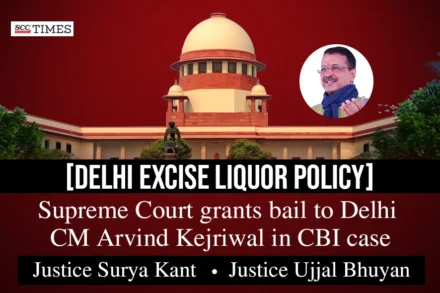
The Delhi excise liquor policy scam involved two parallel investigations by the CBI and the ED regarding irregularities in the formulation and implementation of the excise policy of the Government of the National Capital Territory of Delhi (GNCTD) for the year 2021-2022.
“For a long time, the parties are placing on record black and white photocopies of photographs, mostly which are blurred.”
The High Court advised the female adolescent, to control sexual urge/urges as in the eyes of society she is the looser when she gives in to enjoying the sexual pleasure of hardly two minutes.
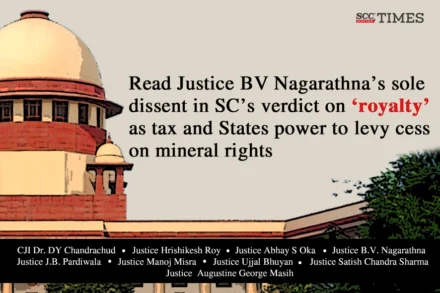
“Royalty is in the nature of a tax or an exaction. It is not merely a contractual payment but a statutory levy under Section 9 of the MMDR Act.”
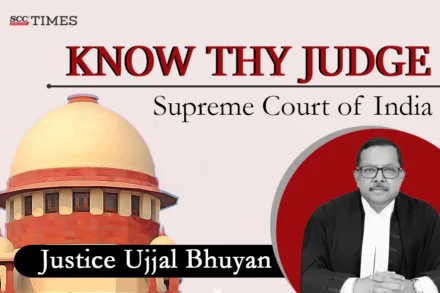
On 05-07-2023, the Supreme Court Collegium had recommended the appointment of Justice Ujjal Bhuyan, Chief Justice, High Court for the State of Telangana to the Supreme Court of India. Upon acceptance of the recommendation by the Law Ministry, Justice Bhuyan took oath as Supreme Court Judge on 14-07-2023.
Supreme Court said that authorizing the Central Government to lay down the terms of mining leases and grant approval to concessions, the MMDR Act seeks to ensure that there is uniformity in the terms for working of mines and extraction of minerals.