Cheque dishonour| Director’s S. 138 NI Act liability subsists despite liquidation of the company: Supreme Court
The Court denied the discharge of the company director in a cheque dishonour case wherein the said company was undergoing liquidation.
The Court clarified that if the Court wants to reject the anticipatory bail, it may do so but the Court has no jurisdiction to say that the petitioner should now surrender.
Upholding NCDRC’s decision holding Canara Bank liable for delayed presentation of cheques, Supreme Court explained that a bank acts as a customer’s agent and is under an obligation to exercise due diligence in presenting the instruments within the prescribed validity period.
“Once a judgement or an order passed by a court in a particular case has attained finality and is not the subject matter of further challenge before a prescribed forum, a subsequent change in the judicial interpretation would not entail a reversal of such decision inter-se the parties to that case.”
The Supreme Court emphasised that freedom of speech does not extend to vilifying communities, with Justice Ujjal Bhuyan underscoring fraternity as a constitutional value. The Court’s observations came while examining objections to the ‘Ghooskhor Pandat’ movie title.
“Non-compete fee only seeks to protect or enhance the profitability of the business, thereby facilitating the carrying on of the business more efficiently and profitably.”
CREDAI had filed a petition seeking review of the Vanashakti judgment that had barred post-facto ECs, putting certain ongoing or completed projects without prior EC at risk of demolition.
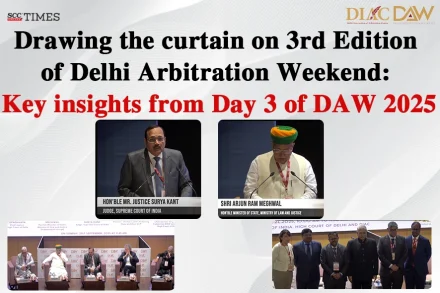
A comprehensive report of the Day 3 of the Delhi Arbitration Weekend 2025, where the discussions concluded with the last panel discussing enforceability and the esteemed speakers delivering insightful speeches in the closing ceremony.
The case revolved around 2 orders passed by the National Green Tribunal- one order directed the constitution of a Joint Committee to investigate the appellant’s environmental transgressions and the 2nd order imposed compensation of Rs 18 crores.
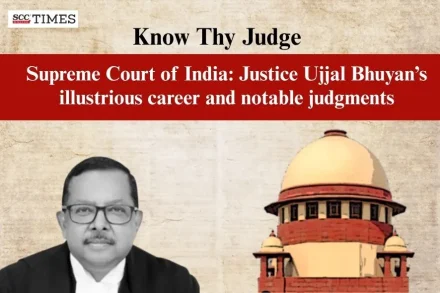
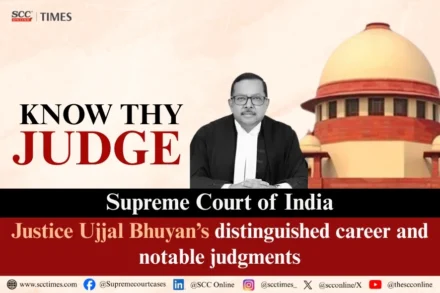
On 05-07-2023, the Supreme Court Collegium had recommended the appointment of Justice Ujjal Bhuyan, Chief Justice, High Court for the State of Telangana to the Supreme Court of India. Upon acceptance of the recommendation by the Law Ministry, Justice Bhuyan took oath as Supreme Court Judge on 14-07-2023.
The application of the doctrine of merger, in every case, shall be accompanied by an awareness of its limitations and shall not be wielded to close avenues for addressing genuine concerns. Prioritizing justice and fairness shall supersede an absolute insistence on finality.
In the instant case, the appellant was denied maternity leave for a third child on account of her re-marriage. The Supreme Court held that the appellant was entitled to grant of maternity leave.
“Under the scheme of the Customs Act, 1962, duty is assessed provisionally or finally whereafter an assessment order or order-in-original is passed. Post assessment order or order-in-original, the concerned importer is required to pay the assessed duty”.
The Bench directed all the High Courts to amend the existing rules in accordance with the Judgment within four months.
The Court also held that the auction purchaser was not entitled to either ownership or leasehold rights in respect of the plot and could not claim to be a lessee as the lease in terms of the lease agreement entered into by the DDA was never executed.
“The accused persons had no knowledge that by asking the two employees to work on the sign board as part of the work of decoration of the frontage of the shop, such an act was likely to cause the death of the two deceased employees.”
“Even if the suicide note is taken as correct and genuine, there was no act of incitement on the part of the accused persons proximate to the date on which the deceased committed suicide.”
Supreme Court said that according to the prosecution, the convicts had committed the murder of the deceased. Therefore, it is for the prosecution to connect the convicts to the murder by producing credible and legally admissible evidence.
“When one of the three circumstances was disbelieved and discarded by the High Court, then the chain of circumstantial evidence could not have been held to be complete and proved and on that basis to hold the accused guilty of the offence.”
“The circumstances taken cumulatively must be so complete that there is no escape from the conclusion that, within all human probability, the crime was committed by the accused and none else. While there is no doubt that conviction can be based solely on circumstantial evidence, great care must be taken in evaluating circumstantial evidence.”