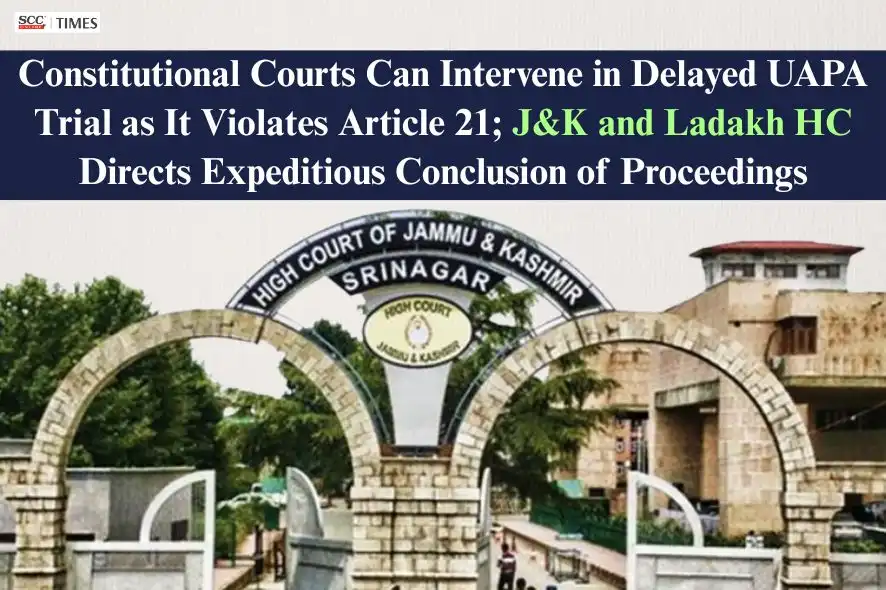
Jammu & Kashmir and Ladakh High Court: In a writ petition seeking expeditious disposal of a criminal trial arising out of offences under the Unlawful Activities (Prevention) Act, 1967 (UAPA) and allied statutes, a Single Judge Bench of Wasim Sadiq Nargal, J., held that Constitutional Courts can intervene in delayed UAPA trial as it violates the right to liberty granted to the accused under Article 21 of the Constitution. The Court directed the trial court to accord priority and conclude the proceedings expeditiously while ensuring day-to-day progress in terms of Section 19, National Investigation Agency Act, 2008 (NIA Act).
The Court observed that,
“Even in cases arising under stringent statutory provisions, prolonged delay in trial cannot be ignored and Constitutional Courts are duty-bound to balance national security concerns with individual liberty. While safeguarding national interests, courts must ensure that undertrial prisoners are not subjected to endless incarceration without timely adjudication.”
Also Read: Del HC Grants Bail to Salim Malik in 2020 Delhi Riots Conspiracy Case
Background
An FIR was registered against the accused on 30 March 2020 for offences under Sections 16, 18, 20 and 23 UAPA, Sections 3/4, Explosive Substances Act, 1908 (1908 Act) and Sections 307 and 427, Penal Code, 1860 (IPC). After the investigation was complete and the charge-sheet was filed, charges were framed on 29 March 2021. The accused pleaded that although around 20 witnesses were cited by the prosecution and several had already been examined, the trial was not being conducted on a day-to-day basis as provided under law. He remained in continuous custody since his arrest and contended that prolonged incarceration along with delay in conclusion of trial amounted to violation of Article 21 of the Constitution. It was further contended that Section 19, NIA Act mandates that trials by Special Courts must be conducted on a day-to-day basis and must be given precedence.
Issues
-
Whether prolonged pendency of trial, despite the accused remaining in judicial custody for a considerable period of time, amounts to infringement of the fundamental right to speedy trial guaranteed under Article 21 of the Constitution.
-
Whether this Court, in exercise of its extraordinary writ jurisdiction, ought to issue appropriate directions for expeditious conclusion of trial?
Also Read: SC on pending cases under UAPA that pose reverse burden of proof
Analysis
The Court highlighted that the right to speedy trial is no longer res integra and stands crystallised as a constitutional guarantee flowing directly from Article 21 of the Constitution, and fair procedure includes fair investigation, inquiry and expeditious conclusion of trial. The Court relied on Pankaj Kumar v. State of Maharashtra, (2008) 16 SCC 117, wherein it was observed that:
Where the Court comes to the conclusion that the right to speedy trial of an accused has been infringed, the charges or the conviction, as the case may be, may be quashed unless the Court feels that having regard to the nature of offence and other relevant circumstances, quashing of proceedings may not be in the interest of justice. In such a situation, it is open to the court to make an appropriate order as it may deem just and equitable including fixation of time for conclusion of trial.
The Court observed that the accused had been in custody for a considerable period and the trial had remained pending for years for no sufficient reason. The Court opined that although the allegations against the accused were serious in nature, constitutional rights guaranteed under Article 21 of the Constitution could not be defeated by prolonged delay in trial.
The Court noted that despite the charges being framed on 29 March 2021, the trial had not culminated into final adjudication even after 5 years. The Court highlighted that such delay causes prejudice not only by deprivation of liberty but also by subjecting the accused to prolonged uncertainty and mental agony. The Court emphasised that even though the offences under UAPA are grave in nature and involve larger issues touching security of the State and public order, seriousness of allegations, by itself, cannot eclipse constitutional guarantees available even to an accused charged with grave offences. Every accused continues to enjoy presumption of innocence till guilt is established in accordance with law.
The Court observed that even in cases arising under stringent statutory provisions, prolonged delay in trial cannot be ignored and Constitutional Courts are duty-bound to balance national security concerns with individual liberty. While safeguarding societal and national interests, courts must equally ensure that undertrial prisoners are not subjected to endless incarceration without timely adjudication.
The Court relied on Supreme Court Legal Aid Committee (Representing Undertrial Prisoners) v. Union of India, (1994) 6 SCC 731, wherein it was held that undertrials cannot indefinitely be detained pending trial. The Court also highlighted that Section 19, NIA Act mandates day-to-day trial and precedence over other cases, reflecting the legislative intent that though a special mechanism for trial of serious offences affecting sovereignty and integrity of the nation is created, such prosecutions are not permitted to linger endlessly. The delay not only affects the accused but also weakens evidentiary value, affects recollection of witnesses and undermines public confidence in judicial process.
The Court referred to Syed Iftikhar Andrabi v. NIA, 2026 SCC OnLine SC 881, wherein it was reiterated that the constitutional requirement of expeditious trial continues to apply irrespective of the seriousness of allegations levelled against an accused. It was clarified that even under stringent provisions of the UAPA, Constitutional Courts can intervene where an accused has remained in custody for a long period and the trial is not likely to conclude within a reasonable time.
The Court emphasised that criminal justice is founded on the principle of fairness, which is not limited only to providing opportunity of hearing to the parties but also requires that proceedings are concluded within a reasonable time. The constitutional guarantee under Article 21 cannot be rendered illusory by procedural stagnation. Liberty once deprived without timely adjudication transforms the process itself into punishment, which is impermissible in law. The Court further opined that unnecessary adjournments defeat the object of speedy trial and observed that the trial court is expected to ensure meaningful progress of the case on each date of hearing, as it is necessary to uphold the statutory mandate contained under Section 19, NIA Act and constitutional guarantee flowing from Article 21.
Also Read: SC UAPA Verdict Decoded: Bail is Rule & Gulfisha Fatima Concerns
Decision
Consequently, the Court, without expressing any opinion on merits of the allegations levelled against the accused, directed the trial court/Special Court to accord priority to the trial and make all possible endeavours to conclude the same expeditiously. The prosecution and defence were also directed to cooperate and refrain from seeking unnecessary adjournments.
[Arif Billa Sheikh v. State (UT of J&K), 2026 SCC OnLine J&K 385, decided on 21-5-2026]
Advocates who appeared in this case:
For the Petitioner: Hussain Rashid, Advocate.
Buy Penal Code, 1860 HERE

Buy Constitution of India HERE