HC cannot substitute injunction with compensation
Case BriefsSupreme Court

Supreme Court held that a High Court cannot substitute a decree of mandatory injunction with monetary compensation in a second appeal when such relief was neither sought nor consented to by the plaintiff.

rejection of nomination papers
Case BriefsSupreme Court

INC candidate Meenakshi Natarajan’s Rajya Sabha nomination from Madhya Pradesh was rejected for non-disclosure of a pending criminal case in her Form 26 affidavit. The Supreme Court declined to examine the merits, holding that the constitutional bar under Article 329(b) admits no exception for cases involving manifest illegality.

right to walk a fundamental right
Case BriefsSupreme Court

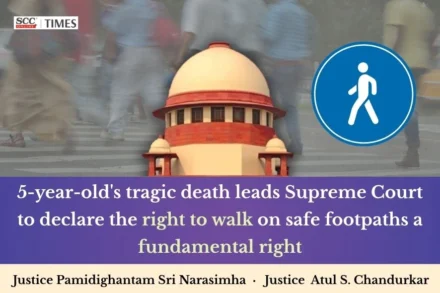
In a judgment arising from a five-year-old child run over by a tanker while walking to school, the Supreme Court declared that Urban Development Authorities, Municipal Corporations and Panchayats bear an enforceable duty to provide pedestrian infrastructure, with remedies independent of the Motor Vehicles Act.

TNPSC Motor Vehicle Inspector Recruitment
Case BriefsSupreme Court

The Court held that the candidates included in the revised list of 226 candidates acquired no vested right and must participate in the fresh selection process.

Transfer of Winding-Up Proceedings to NCLT
Case BriefsSupreme Court

The Calcutta High Court had held that, since no irreversible or irretrievable stage had been reached and the appellant’s unpaid claim could still be pursued before the NCLT, interference with Company Court’s order was unwarranted.

Additional Amenity TDR under MRTP Act
Case BriefsSupreme Court

“The statutory right of the landowner under Section 126(1)(b) being twofold as discussed above, the corporation could not have conjured a precondition for the landowner to abjure part of the compensation in order to receive the other part.”

Signed order prevails over oral dictation
Case BriefsSupreme Court

The Supreme Court held that a digitally signed order is the final and binding order of the Court and that corrections or refinements to a dictated draft before signing are permissible so long as they do not materially alter the judgment.

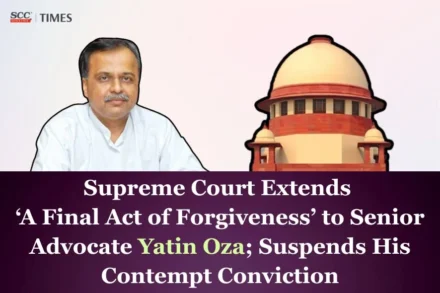
Yatin Oza's Contempt Conviction
Case BriefsSupreme Court

“The Court wields considerable authority, yet the true essence of judicial magnanimity lies in restraint. Measured reprimand and corrective guidance remain the wiser course over sheer penal consequence.”

Formaldehyde units environmental clearance judgment
Case BriefsSupreme Court

Supreme Court allowed appeals by formaldehyde manufacturing units in Rajasthan and Haryana and quashed NGT closure orders over absence of prior Environmental Clearance under the EIA Notification, 2006.

ReT Scheme Closure Judgment
Case BriefsSupreme Court

Supreme Court rules on Rehbar-e-Taleem (ReT) Scheme closure, holds denial of appointment due to pending litigation arbitrary under Article 14, and grants relief to select panel candidates subject to TET qualification.

degree no substitute for experience
Case BriefsSupreme Court

The terms of the recruitment rules and the advertisement form the basis of the selection process and are binding on both, the candidates as well as the recruiting agencies.

2014 regularisation policy
Case BriefsSupreme Court

The criteria prescribed was not in any manner watered down or deviated from the criteria required to be satisfied while seeking regular appointment.

Commuter safety fundamental right
Case BriefsSupreme Court

“The Right to Life enshrined under Article 21 of the Constitution is not merely a guarantee against the unlawful taking of life, but a positive mandate upon the State to ensure a safe environment where human life is preserved and valued.”

extra requirement for stamp duty exemption
Case BriefsSupreme Court

The Court observed that administrative procedures should avoid complexity, redundant requirements, and unnecessary burdens, which waste time, expense, and disturb peace of mind.

suppression of criminal antecedents by election candidate
Case BriefsSupreme Court

Non-furnishing information pertaining to criminal antecedents has the effect of causing undue influence which creates an impediment in the free exercise of electoral right by a voter.