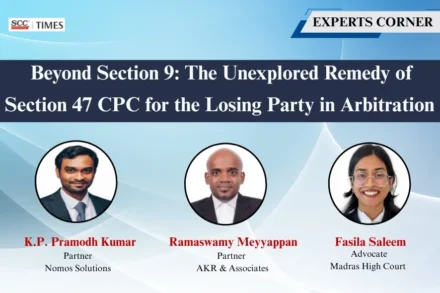
Beyond Section 9: The Unexplored Remedy of Section 47, Civil Procedure Code for the Losing Party in Arbitration
by K.P. Pramodh Kumar*, Ramaswamy Meyyappan** and Fasila Saleem***
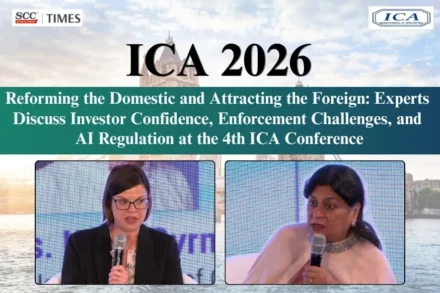
The fireside chat at the 4th ICA Conference on “Arbitrating Indo-UK Commercial Disputes” examined the challenges of enforcement, arbitration efficiency, judicial intervention, institutional reforms, AI regulation, third-party funding, and investor confidence.
Explore the latest Supreme Court Cases in 2026 SCC Vol. 4 Part 4 on reference to arbitration, appointment of district judges, electricity distribution, tariff revision, and more.
Explore the latest Supreme Court Cases in 2026 SCC Vol. 4 Part 3 on arbitral awards, GST proceedings, coparcener, non-compete fee, and more.
Explore the latest Supreme Court Cases in 2026 SCC Vol. 4 Part 2 on demurrer, speculative purchasers, public auction, and more.
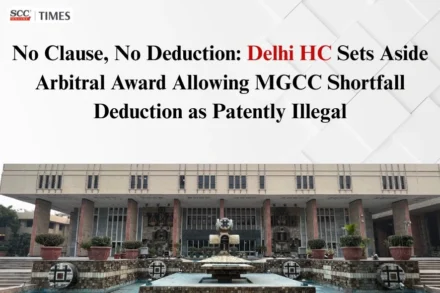
“There cannot be quarrel with the proposition that no clause can be read into the contract entered between the parties.”
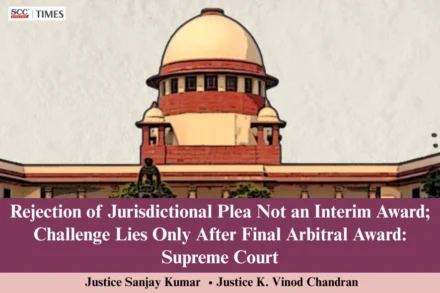
Supreme Court clarifies that rejection of a jurisdictional plea under Section 16, Arbitration and Conciliation Act, 1996 cannot be challenged under Section 34 at an interim stage and must await the final arbitral award.
“A literal interpretation of Section 9 of the Act would indicate that the right to seek interim relief is available to any party to the arbitration before or during arbitral proceedings or at any time after the award is delivered but before it is enforced in accordance with Section 36 of the Act.”
“Scheme of the Arbitration Act does not envision arbitration proceedings to cease with the death of a party. Section 35, Arbitration Act, extends the finality of an arbitral award not only to parties to the award, but also to ‘parties claiming under them’.”
“Alternate Dispute Resolution mechanisms or more particularly, arbitration, can only be the chosen method if both/all parties to the dispute can agree that it will be so. This freedom is not only insofar as choosing the medium, but it also encompasses choice of forum, applicable law and to some extent even procedural norms.”
The fifth and final day of IIDW 2026 brought together judges, senior advocates, academics, practitioners, and international delegates for a series of discussions on arbitration, mediation, and institutional reform, culminating in reflections on India’s evolving role as a trusted seat of dispute resolution.
India International Disputes Week 2026 explored India’s growing influence in the global legal order, with discussions on constitutional jurisprudence, arbitration law, international criminal justice, and cross-border dispute resolution.
Day 1 of India International Disputes Week 2026, commenced in Chandigarh with the launch of the Chandigarh International Arbitration Centre (CIAC), an initiative of the Punjab and Haryana High Court, marking an important institutional development in India’s dispute resolution ecosystem.
“The impugned interim order has been passed by the High Court on a misinterpretation of the ratio of the decision of this Court in Mohan Lal Fatehpuria (supra).”
“The ‘Court’ under Section 29A shall be the Civil Court of ordinary original jurisdiction in a district and includes the High Court in exercise of its original civil jurisdiction under Section 2(1)(e), and shall not be the High Court or the Supreme Court under Section 11(6) of the Act.”
“Arbitration is founded upon consent. A party may be bound by the arbitral process only if it is first shown, even at a prima facie level, that such a party had agreed to submit disputes to arbitration.”
Once arbitral award attains finality up to the Supreme Court, separate civil suit challenging underlying transaction on grounds of fraud is barred by Section 5 of the Arbitration Act and principles of finality.
In light of the settlement agreement and receipt of ₹5 Crores, the Court vacated the he interim order of injunction and permitted the release the movie ‘Akhanda 2’.
“TCS should consider itself lucky that Inspira was successful in selling TCS’s user-specific Servers… Otherwise, TCS would have been liable to pay the entire price.”
Supreme Court held that the undue delay and indecisive conduct of the Arbitrator, which culminated in a rudderless Award, were utterly shocking, as he completely lost sight of the fundamental purpose of the arbitration process.