








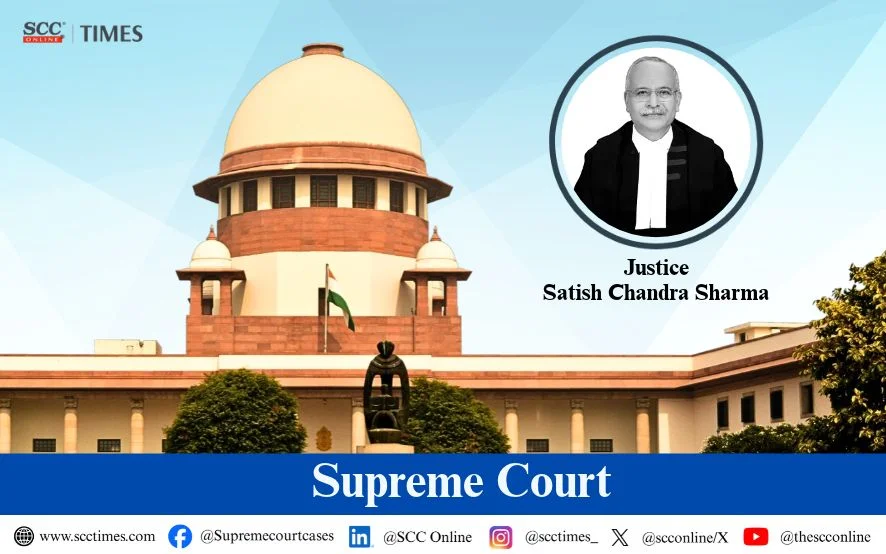
After a judicial career spanning nearly 19 years, Justice Satish Chandra Sharma retires as a Judge of the Supreme Court of India on 29 November 2026. His career has taken him from practice before the Madhya Pradesh High Court at Jabalpur to judicial offices in Madhya Pradesh, Karnataka, Telangana and Delhi, before his elevation to the Supreme Court in November 2023.
His professional journey has involved different roles within the justice delivery system as an advocate, Senior Advocate, High Court Judge, Acting Chief Justice of one and Chief Justice of three High Courts and eventually as a Judge of the Supreme Court. His tenure also included responsibilities relating to judicial administration and the functioning of High Court institutions. On his retirement, we look back at the milestones that shaped his career and the legacy he leaves behind.
Birth, Early Life and Education1
Justice Satish Chandra Sharma was born on 30 November 1961 in Bhopal, Madhya Pradesh. His father, Dr B.N. Sharma was a well-established agriculturalist and renowned professor at Jabalpur University, and later also served as the Vice-Chancellor of Barkatullah University, Bhopal. His mother, Shanti Sharma, served as a school principal and subsequently as District Education Officer in Jabalpur before retirement.
Justice S.C. Sharma began his schooling at Christ Church Boys Higher Secondary School and completed his Class X and XII education at Central School, Jabalpur. In 1979, he enrolled for a Bachelor of Science degree at Dr Hari Singh Gour University, Sagar, graduating in 1981 with distinction in three subjects.
He was awarded the National Merit Scholarship for postgraduate studies and enrolled as a student of law in 1981. He graduated and obtained LL. B. degree in 1984, securing the top position in his class and three university gold medals.
From the Bar to the Bench2
Justice Sharma enrolled as an advocate on 1 September 1984 and began practising before the Madhya Pradesh High Court at Jabalpur. His practice covered Constitutional, Service, Civil and Criminal matters.
On 28 May 1993, he was appointed Additional Central Government Counsel. In 2003, he was designated as a Senior Advocate by the Madhya Pradesh High Court. The following year, on 28 June 2004, he was appointed Senior Panel Counsel for the Government of India.
His years at the Bar preceded his elevation to the Bench in January 2008. He was appointed as an Additional Judge of the Madhya Pradesh High Court on 18 January 2008 and became a permanent Judge on 15 January 2010.
*Did You Know? In 2003, Justice Satish Chandra Sharma became one of the youngest Senior Advocates of Madhya Pradesh High Court.3
Across High Courts: Madhya Pradesh, Karnataka, Telangana and Delhi
Justice Sharma served at the Madhya Pradesh High Court for over 12 years before being transferred to the Karnataka High Court on 31 December 2020. He took oath as a Judge of the Karnataka High Court on 4 January 2021. On 31 August 2021, he assumed charge as Acting Chief Justice of the Karnataka High Court. He was subsequently elevated and appointed as Chief Justice of the Telangana High Court on 11 October 2021. His next assignment was at the Delhi High Court, where he took oath as Chief Justice on 28 June 2022.4
His tenure in Delhi placed him at the head of one of the country’s principal constitutional courts, with responsibilities extending beyond adjudication to the administration and functioning of the institution. During his tenure as Chief Justice of the Delhi High Court, several technology-related initiatives were introduced to improve access to court information and facilitate judicial processes. These included the S 3WaaS platform for district courts, a digital platform for sharing trial court records with the High Court, and an accessible cause list. These initiatives formed part of the institution’s broader technology and e-governance efforts during this period.5
Elevation to the Supreme Court
On 6 November 2023, the Supreme Court Collegium recommended Justice Sharma’s appointment to the Supreme Court of India.6 At the time, he was serving as Chief Justice of the Delhi High Court. The Collegium resolution recorded his appointment as a Judge of the Madhya Pradesh High Court on 18 January 2008 and his subsequent elevation as Chief Justice of the Telangana High Court, followed by his transfer to the Delhi High Court.7
He was appointed as a Judge of the Supreme Court and took oath on 9 November 2023.8
Engagement with legal education and research9
Alongside his judicial responsibilities, Justice Sharma has maintained an association with legal education and academic institutions. He has been associated with National Law Universities and has served on the Advisory Board of the National Law Institute University, Bhopal, and the India International University of Legal Education and Research, Goa.
He is also an avid reader and has published research papers and articles. These engagements reflect an association with legal scholarship and institutional legal education beyond his work in court.
The judge’s stated approach to the administration of justice10
During his farewell reference at the Delhi High Court on 9 November 2023, Justice Sharma spoke about the importance of the relationship between lawyers and judges, emphasising that mutual respect between the two is necessary for the effective delivery of justice.
He also spoke of the consistent importance he attached to the rights of litigants and recalling his transition from the Bar to the Bench, he described the opportunity to alleviate the suffering of litigants and uphold their rights as a significant aspect of judicial work.
These remarks offer an indication of the values he chose to emphasise while reflecting on his judicial career: the role of bar and bench in the justice delivery system, the rights of litigants, and the responsibility attached to judicial office.
Did You Know? At the felicitation function organised by the Supreme Court Bar Association in honour of Justice Satish Chandra Sharma, he acknowledged his wife’s contribution to his professional journey. He remarked that she is more educated than him, holding a PhD in Biotechnology and a Master’s degree in Computer Applications.11
Notable Judgments by Justice Satish Chandra Sharma in Supreme Court
In a case concerning the alleged criminalisation of a purely civil dispute arising out of a sale of land, a Division Bench of Satish Chandra Sharma* and Nongmeikapam Kotiswar Singh, JJ., held that the criminal proceedings against the petitioner, a general-power-of-attorney (GPA) holder and confirming party to the subsequent sale, could not be sustained when the FIR against the landowners had already been quashed. Emphasising that the foundational ingredients of cheating were absent and that the petitioner’s culpability could not be stretched beyond that of the landowners, the Court observed that the case was a classic instance of “casting the shadow of criminality on a pure civil dispute” and reiterated the principle of judicial consistency and propriety in quashing the FIR against the petitioner as well. [Sudha Rakesh v. State of Karnataka, 2026 SCC OnLine SC 2062]
In a reference on whether the nearly 5 decades old landmark decision in Bangalore Water Supply & Sewerage Board v. A. Rajappa, (1978) 2 SCC 213, which laid down the “Triple Test” for determining whether an undertaking falls within the ambit of “industry” under Section 2(j), Industrial Disputes Act, 1947 (Industrial Disputes Act), remains a good law, the Constitution Bench of Surya Kant*, CJ, and Satish Chandra Sharma, Alok Aradhe, Vipul M. Pancholi, B.V. Nagarathna**, P.S. Narasimha**, Dipankar Datta**, Ujjal Bhuyan and Joymalya Bagchi**, JJ., by 5:4 ratio, established that the “Triple Test” remained the governing legal framework for Section 2(j) of the repealed Industrial Disputes Act. The Court held that:
-
All matters currently pending before courts, tribunals, and labour authorities under the repealed Industrial Disputes Act continue to be governed and adjudicated under the original Triple Test laid down in Bangalore Water Supply.
-
Industrial Relations Code, 2020 (Industrial Relations Code) was an independent, distinct enactment that must be interpreted entirely on its own terms, text, and statutory scheme whenever a proper controversy arises under it. [State of U.P. v. Jai Bir Singh, 2026 SCC OnLine SC 1684
While considering the challenge to various provisions of the Chief Election Commissioner and other Election Commissioners (Appointment, Conditions of Service and Term of Office) Act, 2023 (2023 Act), especially Section 7 of the 2023 Act which deals with composition of Selection Committee for the appointment of Chief Election Commissioner (CEC), the Division Bench of Dipankar Datta and Satish Chandra Sharma, JJ., delivered a split verdict over referring this matter to a larger Bench for consideration.
Sharma, J., opined that the petitions are eligible to be placed before the Chief Justice of India for constitution of a Constitution Bench to adjudicate the constitutional validity of Sections 7, 6 and 8 of the 2023 Act. He opined that the primary contention of the petitioners to the validity of Sections 7, 6 and 8 of the 2023 Act does raise a substantial question of law as to interpretation of the Constitution, which has not been decided before, and hence should and must be decided by a Constitution Bench now. Per contra, Datta, J., opined that it has been clearly laid down by judicial precedents that free and fair elections are a basic feature of the Constitution and that the Election Commission of India (ECI) should be insulated from exclusive executive control in relation to appointments of the CEC and the Election Commissioners (ECs). Hence, Datta, J., rejected the plea for referring the matter before a larger Bench.
Given the split opinion over whether the present petitions and the applications should be heard by a Constitution Bench of 5 Judges, the present Division Bench thus directed papers to be placed before the CJI for considering the desirability of constituting a Constitution Bench of such number of Judges as may be considered appropriate, to decide the question of vires of Section 7 of the 2023 Act. Furthermore, taking grim note of the time taken to decide references, the Court requested the Chief Justice to explore the necessity of constituting a permanent five-Judge Bench to decide pure constitutional issues. [Jaya Thakur v. Union of India, 2026 SCC OnLine SC 1980]
In an appeal challenging the National Green Tribunal’s (NGT) dated 7 December 2017 in Manoj Misra v. DDA, 2017 SCC OnLine NGT 966, wherein the appellant, the organiser of the 2016 World Culture Festival, “Vyakti Vikas Kendra, India” or as per NGT “Art of Living International Centre”, was held liable for environmental damage allegedly caused to the Yamuna floodplain, the Division Bench of Satish Chandra Sharma* and Nongmeikapam Kotiswar Singh, JJ., found that the floodplain was already in a damaged condition before the site was handed over to the appellant and that the evidence relied on by the NGT did not establish that the appellant caused additional damage. The Court further held that
-
The mere existence of environmental degradation is insufficient. A causal connection between the conduct of the alleged polluter and the environmental damage must be established.
-
Once a person is established to be the polluter, the polluter pays principle can impose absolute liability for the environmental degradation caused by that person. But the principle cannot be applied unless the degradation is attributable to the alleged polluter.
-
The NGT cannot mechanically invoke the statutory no-fault provision where the case does not arise from an “accident” within the meaning contemplated by Section 17(3), National Green Tribunal Act, 2010 (NGT Act).
-
Restoration and rehabilitation are legally distinct. Restoration seeks to return an affected area to its original state; rehabilitation seeks optimum ecological functionality.
-
Section 15 does not permit expansion of the dispute into a general rehabilitation project. Where proceedings concern damage allegedly caused by a particular private party, compensation/restoration must remain connected to the damage attributable to that party.
-
An interim finding cannot ordinarily become a final adjudication merely because it was not challenged immediately. Particularly where the order itself was stated to be interim and without prejudice, the NGT must reconsider the issue after allowing the parties a meaningful opportunity to contest the factual findings.
-
The State’s obligation to rehabilitate public resources flows from the public trust doctrine and intergenerational equity; private liability arises where environmental damage is actually attributable to the private party.
Accordingly, the Court set aside the impugned NGT judgment, directed to refund ₹5 crore deposit to the appellant, and left the Delhi Development Authority’s (DDA) existing responsibility for rehabilitation of the Yamuna floodplain undisturbed. [Vyakti Vikas Kendra India v. Manoj Misra, 2026 SCC OnLine SC 1694]
In a batch of criminal appeals arising from the conviction of a husband and his co-conspirators for the murder of his wife, a Division Bench of Dipankar Datta and Satish Chandra Sharma*, JJ., upheld the conviction of the husband (A1) and 2 co-accused (A4 and A5), holding that the prosecution had successfully established a complete chain of circumstantial evidence proving a premeditated conspiracy to murder the deceased. The Court held that the call detail records, CCTV footage, location data, recoveries made under Section 27, Evidence Act, 1872, and the unnatural conduct of the husband before and after the incident formed an unbroken chain pointing exclusively towards the guilt of the accused.
Observing that frequent telephonic conversations, by themselves, could not establish participation in a criminal conspiracy, the Court upheld the acquittal of the alleged co-conspirator (A2), holding that suspicion, however strong, could not substitute proof beyond reasonable doubt in the absence of evidence connecting her with the other accused or the execution of the offence. Consequently, the Court dismissed the appeals preferred by the convicted accused as well as the State’s appeal challenging A2’s acquittal.
“Marriage is often dubbed as one of the most significant decisions in the life of a person. The consequences of a marital discord could be drastic and at times, even fatal. The present case depicts an extreme scenario wherein two lives have met an irreversible fate as a consequence of their marital discord.” [Piyush Shyamdasani v. State of U.P., 2026 SCC OnLine SC 1357]
The appeal concerned with the interpretation of Section 9(2), Presidency-Towns Insolvency Act, 1909 (Presidency-Towns Insolvency Act), and whether a recovery certificate issued by the Debts Recovery Tribunal (DRT) can be treated as a “decree or order” for initiating insolvency proceedings. Reaffirming the principle that insolvency laws must be strictly construed due to their serious civil consequences, the Division Bench of Dipankar Datta* and Satish Chandra Sharma, JJ., held that a recovery certificate issued by the DRT before the before the insertion of Section 19(22-A), Recovery of Debts and Bankruptcy Act, 1993 (Recovery of Debts and Bankruptcy Act), i.e., 2016 Amendment, could not be treated as a “decree or order” under Section 9(2), Presidency-Towns Insolvency Act and, therefore, could not form the basis of an insolvency notice under Section 9(2), Presidency-Towns Insolvency Act. [HDFC Bank Ltd. v. Kishore K. Mehta, 2026 SCC OnLine SC 1320]
In an appeal preferred by the Gujarat Pollution Control Board (GPCB), assailing the National Green Tribunal (NGT) order holding the landlord not accountable for the tenant’s environmental violations, the Division Bench of Satish Chandra Sharma and Sanjeev Sachdeva, JJ., held that the landlord could not be held accountable for the illegal acts committed by the tenant. The appeal was allowed, the impugned order was set aside, and the GPCB was left at liberty to proceed against the tenant in accordance with law. [Gujarat Pollution Control Board v. Jagmohan Lachiram Jalan, 2026 SCC OnLine SC 1106]
In an appeal arising from the Tripura High Court’s judgment dated 14 March 2024 wherein the High Court had set aside the order of the Additional Sessions Judge, West Tripura, Agartala dated 6 February 2024 and allowed an application under Section 311, Criminal Procedure Code, 1973 (CrPC) seeking recall of the prosecutrix (PW 1) for further cross-examination, the Bench of Dipankar Datta and Satish Chandra Sharma*, JJ., set aside impugned order passed by the High Court and restored the trial court’s order, holding that “power under Section 311 CrPC cannot be exercised merely to fill up lacunae in the defence case”.
The Court further observed that witnesses, particularly victims of heinous offences and sensitive crimes, cannot be expected to repeatedly appear before courts to face cross-examination. [State of Tripura v. Panna Ahmed, 2026 SCC OnLine SC 960]
In an appeal assailing the direction of the Central Administrative Tribunal (CAT) to allow the respondent to take the test with the next batch, the Division Bench of Dipankar Datta and Satish Chandra Sharma, JJ., allowed the appeal by setting aside the impugned judgment and observed that grace, charity or compassion ought to stay at a distance in matters of public employment, if a fair level playing field is to be secured. The Court held that,
“We, thus, see no reason to hold that the omission, neglect or failure of the appellants to even respond to the respondent’s representations, assuming that they were received, conferred on him the enforceable right to seek a rescheduling of the examination date. Most certainly, non-communication of any decision on any of the representations, on facts and in the circumstances, did not clothe the Tribunal to make the order it did while disposing of the original application, throwing the process asunder.” [Commr., Delhi Police v. Uttam Kumar, 2026 SCC OnLine SC 523]
In Special Leave Petition (SLP), challenging the rejection of application for condonation of 11 years of delay, filed with further delay of 123 days in filing and 96 days in re-filing after curing defects, a Division Bench of Dipankar Datta and Satish Chandra Sharma, JJ., held that “condonation of delay cannot be claimed as a matter of right. It is entirely the discretion of the Court whether or not to condone delay.” The Court emphasised that despite the latitude shown to the State, no case for exercise of discretion had been made out. Consequently, it rejected the applications for condonation of delay in filing and re-filing the SLP and dismissed the SLP as time-barred. [State of Odisha v. Managing Committee of Namatara Girls High School, 2026 SCC OnLine SC 191]
In a writ petition, challenging Madras High Court’s directions issued for completion of investigation, filing of charge-sheets within a fixed period, and expeditious disposal of pending trials, a Division Bench of Dipankar Datta and Satish Chandra Sharma, JJ., deemd the paragraphs 8 and 9 of the High Court’s order as “unwarranted and uncalled for” and directed for their deletion. The Court held that a writ court cannot direct the investigating agency to file a charge-sheet or compel completion of investigation within a fixed time-frame irrespective of the material collected, as this forecloses the statutory discretion of the investigating officer. Directions to conclude criminal trials within a stipulated period, without regard to the stage of proceedings, amount to improper exercise of writ jurisdiction and may undermine the fairness of trial. [A. Shankar v. Secretary to Government, 2026 SCC OnLine SC 120]
In a Special Leave Petition (SLP) examining whether offences under the Prevention of Corruption Act, 1988 (PC Act), allegedly committed by a Central Government employee within a State, can be investigated by the State Anti-Corruption Bureau, or whether jurisdiction to investigate Prevention of Corruption offences vests exclusively with the Central Bureau of Investigation (CBI), a Division Bench of J.B. Pardiwala and Satish Chandra Sharma, JJ., affirmed the view of the Rajasthan High Court and held that —
-
The Anti-Corruption Bureau (ACB) of the State of Rajasthan has jurisdiction to register and investigate offences under the PC Act even where the accused is a Central Government employee.
-
There is no requirement in law that prior approval or consent of the CBI must be obtained before such investigation.
-
A charge-sheet filed by the State ACB in such cases is valid in law. [Nawal Kishore Meena v. State of Rajasthan, 2026 SCC OnLine SC 103]
The present writ petition raised, for the first time, an important question concerning the proper interpretation of Section 3 of the Judges (Inquiry) Act, 1968 (Inquiry Act), particularly the scope and operation of the first proviso to Section 3(2) in a situation where notices of motion for removal of a Judge was given in both Houses of Parliament on the same day but the notice was not admitted in the Rajya Sabha. A Division Bench of Dipankar Datta* and Satish Chandra Sharma, JJ., dismissed the writ petition challenging the impeachment proceeding against High Court Judge in Parliament and held that —
-
The first proviso to Section 3(2) of the Inquiry Act applies only where notices given on the same day are admitted in both Houses.
-
The Deputy Chairman is constitutionally competent under Article 91 to exercise the powers of the Chairman when the office is vacant.
-
The Speaker’s power to constitute a Committee is not dependent upon the fate of a notice in the other House unless both notices are admitted.
-
Secretariat of Parliament has only an administrative role and cannot assume a quasi-adjudicatory function.
-
Article 32 cannot be invoked to interfere with parliamentary procedure absent infringement of Fundamental Rights. [X v. Office of the Speaker of the House of People, 2026 SCC OnLine SC 91]
In an appeal challenging order of National Consumer Disputes Redressal Commission (NCDRC) dismissing appellant’s consumer complaint on the grounds of limitation and lack of consumer status, a Division Bench of Dipankar Datta and Satish Chandra Sharma, JJ., declined to interfere with the findings of the NCDRC and held that Landowners in Joint Development Agreement are not “Consumers” and that there was “no reason to entertain this civil appeal” , while granting liberty to the appellants to pursue their remedies before the civil court. [Habib Alladin v. Mahmood Builders (P) Ltd., 2026 SCC OnLine SC 54]
While considering a criminal appeal challenging the setting aside of the Respondents’ convictions under Sections 376(2) of Penal Code, 1860 and Sections 4 & 6 of Protection of Children from Sexual Offences (POCSO) Act, 2012 by Patna High Court, the Division Bench of Sanjay Kumar and Satish Chandra Sharma*, JJ., set aside the High Court’s decision and restored the Respondents’ conviction and sentence as given by the Trial Court, while pointing out that, in the present case, a fairly consistent and creditworthy case of the prosecution was discarded on basis of misapplication of procedure. The Court further pointed out that the victims often find themselves in conflict with the procedural intricacies of the laws in place. Despite the importance of procedural sanctity, it is always a matter of utter failure for the system when a culprit, that too of a heinous sexual offence, manages to walk free by entangling the victim in misapplication of procedural rules, without the knowledge of the victim and without any control of the victim.
“Procedure is not supposed to control justice”.
The Court further shed light on the misunderstanding of the principle of beyond reasonable doubt, stating that underlying foundation of the principle is that no innocent should face punishment for a crime that he has not done; however, a flipside of the same is that at times, owing to a misapplication of this principle, actual culprits manage to find their way out of the clutches of law.
“Every instance of acquittal of an actual culprit revolt against the sense of security of the society and acts as a blot on the criminal justice system”. [X v. Y, 2025 SCC OnLine SC 1878]
In a landmark ruling, a 5-Judge Constitution Bench comprising of B.R. Gavai, CJI.*, M.M. Sundresh, Aravind Kumar, S.C. Sharma and K. Vinod Chandran, JJ., while deciding a reference on issues related to appointment of Judicial Officers as District Judges, held the following:
-
Judicial Officers who have already completed 7 years in Bar before they were recruited in the subordinate judicial service, would be entitled for being appointed as a District Judge/Additional District Judge in the selection process for the post of District Judges in the direct recruitment process.
-
The eligibility for appointment as a District Judge/Additional District Judge is to be seen at the time of application.
-
Though there is no eligibility prescribed under Article 233(2) of the Constitution for a person already in judicial service of the Union or of the State for being appointed as District Judge; in order to provide a level playing field, the Court directed that a candidate applying as an in-service candidate should have 7 years’ combined experience as a Judicial Officer and an advocate.
-
A person who has been or who is in judicial service and has a combined experience of 7 years or more as an advocate or a Judicial Officer, would be eligible for being considered and appointed as a District Judge/Additional District Judge under Article 233 of the Constitution.
-
In order to ensure level playing field, the Court directed that the minimum age for being considered and appointed as a District Judge/Additional District Judge for both advocates and Judicial Officers would be 35 years of age as on the date of application.
-
The Court held that view taken in Satya Narain Singh v. High Court of Judicature at Allahabad, (1985) 1 SCC 225, till Dheeraj Mor v. High Court of Delhi, (2018) 4 SCC 619, which takes a view contrary to what has been held above, do not lay down the correct proposition of law.
[Rejanish K.V. v. K. Deepa, 2025 SCC OnLine SC 2196]
In a criminal appeal against Calcutta High Court’s decision, whereby the chargesheet for offence under Section 306 of the Penal Code, 1860 (‘IPC’) against the other two accused persons was quashed, while the present applicant’s (‘accused’) plea for quashing the chargesheet was rejected, the Division Bench of BV Nagarathna and Satish Chandra Sharma*, JJ. allowed the appeal and set aside the High Court’s decision to the extent of refusing to quash the chargesheet qua the present accused.
[Laxmi Das v. State of W.B., 2025 SCC OnLine SC 120]
Only arguing counsel appearing physically and assisting counsel will be recorded in appearance; Senior Advocate shall not appear without AOR: Supreme Court
In a set of two miscellaneous applications filed jointly by the Supreme Court Bar Association (SCBA) and the Supreme Court Advocates-on-Record Association (SCAORA) seeking clarification/ modification of the directions in para 42 of Bhagwan Singh v. State of U.P., 2024 SCC OnLine SC 2599, wherein it was directed that the Advocates-on-Record may mark the appearances of only those Advocates who are authorized to appear and argue the case on the particular day of hearing, the Division Bench of Bela M. Trivedi and Satish Chandra Sharma, JJ. gave a slew of directions to regulate practice and procedure on the following issues:
-
whether the Advocates have an indefeasible right to appear for a party or to get their appearances marked for a party, though not duly authorised to appear in the court proceedings; and
-
whether the impugned directions given by the court impinge or affect any of the legal, fundamental or statutory rights of the Advocates.
“A right of an Advocate to appear for a party and to practice in the Courts is coupled with the duty to remain present in the Court at the time of hearing, and to participate and conduct the proceedings diligently, sincerely, honestly and to the best of his ability. Rights and duties are two sides of the same coin, and they are inherently connected with each other.”
The Court held that the Supreme Court Rules, 2013 as amended by Rules, 2019 having the statutory force, have to be adhered to and complied with by all the officers of the Court as also the Advocates practicing in the Supreme Court.
[Supreme Court Bar Association v. State of UP, 2025 SCC OnLine SC 587]
While considering the instant matter concerning abuse of process of Court by an Advocate on Record (AoR) and a lawyer, the Division Bench of Bela M. Trivedi** and Satish Chandra Sharma**, JJ., reached a spilt verdict on the issue of acceptance of unconditional apology by the errant advocates. As a result, the matter was directed to be placed before the Chief Justice of India for appropriate orders.
Bela M. Trivedi, J., directed that the name of the AoR be removed from the Register of Advocates-on- Record for a period of one month from the date of the instant judgment. Vis-a-vis the other errant Advocate, Trivedi, J., directed that he shall pay cost of Rs.1,00,000/- from his own pocket to be deposited by him with the SCAORA to be utilized for the welfare of the Advocates.
Meanwhile, S.C. Sharma, J., agreed with Trivedi, J., that the errant Advocates did not keep in mind the honour and dignity of the institution, and they have also failed to discharge their duties to the Court. However, Sharma, J., opined that Justice Trivedi’s directions are too onerous on the errant Advocates as the same would cast a stigma on their future especially when both the Advocates belong from a remote village in Tamil Nadu. Given the unconditional apology tendered by the errant Advocates and their unblemished track record so far, Sharma J., accepted the apology and cautioned the advocates to be careful in not repeating any such misconduct in future. They were also directed to ensure that they shall appear before all cases where they have entered appearances.
[N. Eswaranathan v. State, 2025 SCC OnLine SC 805]
In a criminal appeal filed by the accused against the order passed by the Calcutta High Court, wherein the Court refused to discharge the accused charged under Sections 376, 417 and 506 of the Penal Code, 1860 (‘IPC’), the division bench of BV Nagarathna and Satish Chandra Sharma*, JJ. said that there is a growing tendency of resorting to initiation of criminal proceedings when relationships turn sour. Every consensual relationship, where a possibility of marriage may exist, cannot be given a colour of a false pretext to marry, in the event of fallout. It is such lis that amounts to an abuse of process of law. Thus, the Court set aside the impugned order and terminated the proceedings as the physical relationship between the complainant and the accused was consensual.
[Biswajyoti Chatterjee v. State of West Bengal, 2025 SCC OnLine SC 741]
In a criminal appeal concerning a matter under the Protection of Children from Sexual Offence Act, 2012 (‘POCSO Act’), the division bench of B.V. Nagarathna and Satish Chandra Sharma, JJ. noted that the convict had already undergone eleven years and eight months of incarceration. Observing that this period far exceeded the original sentence, the Court concluded that the ends of justice would be best served by bringing the matter to a close. Accordingly, the convict was directed to be released from custody forthwith.
[Sachin v. State of Maharashtra, 2025 SCC OnLine SC 834]
In an appeal filed by the convict against the order passed by the Allahabad High Court, which had upheld the convict’s conviction under Section 498A of the Penal Code, 1860 (‘IPC’), and Section 4 of the Dowry Prohibition Act, 1961 (‘DP Act, 1961’), the Division Bench of B.V. Nagarathna and Satish Chandra Sharma*, JJ. expressed concern over the misuse of Sections 498A IPC and Sections 3 and 4 of the DP Act, 1961. The Court highlighted a growing trend where complainant-wives indiscriminately array aged parents, distant relatives, and married sisters living separately as accused in matrimonial disputes. The Bench observed that such practices undermine the credibility of the allegations and vitiate the very core intent of these protective legal provisions.
The Court further emphasised that the term “cruelty” under Section 498A IPC is often subject to misuse and cannot be established by general or vague allegations alone. It must be supported by specific instances detailing the time, date, and manner of the alleged cruelty. The Court remarked that invoking these penal provisions without providing clear, concrete instances significantly weakens the prosecution’s case and raises serious doubts about the credibility of the complainant’s version.
Given these considerations, the Court allowed the appeals, set aside the judgment passed by the High Court, and acquitted the convict of all charges under Section 498A IPC and Section 4 of the DP Act, 1961.
[Rajesh Chaddha v. State of Uttar Pradesh, 2025 SCC OnLine SC 1094]
While considering the instant petition challenging Bombay High Court’s decision to upholding the conviction of the petitioner (convict) under 6 of the Protection of the Children from Sexual Offences Act (POCSO Act) thereby sentencing him to 20 years’ rigorous imprisonment; the Division Bench of B.V. Nagarathna and Satish Chandra Sharma, JJ.,* dismissed the petition finding no reason to interfere with the impugned judgment.
[Sachin v. State of Maharashtra, 2025 SCC OnLine SC 1255]
While deliberating over instant appeal whereby Rajasthan High Court dismissed a petition filed by the appellant challenging her discharge from Rajasthan Judicial Services (RJS); the Division Bench of B.V. Nagarathna and Satish Chandra Sharma*, JJ., set aside the order of discharge and directed the respondent to reinstate the appellant. The Court opined that non-disclosure of past government service, cannot be a ground to discharge the appellant.
While deciding the matter, the Court emphasised on the necessity of women’s participation in the judiciary and said that country will greatly benefit from a judicial force that is competent, committed and most importantly, diverse. The Court also commended the appellant for her perseverance by fighting societal stigmas and gaining a rich education that will ultimately benefit the judicial system and the democratic project.
[Pinky Mehta v. High Court of Judicature for Rajasthan, 2025 SCC OnLine SC 1214]
In a civil appeal against Madhya Pradesh High Court’s decision whereby the applicability of Customs Circular No. 35/2010-Cus. Dated 17-09-2010 for the purposes of All Industry Rate (AIR) Duty Drawbacks was held to be prospective in nature, the Division Bench of B.V. Nagarathna and Satish Chandra Sharma*, JJ. relating to the applicability of duty drawback provisions for exporters, held that the Circular issued by the Central Board of Excise and Customs (CBEC), must be retrospectively applied. The Court ruled in favour of Suraj Impex (India) Pvt. Ltd. (appellant) restoring their entitlement to 1% AIR customs duty drawback for Soyabean Meal (SBM) exports made prior to 20-09-2010.
[Suraj Impex (India) (P) Ltd. V. Union of India, 2025 SCC OnLine SC 1226]
While considering a matter wherein the appellant (convict) who was convicted for murdering his friend had challenged his conviction, the Division Bench of B.V. Nagarathna and Satish Chandra Sharma*, JJ., took note of the inconsistent version of events presented by the prosecution and opined that accused person’s inability to explain certain circumstances, could not be made the basis to relieve the prosecution from discharging its primary burden of proving the case against the accused beyond reasonable doubt.
It was stated that in criminal jurisprudence, it is a time-tested proposition that the primary burden falls upon the shoulders of the prosecution and it is only if the prosecution succeeds in discharging its burden beyond reasonable doubt that the burden shifts upon the accused to explain the evidence against him or to present a defence.
[Vaibhav v. State of Maharashtra, 2025 SCC OnLine SC 1304]
In an appeal filed against the judgment of the Bombay High Court , wherein the petition under Section 482 of the Code of Criminal Procedure, 1973 (‘CrPC’) seeking quashing of criminal proceedings was dismissed, involving allegations under Sections 376, 376(2)(n), 377, 504, and 506 of the Penal Code (‘IPC’), 1860, the Division Bench of B.V. Nagarathna and Satish Chandra Sharma*, JJ. observed that the present case did not involve a false promise to marry from the outset. The Court held that a consensual relationship, which subsequently deteriorates or results in estrangement between the parties, cannot form the basis for invoking the criminal machinery of the State. It further emphasised that such actions unnecessarily burden the courts and irreversibly damage the reputation of individuals accused of serious offences.
Taking into account that the accused was a young individual of 25 years with his entire future ahead of him, the Court was of the considered opinion that subjecting him to a protracted criminal trial would not subserve the ends of justice. To prevent undue hardship and miscarriage of justice, the Court found it appropriate to quash the criminal proceedings at this stage.
Accordingly, the appeal was allowed. The impugned order of the Bombay High Court was set aside. Consequently, the accused was discharged from the case.
[Amol Bhagwan Nehul v. State of Maharashtra, 2025 SCC OnLine SC 1230]
In an appeal against the judgment passed by the Punjab and Haryana High Court, where the High Court had ruled that recorded conversations between a husband and wife could not be the basis for deciding a petition under Section 13 of the Hindu Marriage Act, 1955 the Division Bench of BV Nagarathna* and Satish Chandra Sharma, JJ. held that the founding rationale for Section 122 of the Evidence Act, 1872 as acknowledged by the Law Commission and various High Courts, was to protect the sanctity of marriage rather than focusing on the right to privacy of the individuals involved. Consequently, the Court stated that the right to privacy is not a relevant consideration in situations where the privilege under Section 122 is not granted, such as in proceedings between spouses (an exception recognized in Section 122 itself).
The Court emphasised that spousal communications were deemed privileged under Section 122 for the purpose of protecting the sanctity of the marital relationship, and not for safeguarding individual privacy rights.
As a result, the Court set aside the impugned order of the High Court and restored the Family Court’s order. The Court directed the Family Court to accept the supplementary affidavit filed by the husband, which included evidence such as the memory card/chip of the mobile phones, compact disc (CD), and the transcript of the recorded conversations from the relevant period. The Family Court was instructed to consider this evidence in accordance with the law.
[Vibhor Garg v. Neha, 2025 SCC OnLine SC 1421]
While considering this matter whereby the appellant was aggrieved at the dismissal of his complaint regarding police inaction apropos the attack and assault on him during communal riots in Akola City, Maharashtra on 13-05-2023 by Bombay High Court after expressing suspicions on the appellant’s bonafides; the Division Bench of Sanjay Kumar* and Satish Chandra Sharma, JJ., directed the Secretary, Home Ministry, Government of Maharashtra, to constitute a special investigation team (SIT), comprising senior police officers of both Hindu and Muslim communities, to undertake an investigation into all the allegations made by the appellant, by registering an FIR in connection with the assault upon him, and take appropriate action thereon as warranted. The Court further directed to initiate measures to instruct and sensitize the rank and file in the police department as to what law requires of them in the discharge of their duties.
Taking note of the approach taken by the Police in the present case, the Court emphasised that when members of the police force don their uniforms, they are required to shed their personal predilections and biases, be they religious, racial, casteist or otherwise. They must be true to the call of duty attached to their office and their uniform with absolute and total integrity.
[Mohammad Afzal Mohammad Sharif v. State of Maharashtra, 2025 SCC OnLine SC 1955]
In the present case, an appeal was filed assailing the order passed by National Consumer Disputes Redressal Commission, Delhi (‘NCDRC’) whereby it was held that, there was no liability attached to the Nursing Home, Chandigarh (‘nursing home’) for the death of Respondent 1’s wife and his new born son, and the entire responsibility of paying Rs. 20,26,000 was upon the Obstetrician/Gynaecologist, consulted by Respondent 1 and his wife.
The Division Bench of Sanjay Kumar* and Satish Chandra Sharma, JJ., stated that the entire focus of NCDRC was only upon the antenatal care and management of the patient, which was never the subject matter of the complaint case. In doing so, the NCDRC overstepped its power and jurisdiction, as it was not for it to travel beyond the pleadings and build up a new case on its own. Thus, the Court stated that the NCDRC clearly transgressed its jurisdiction in building a new case for the complainants, contrary to their pleadings. Accordingly, the Court set aside the impugned order passed by NCDRC, stated that Respondent 1 should return and refund the sum of 10,00,000 received by him, to Obstetrician/Gynaecologist, ‘Dr. G’ and the insurer, New India Assurance Company Ltd.
[Deep Nursing Home v. Manmeet Singh Mattewal, 2025 SCC OnLine SC 1934]
In a batch of 13 Special Leave Petitions (‘SLPs’) filed in connection with the Chhattisgarh liquor scam case, the division bench comprising of M.M. Sundresh and Satish Chandra Sharma, JJ. dismissed all the petitions. The SLPs challenged various FIRs registered in the States of Chhattisgarh and Uttar Pradesh, an Enforcement Case Information Report (‘ECIR’), as well as the rejection of bail applications, including one filed by IAS officer Anil Tuteja.
[Anil Tuteja v Union of India, 2025 SCC OnLine SC 2110]
In an appeal filed by the State of Rajasthan against the judgment passed by the Delhi High Court, wherein the Court upheld the validity of the Will of Late Raja Bahadur Sardar Singh of Khetri, holding that there had been due compliance with Section 63 of the Indian Succession Act, 1925 (‘IS Act’) and that the Will had been duly proved in accordance with Section 68 of the ‘Evidence Act, 1872, the division bench of B.V. Nagarathna and Satish Chandra Sharma, JJ. held that a State has no locus to challenge a Probate granted to a Will.
The Court further clarified that Section 29 of the Hindu Succession Act (which allows for escheat of property to the Government) would apply only in the event of a failure of heirs upon intestate succession. Therefore, until such a situation arises, the Government remains a stranger to both probate proceedings and succession under personal law.
[State of Rajasthan v Ajit Singh, 2025 SCC OnLine SC 1992]
In an appeal against Allahabad High Court’s Order in Naresh Agarwal v. Union of India, 2005 SCC OnLine All 1705, whereby, Aligarh Muslim University’s (‘AMU’) action of 50 per cent seat reservation in postgraduate medical courses for Muslim candidates by claiming it to be a minority institution, was struck down and held that AMU cannot have an exclusive reservation because it is not a minority institution, the Seven-Judge Constitution Bench comprising of Dr. DY Chandrachud,* CJ., Sanjiv Khanna, Surya Kant,** JB Pardiwala, Dipankar Datta,** Manoj Misra and Satish Chandra Sharma,** JJ. in 4: 3 overruled the Five-Judge Bench verdict in S. Azeez Basha v. Union of India, 1967 SCC OnLine SC 321, which held that an institution incorporated by a statute cannot claim to be a minority institution, hence AMU as created by an Act of Parliament, is not a minority institution so as to be covered under Article 30 of the Constitution of India.
“To be a minority institution, it only had to be established by the minority and not necessarily be administered by the minority members. Minority institutions may wish to emphasise secular education and for that minority members are not needed in administration”
The Chief Justice authored the majority opinion in the case, joined by Justices Sanjiv Khanna, JB Pardiwala, and Manoj Misra. In contrast, Justices Surya Kant, Dipankar Datta, and Satish Chandra Sharma each wrote separate dissenting opinions, outlining their differing perspectives on the matter.
In his dissenting opinion, Justice Sharma said that the bench of two judges in Anjuman (supra) could not have referred the matter to a bench of seven Judges directly, without the Chief Justice of India, being a part of the bench. He mentioned that “establishment” of an institution by the minority is necessary for the said minority to claim right of administration under Article 30. The words “establish” and “administer” are used conjunctively in Article 30 of the Constitution. He clarified that the term “establish” in Article 30 means “to bring into existence or to create” and cannot be conflated with generic phrases such as “genesis of the institution” or the “founding moment of the institution”
[Aligarh Muslim University v. Naresh Agarwal, 2024 SCC OnLine SC 3213]
In a batch of civil appeal and special leave petitions, the seven Judge Constitution Bench comprising of Dr. DY Chandrachud,* CJI, B.R. Gavai,* Vikram Nath,* Bela M. Trivedi,** Pankaj Mithal, Manoj Misra, and Satish Chandra Sharma,* JJ., by a majority of 6:1, held that sub-classification of Scheduled Castes among reserved categories is permissible for granting separate quotas for more backwards within the SC categories. Justice Bela M. Trivedi dissented, holding that such sub-classification is not permissible.
[State of Punjab v. Davinder Singh, 2024 SCC OnLine SC 1860]
The Nine-Judge Constitution Bench comprising of Dr. DY Chandrachud,* CJI., Hrishikesh Roy, B.V. Nagarathna,** Sudhanshu Dhulia,* J.B. Pardiwala, Manoj Misra, Rajesh Bindal, Satish Chandra Sharma and Augustine George Masih, JJ., delivered its judgment on the issue of whether private resources form part of the ‘material resource of the community’ under Article 39(b) of the Constitution. The majority judgment delivered by CJI Dr. DY Chandrachud by ratio of 7:2 held that that all the ‘private properties’ cannot form part of the ‘material resources of the community’ under Article 39(b) of the Constitution. The Court unanimously held that Article 31 C of the Constitution to the extent that it was upheld in Kesavananda Bharati v. State of Kerala, (1973) 4 SCC 225 remains in force.
[Property Owners Assn. v. State of Maharashtra, 2024 SCC OnLine SC 3122]
Supreme Court overturns Patna High Court’s Order postponing bail implementation for six months
In a special leave petition filed against the order of Patna High Court, wherein without deciding the matter on merits, the High Court has granted the bail to the accused, subject to the condition that the accused shall furnish the bail bonds after six months of the passing of the order, the division bench of Bela M. Trivedi and Satish Chandra Sharma, JJ. said that there are no reasons assigned as to why the implementation of the order granting bail was postponed for six months. The Bench opined that no such condition could be imposed for grant of bail to a person/accused. If the Court is satisfied on merits, it should grant bail or otherwise, reject the same.
[Nanhak Manjhi v. State of Bihar, 2024 SCC OnLine SC 3110]
Read Supreme Court’s Majority Opinion on States’ power to regulate industry of ‘Intoxicating Liquor’
In a significant ruling, the 9-Judge Bench of the Court with a ratio of 8:1, held that States have the legislative power to regulate ‘intoxicating liquor’. The majority of Dr. DY Chandrachud,* CJ., Hrishikesh Roy, Abhay S. Oka, JB Pardiwala, Manoj Misra, Ujjal Bhuyan, Satish Chandra Sharma and Augustine George Masih, JJ., had held that Entry 8 of List II of the Seventh Schedule to the Constitution is both an industry-based entry and a product-based entry. The words that follow the expression “that is to say” in the Entry are not exhaustive of its contents. It includes the regulation of everything from the raw materials to the consumption of ‘intoxicating liquor’. The majority also overruled 7-Judge Bench ruling in Synthetics and Chemicals Ltd. v. State of U.P., (1990) 1 SCC 109. B.V. Nagarathna, J**., was the sole dissenting voice on several aspects of the majority decision.
[State of U.P. v. Lalta Prasad Vaish, 2024 SCC OnLine SC 3029]
While considering the instant appeal challenging 2015 decision by Patna High Court to uphold conviction and sentencing of 5 accused persons and reversing acquittal of 2 accused persons in connection to a murder case in 1985; the Division Bench of Bela M. Trivedi and Satish Chandra Sharma*, JJ., on detailed analysis of the case, found that the prosecution failed to discharge its burden to prove the case beyond reasonable doubt. The reasonable doubts were irreconcilable and struck at the foundation of the prosecution’s case. Therefore, the Court set aside the conviction and sentence of the 7 accused persons and acquitted them of all charges.
The Court emphasised that in order to reverse a finding of acquittal, a higher threshold is required. The presumption of innocence operating in favour of an accused throughout the trial gets concretized with a finding of acquittal by the Trial Court. Thus, such a finding could not be reversed merely because the possibility of an alternate view was alive.
[Vijay Singh v. State of Bihar, 2024 SCC OnLine SC 2623]
In a criminal special leave petition before the Division Bench of Bela M. Trivedi and Satish Chandra Sharma, JJ. it was pointed out by the petitioner, present in person before the Court that he did not know either of the advocates/ AORs who were representing him and that he came to know about the present proceedings filed in his name only when the Police Station of his area came to serve Court notice upon him. The Division Bench of Bela M. Trivedi and Satish Chandra Sharma, JJ. expressed utter shock in the matter, which disclosed notarisation of fake signatures, inclusion of names of advocates/AORs who did not appear and allegations of conspiracy against a witness in a famous case. The Bench directed the Notary to file an affidavit explaining the procedure of notarizing any document and also explaining as to why he attested the signatures.
[Bhagwan Singh v. State of U.P., 2024 SCC OnLine SC 2318]
In a matter concerning the distribution of legislative powers between the Union and the States on the taxation of mineral rights, the Nine Judge Constitution Bench of Dr. DY Chandrachud, CJI, Hrishikesh Roy, Abhay S Oka, BV Nagarathna, JB Pardiwala, Manoj Misra, Ujjal Bhuyan, Satish Chandra Sharma and Augustine George Masih JJ. has held that royalty paid by mining operators to the Central government is not a tax and that States have the power to levy cesses on mining and mineral-use activities. Whereas, Justice BV Nagarathna, gave a dissenting opinion.
The Majority held the following:
-
Royalty is not a tax. Royalty is a contractual consideration paid by the mining lessee to the lessor for enjoyment of mineral rights. The liability to pay royalty arises out of the contractual conditions of the mining lease. The payments made to the Government cannot be deemed to be a tax merely because the statute provides for their recovery as arrears.
-
Entry 50 of List II does not constitute an exception to the position of law laid down in M. P. V. Sundararamier & Co. v. State of A.P., 1958 SCC OnLine SC 22. The legislative power to tax mineral rights vests with the State legislatures. Parliament does not have legislative competence to tax mineral rights under Entry 54 of List I, it being a general entry. Since the power to tax mineral rights is enumerated in Entry 50 of List II, Parliament cannot use its residuary powers with respect to that subject-matter.
[Mineral Area Development Authority v. SAIL, 2024 SCC OnLine SC 1796]
In a matter concerning the question of applicability of the judgment dated 25-7-2024 in Mineral Area Development Authority v. SAIL, 2024 SCC OnLine SC 1796 (‘MADA’) , the 8 judges, who wrote the majority view in the 9- Judge Constitution Bench verdict, directed that while the States may levy or renew demands of tax, if any, pertaining to Entries 49 and 50 of List II of the Seventh Schedule in terms of the law laid down in the decision in MADA (supra), the demand of tax shall not operate on transactions made prior to 1-4-2005.
[Mineral Area Development Authority v. Steel Authority of India, 2024 SCC OnLine SC 1974]
In a civil appeal against the Delhi High Court’s decision partly allowing the appeal filed by the Respondent- mother against the Family Court’s decision and setting aside the underlying order, whereby the permanent custody of minor children was granted to the appellant-father and provided visitation rights to the mother, the Division Bench of Vikram Nath and Satish Chandra Sharma*, JJ. allowed the appeal and set aside the High Court’s decision. The Court directed that the custody of the minor children be retained by the father, subject to the mother’s visitation rights as granted by the Family Court vide the underlying order.
“The Courts ought not to prematurely and without identification of individual instances of ‘alienating behaviour’, label any parent as propagator and or potential promoter of such behaviour and that this label has far-reaching implications which must not be imputed or attributed to an individual parent routinely.”
[Ramneesh Pal Singh v. Sugandhi Aggarwal, 2024 SCC OnLine SC 847]
In a special leave to appeal against Delhi High Court’s decision, whereby the petitioner’s writ petition challenging the rejection of his candidature for appointment to the post of Navik (General Duty) in the Indian Coast Guard (respondent) was dismissed, the three Judge Bench comprising of BR Gavai, Satish Chandra Sharma and Sandeep Mehta, JJ. issued notice and gave interim relief by way of an ad interim direction to the respondent to permit the petitioner to participate in the selection process.
[Chanchali Gowrinaidu v. Indian Coast Guard, 2024 SCC OnLine SC 557]
In a criminal appeal against Allahabad High Court’s decision, whereby the convict’s application against his conviction and life imprisonment sentence by the Trial Court for offence under Section 302 of the Penal Code, 1860 (‘IPC’) and five years rigorous imprisonment for offence under Sections 25/ 27 of the Arms Act, 1959 (‘Arms Act’) was dismissed, the Division Bench of Vikram Nath and Satish Chandra Sharma*, JJ. allowed the appeal and altered the conviction to offence under Section 299 of the IPC i.e., punishable under Section 304 Part II of the IPC.
[Shahid Ali v. State of U.P., 2024 SCC OnLine SC 259]
Notable High Court Judgments by Justice Satish Chandra Sharma
The present petition was filed as a public interest litigation (‘PIL’) seeking directions from this Court to be issued to respondents in relation to inter alia (i) conducting a survey in order to identify unauthorized and illegal construction in the Azad Market, Delhi (‘the Subject Area’); and (ii) to take action against such properties situated in the Subject Area. The Division Bench of Satish Chandra Sharma, C.J.*, and Tushar Rao Gedela, J., opined that the grievance raised by petitioner had been sufficiently addressed by the Municipal Corporation of Delhi (‘MCD’) through the considerable efforts it had made in relation to clearing unauthorized and illegal construction in the Subject Area. However, the Court opined that it could not turn a blind eye towards any potential violations of Fire Norms, and accordingly directed the MCD and the Delhi Fire Services to ensure scrupulous and rigorous enforcement of the Fire Norms pertaining to premises specified under Rule 27 of the Delhi Fire Service Rules, 2010 (‘the Delhi Fire Rules’).
[Azad Market Residents Welfare Assn. v. Ministry of Home Affairs, 2023 SCC OnLine Del 7115]
A petition was filed for strict enforcement of the provisions of the Prohibition of Employment as Manual Scavengers and their Rehabilitation Act, 2013 (“PEMSR Act”) and the Rules framed thereunder. A division bench of Satish Chandra Sharma, CJ.*, and Tushar Rao Gedela, J., directed the Government of NCT of Delhi, the Delhi Jal Board, the Municipal Corporation of Delhi to strictly comply with the directions as laid down by the Supreme Court in Balram Singh v. Union of India, 2023 SCC OnLine SC 1386.
[Ashok Agarwal v. Union of India, 2023 SCC OnLine Del 7114]
A PIL was filed based upon a letter dated 7-12-2022 of the National Association of Deaf (NAD) through its President Mr. A.S. Narayanan being aggrieved by advertisements issued by Kendriya Vidyalaya Sangathan (KVS) inviting applications for various posts of Principal, Vice Principal, Post-Graduate Teacher (PGT), Trained Graduate Teacher (TGT), Librarian, Primary Teacher (Music), Finance Officer, as well as other posts. A division bench of Satish Chandra Sharma, CJ., and Sanjeev Narula, JJ., held that the KVS in respect of the identified posts as per the notification dated 4-1-2021, shall issue an advertisement and shall clear the backlog of vacancies within six months from the date of receipt of certified copy of the judgment. The Court directed the Secretary, Ministry of Social Justice and Empowerment concerned to issue suitable guidelines for the implementation of reservation policy by all departments in a uniform manner.
[Court on its own motion v. KVS, 2023 SCC OnLine Del 6993]
A PIL was filed raising concerns regarding the National Policy on Biofuels, 2018 [“NBP 2018”], promulgated by the Ministry of Petroleum and Natural Gas, Government of India (respondent 2) on 4-6-2018, and subsequently amended on 15-6-2022. A division bench of Satish Chandra Sharma, CJ., and Sanjeev Narula, J., held that given the in-built mechanism of the NBP 2018, aimed at balancing the country’s competing needs, the Petitioner’s anxiety over the possible ramifications on accessibility and availability of food as well as the industry, does not call for this Court’s intervention.
[Neeraj Kumar Dubey v. Union of India, W.P.(C) 12262 of 2023]
etitioners before this Court were intending couples availing surrogacy services under the Surrogacy (Regulation) Act, 2021 (‘Surrogacy Act’), whose long-anticipated surrogacy procedures had been abruptly halted on account of the Notification No. 179(E) dated 14-03-2023, issued by the Ministry of Health and Family Welfare (‘Impugned Notification’), by which the use of donor gametes in surrogacy procedures was disallowed by amending Paragraph 1(d) of Form 2 under Rule 7 of the Surrogacy (Regulation) Rules, 2022 (‘Surrogacy Rules’).
The Division Bench of Satish Chandra Sharma, C.J., and Sanjeev Narula, J., held that prima facie, the Impugned Notification violated the basic rights of a married infertile couple to parenthood by denying them access to legally and medically regulated procedures and services. Further, the Impugned Notification did not disclose any rational justification, basis, or intelligible criteria for discriminating between citizens based on their ability to produce gametes for the purpose of availing Surrogacy services. Further, the Court opined that petitioners possessed a vested and constitutionally protected right to parenthood and the amendment could not be allowed to retroactively render their legally fertilized embryo unviable.
[Ravikant Chauhan v. Union of India, W.P.(C) 6020 of 2023]
In a case wherein a suo motu Public Interest Litigation (‘PIL’) was registered in respect of the well-being of the family members of under trial prisoners as well as convicts, the Division Bench of Satish Chandra Sharma, C.J., and Sanjeev Narula, J., opined that various departments and ministries including Ministry of Skill Development, Ministry of Housing and Urban Affairs, and Ministry of Rural Development, etc. were actively implementing social and developmental schemes and the dependents of prisoners were eligible to benefit from these programs. However, the Court issued directions to increase awareness and publicity of the existing schemes, ensuring that prisoners and their dependents were informed and could readily access the respective benefits.
“By ensuring that convicts, undertrials, and their dependents are aware of and can access benefits designed for their welfare will be crucial in rehabilitation and social reintegration.”
[Court on its Own Motion v. Union of India, W.P.(C) 1481 of 2015]
A PIL was filed for issuance of an appropriate writ, order, or direction, directing the respondents to set up Commercial Courts in Delhi, in furtherance of the decision taken by the Cabinet of the Government of Delhi for creation of 22 Commercial Courts and 42 additional posts of judges in Delhi. The Division Bench of Satish Chandra Sharma, C.J., and Sanjeev Narula, J., directed that the Delhi High Court (‘High Court’) shall ensure that all the Commercial Courts were made fully functional as and when the infrastructure was available and Officers were available to be appointed to the post of District Judge, Commercial Courts.
[Amit Sahni v. High Court of Delhi, 2023 SCC OnLine Del 6718]
The petitioner, National Federation of the Blind (‘federation’) was aggrieved by non-implementation of statutory reservation for Persons with Disabilities (‘PwDs’), particularly for blind persons, in recruitment process by respondent, Kendriya Vidyalaya Sangathan (‘Sangathan’). The petitioner seeks implementation of statutory and constitutional mandate regarding reservations for persons with visual disabilities. The Division Bench of Satish Chandra Sharma, C.J.*, and Sanjeev Narula, J., held that respondent has failed to implement minimum 4% reservation criteria as per Section 34 of the Rights of Persons with Disabilities Act, 2016 (‘the Act’) in Advertisement No. 14 (‘impugned advertisement’) published by respondent for recruitment and thus, the same was set aside. The Court further held that the impugned advertisement distinguished persons with disabilities from others and had put a restriction on their potential to participate in the recruitment process to their full ability and as per Section 33 of the Act, the primary function of identification of posts was of appropriate government, thus, there was no power with respondent or its committee to revisit and cut short the list notified by the government.
“An act of discrimination is not only a denial of promise of equal protection before the law. Rather, every act of exclusion is an assault on the dignity of a person. Instead of providing an equal space to grow, we have been compelling the persons with disabilities to prove, time and again, that they are capable of a lot more than we think.”
[National Federation of the Blind v. KVS, 2023 SCC OnLine Del 6545]
n a petition filed by the petitioner highlighting the inaction of the University Grants Commission (‘UGC’) with respect to Universities/ Institution/ Colleges providing unspecified courses, a division bench of Satish Chandra Sharma,* CJ., and Sanjeev Narula, J., did not pass specific order and directed UGC to comply with the provisions of the UGC Act, 1956.
[Rahul Mahajan v. Ministry of Education, 2023 SCC OnLine Del 6117]
In a petition filed by the National Federation of the Blind (NFB) (petitioner) alleging inaction on the part of the State (respondent) in filling up the vacancies which are reserved for Blind and Low Vision candidates. It is further challenging the inaction on the part of the State in not providing reservations to Disabled Persons (Blind and Low Vision) keeping in view Section 33 of the Persons with Disabilities (Equal Opportunities, Protection of Rights and Full Participation) Act, 1995 read with Right of Persons with Disabilities Rules 2017. A division bench of Satish Chandra Sharma, CJ.*, and Subramonium Prasad, J., directed the Chief Secretary, Government of NCT of Delhi (GNCTD) to undertake a special recruitment drive for filling up the backlog of vacancies for the Persons with Disabilities in a time bound manner.
[National Federation of the Blind v. State (NCT of Delhi), 2023 SCC OnLine Del 1403]
In a case which was inherently for the revision of pay scales of Assistant Public Prosecutors, the Division Bench of Satish Chandra Sharma, C.J. and Sanjeev Narula, J., directed Government of Delhi to coordinate with Delhi Judicial Academy to conduct training of the newly recruited public prosecutors, and file a status report regarding the implementation of direction regarding training programmes, and the latest position of vacancies in respect of public prosecutors. A letter dated 13-9-2023 issued by the Government of India to Anil Soni, Central Government Standing Counsel, was brought to the notice of this Court by Chetan Sharma, ASG, informing that the matter in respect of revision of pay scales of Assistant Public Prosecutors was under active consideration of Ministry of Home Affairs, Government of India. Further it was stated that the Union of India had requested the Chief Secretary, Government of Delhi to provide ‘total financial implication’ for revision of pay scales of Assistant Public Prosecutors working under the Directorate of Prosecution, Government of Delhi, as per their proposal.
[Delhi Prosecutors Welfare Assn. v. Rajiv Mehrishi, 2023 SCC OnLine Del 5814]
In a petition filed by the petitioner, a society working towards protecting the interests of consumers in the telecom sector, seeking direction to the Central Bureau of Investigation (CBI) to investigate a complaint dated 11-3-2016, sent by the petitioner to the CBI alleging a criminal conspiracy between some officials of Bharat Sanchar Nigam Ltd (BSNL) & Chinese vendor M/S ZTE Telecom Ltd. in relation to a tender invited by the BSNL for Planning, Engineering, Supply, Installation, Testing, Commissioning and Annual Maintenance of 14.37 million Lines for Phase-VII Expansion of GSM/UMTS Based Cellular Mobile Network in North, East & South Zones, a division bench of Satish Chandra Sharma, CJ., and Subramonium Prasad, J., directed BSNL to initiate departmental action, as suggested by the CBI, against its officers without giving any opinion on the merits of the case.
[Telecom Watchdog v. CBI, 2023 SCC OnLine Del 759]
In a case wherein a writ petition had been filed as a Public Interest Litigation under Article 226 of the Constitution by the petitioner, who was a practicing advocate in the Delhi High Court, wherein he prayed for directing the respondents to provide safety and security measures at every railway station in India, the Division Bench of Satish Chandra Sharma, C.J.*, and Saurabh Banerjee, J., opined that the measures undertaken by the Indian Railways clearly reflected that the safety and security of passengers was of paramount importance to the Railways, and they had been taking all necessary safeguards to ensure that there was no breach in respect of safety and security of passengers. The Court directed that the respondents should ensure that there was a periodic audit in respect of the safety and security measures in the Indian Railways.
[Kush Kalra v. Union of India, 2023 SCC OnLine Del 4370]
In a PIL filed by an advocate under Article 226 highlighting various issues pertaining to the use of electric vehicles (EVs) in the country, a division bench of Satish Chandra Sharma and Subramonium Prasad, JJ., dismissed the petition stating that the issues raised by the petitioner in the instant PIL have already been addressed through relevant statutes, rules and notifications.
The Court held that no orders or directions are required to be passed as the relevant provisions of the MV Act and CMV Rules are already applicable to EVs, specifically pertaining to mandatory insurance cover, wearing of headgear on two-wheelers and penal provisions for noncompliance of the provisions. Similarly, as the Union of India has already prescribed standards to be followed by manufacturers for batteries to be used in battery operated vehicles/EVs, there is no need for any orders/directions to be passed by this Court in that regard as well.
[Rajat Kapoor Advocate v. Union of India, 2023 SCC OnLine Del 5666]
In a case wherein the petitioners filed the present petition impugning recommendations dated 6-12-2022 issued by the Committee on Stem Cell Use in Autism Spectrum Disorder constituted by Ethics and Medical Registration Board (‘EMRB’) of the National Medical Commission (‘NMC’), the Division Bench of Satish Chandra Sharma, C.J.*, and Sanjeev Narula, J., held that an abrupt cessation of the stem cell treatment might not be in the best interests of the patients involved and while granting permission to the petitioners to continue the stem cell treatment, the Court opined that they must do so with full knowledge and at their own risk.
[Dalip Kaur v. Union of India, 2023 SCC OnLine Del 5491]
A Division Bench of Satish Chandra Sharma CJ. and Sachin Shankar Magadum J. allowed the petition and quashed the orders passed by the State Govbernment dated 3-3-2017 and the order dated 28-8-2017 of Mysuru Mahanagara Palike.
The Court observed that Supreme Court has categorically directed the State Governments not to grant any permission for installation of any statue or construction of any structure in public roads, pavements, sideways and other public utility places and therefore on account of the order passed by the Supreme Court, the question of permitting the State Government and Mysuru Mahanagar Palike to install the statue does not arise. The Court thus held “neither the petitioners nor any one can install the statue on the island which is on the road (circle which is on the road) keeping in view the judgment delivered by the Supreme Court”
[Akhila Bharata Kshatriya Mahasabha v. State of Karnataka, Writ petition No. 49960 of 2017, decided on 7-9-2021]
Telangana High Court upholds the legality of the land regularization process
In an appeal challenging the action of the Government of Andhra Pradesh in regularizing the occupation of respondent in relation to a piece of land, as per Government Order dated 17-1-2005, a Division bench comprising of Satish Chandra Sharma, C.J.* and Abhinand Kumar Shavili, J., affirmed the Single Judge’s decision, emphasising that the appellant lacked any right or possession over the land. The Court upheld the legality of the land regularization process and dismissed the appeal.
[Nagarjuna Nagar Welfare Assn. v. State of Telangana, 2022 SCC OnLine TS 775]
A Division Bench of Satish Chandra Sharma, CJ and Sachin Shankar Magadum, J. directed State Government to ensure that no display boards, unauthorized advertisements, hoardings at public places as well as in respect of various Government projects are displayed in future.
The Court directed respondent State “to ensure that in future also, no display boards, unauthorized advertisements, hoardings at public places as well as in respect of various Government projects are displayed in future.” The Court further directed the Government “to take prompt action in the matter keeping in view the Circular and the orders passed by the Supreme Court in the case of Common Cause (supra).”
[H.M. Venkatesh v. State of Karnataka, 2021 SCC OnLine Kar 14703]
A Division Bench of Satish Chandra Sharma CJ and Sachin Shankar Magadum J allowed the petition, quashed the initial allotment of the site to respondent 3 and sets aside the allotment order made in favour of respondent 3.
The Court observed that “The most shocking aspect of the case is that an instrumentality of the State i.e., KHB has allotted the site in question without following the allotment regulations. There is a detailed procedure provided under the KHB Regulations for allotment of sites and the procedure has not been followed at all especially when the site was reserved as a Civic Amenity Site.”
The Court held that in the present case, the land has been allotted by the KHB without following a transparent procedure. Therefore, “the allotment order, as well as the subsequent sale deed in favour of respondent No.3, deserves to be quashed.”
[Adinarayan Shetty v. Principal Secretary, Writ Petition 9616 of 2020, decided on 30-9-2021]
A Division Bench of Satish Chandra Sharma, CJ. and Sachin Shankar Magadum J. directed the State Government to provide textbooks in Braille for all specially abled children having visual disabilities within a period of 15 days. The Court directed “as next academic year has already been commenced, the State Government is directed to provide text books in Brailee for all special children (visual disabilities) positively within a period of 15 days from today, if the same has not been done”.
[National Federation of Blind v. State of Karnataka, WP No. 52201 of 2019, decided on 17-9-2021]
In a case where the petitioner is an advocate and a trade unionist as well as a social activist who filed this present public interest litigation stating that the Karnataka Police is assaulting persons as and when they are going out from houses during the lockdown period, the Division Bench of Satish Chandra Sharma and M. Nagaprasanna, JJ., dismissed the petition being devoid of merits.
The Court observed that the petitioner has not been brought on record any instance or documentary proof to demonstrate that persons have been assaulted by the police for violating the lockdown orders. It was also observed that the petitioner being a party in person, who is also an Advocate is fully aware of the process of filing an FIR and in case, the police is not registering a case, he has a remedy of filing a complaint under Section 200 of Code of Criminal Procedure, 1973.
The Court further observed “This Court does not rule out the possibility of one or two cases of such alleged atrocities, but there is a remedy available in law of filing a compliant under the Code of Criminal Procedure. Roving enquiry cannot be done as prayed for by the learned counsel for petitioner.”
[S. Balakrishnan v. State of Karnataka, 2021 SCC OnLine Kar 12782]
In ad petition file against a judgment passed in appeal by the Debts Recovery Appellate Tribunal, Allahabad, a Division bench comprising of Satish Chandra Sharma and Virender Singh, JJ., while going through the process of auction, Court found no illegality on part of the Bank while recovering the dues from the mortgaged property. The Court found no reason to interfere with the auction process conducted by the Bank, therefore, this writ petition was dismissed.
[Mayunk Industries v. Union Bank of India, 2019 SCC OnLine MP 9]
In a PIL seeking directions to the State for necessary action to control and prevent rabies to the resident by the expanded population of stray dogs in the locality, a Division Bench of Satish Chandra Sharma and Virendra Singh, JJ., held Municipal Corporation has taken all possible steps to control the population of stray dogs and its ongoing process. Resultantly, no further orders are required to be passed in the present writ petition. It further directed the Corporation to continue with the sterilization until all strays are sterilized and to start with a campaign for public awareness related to birth and control of strays, it directed State to provide a free supply of rabies vaccines for all aggrieved.
[Sanjay v. District Collector, 2019 SCC OnLine MP 855]
Madhya Pradesh High Court declined to interfere with the reassessment where identity of cash creditors was found doubtful
While deciding whether the Assessing Authority had sufficient reason to believe that the petitioner’s income had escaped assessment, a division bench comprising of Shantanu Kemkar and Satish Chandra Sharma,* JJ., held that there was a valid reason to believe that income had escaped assessment because though the petitioner had furnished information about parties from whom it received cash, but the identity of these parties was doubtful. The Court declined admission, noting that the petitioner had an alternate remedy under the Income-tax Act, and there was no ground for interference.
[Dewas Soya Ltd. v. CIT, 2011 SCC OnLine MP 2315]
The Jurisprudence He Leaves Behind
Justice Satish Chandra Sharma’s judicial record, viewed across the different courts in which he served, offers a cross-section of the questions that have shaped India’s constitutional, civil and criminal jurisprudence. His opinions and participation in significant Bench decisions reflect the breadth of issues that came before him, from the interpretation of constitutional provisions and statutory frameworks to questions of individual rights, institutional accountability and the administration of justice. As he lays down office, these decisions remain part of the continuing legal discourse, to be examined, debated and understood in the light of the principles they articulate. His retirement though marks the conclusion of a judicial tenure, the jurisprudence associated with his time on the Bench continues and will continue to form part of the evolving body of Indian law.
*Judge who has penned the judgment.
**Judge who penned the dissenting judgment.
1. Justice Satish Chandra Sharma | Supreme Court | India
2. Justice Satish Chandra Sharma, High Court of Delhi
3. Supra.
4. Justice Satish Chandra Sharma | Supreme Court | India
5. Delhi High Court launches ICT initiatives on Independence Day, 2023 in line with its aim to revolutionize the electronic legal ecosystem
6. SC Collegium recommends appointment of 3 Chief Justices of High Courts as Judges of the Supreme Court of India
7. Resolution dated 6 November 2023 reg. appointment of Judges in the Supreme Court
8. Justice Satish Chandra Sharma | Supreme Court | India
9. supra
10. Farewell Reference of Hon’ble Mr. Justice Satish Chandra Sharma
11. Felicitation Function in honour of Hon’ble Judges, Supreme Court of India on 28th Feb 2024





0 replies