The General Counsels’ Association of India (GCAI) -Drew & Napier Singapore Dialogue 2026 featured a session on “Cross-Border Dispute Resolution: What Businesses Really Need”, with the theme “From Contracts to Enforcement: Making Dispute Resolution Work for Business”. The discussion examined the practical challenges involved in choosing between litigation, arbitration and mediation, drafting dispute resolution clauses, enforcing awards and judgments, obtaining interim reliefs and making arbitration more efficient and business-friendly. The session also considered the growing role of technology and AI and the development of dispute resolution talent along the India-Singapore corridor.
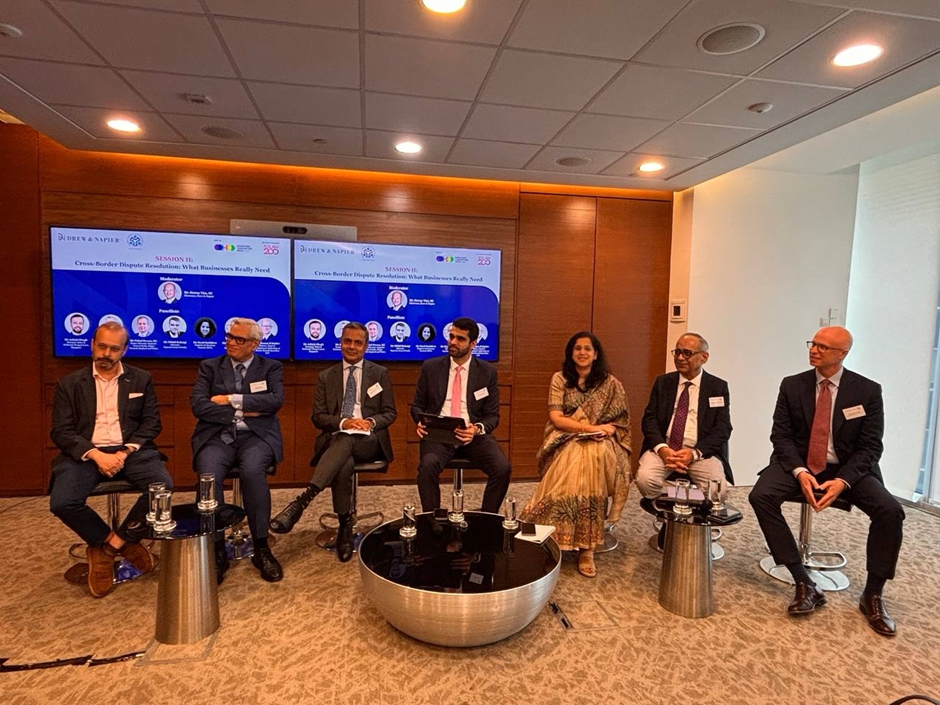
[In Picture Left to Right: Ashish Chugh, Atul Sharma, Nakul Dewan, Nikhil Rohatgi, Neeti Sachdeva, Rajeev Virmani and Thomas R Snider]
The session was moderated by Mr Jimmy Yim, SC, Chairman, Drew & Napier, and featured Mr Ashish Chugh, Principal in the Dispute Resolution Practice Group at Baker McKenzie, Singapore, Mr Atul Sharma, Executive Chairman, Dentons Link Legal, Mr Nakul Dewan, SA, KC, Twenty Essex, Mr Nikhil Rohatgi, Advocate, Ms Neeti Sachdeva, Secretary General, Mumbai Centre for International Arbitration (MCIA), Mr Rajeev Virmani, SA, Supreme Court of India and Mr Thomas R Snider, Partner and Head of International Arbitration, Charles Russell Speechlys LLP. Dr Sanjeev Gemawat, Co-Founder, GCAI, also spoke during the session, sharing his perspectives on mediation, dispute resolution and the development of India’s dispute resolution ecosystem.
Mediation and arbitration: What should businesses choose?
Opening the discussion, Mr Jimmy Yim grouped the questions around the choice of dispute resolution mechanism and asked what lawyers should advise clients at the drafting stage. The discussion considered whether litigation, mediation and arbitration should be viewed as competing mechanisms or as components of an integrated dispute resolution ecosystem.
Mr Nikhil Rohatgi preferred a mediation-arbitration route, while pointing out that litigation could not be completely excluded because courts would continue to have a role, particularly in applications for urgent interim measures under Section 9, Arbitration and Conciliation Act, 1996. He emphasised that if mediation was to be made a precondition, the clause had to be drafted specifically enough to ensure that parties took it seriously.
Mr Ashish Chugh took a case-specific approach. According to him, the location of the counterparty’s assets and the efficiency of the relevant courts were important factors in choosing the appropriate mechanism. Arbitration could be preferable where enforcement through the Convention framework offered greater certainty, while litigation could be more appropriate where parties anticipated requiring injunctions or other court reliefs.
Mr Nakul Dewan questioned whether mandatory mediation clauses had actually resulted in greater use of mediation. He observed that such clauses had instead generated litigation over whether the requirement to mediate concerned admissibility or jurisdiction when a party proceeded directly to arbitration.
He asked:
“How many times have matters gone to mediation and stopped right there and not ended up in arbitration?”
Mr Yim referred to the Singapore Mediation Centre’s experience, where more than 80 per cent of matters that actually reach mediation are resolved. Mr Rajeev Virmani shared the experience of the Delhi High Court Mediation Centre, which has a success rate of about 54 per cent among referred matters. He also noted that parties were increasingly approaching mediation before commencing arbitration or litigation and referred to the mandatory pre-litigation mediation requirement under the Commercial Courts Act, 2015.
Mr Atul Sharma agreed that the answer depended on the circumstances of each case. However, in an international dispute, he considered arbitration to offer the greatest assurance because of the international Convention framework.
He remarked:
“The best assurance that you today have is arbitration.”
He also agreed with Mr Dewan that Med-Arb had not always worked effectively because parties could end up spending years litigating whether the mediation requirement had been satisfied. In his view, arbitration remained the more efficacious choice for international disputes.
Drafting Med-Arb clauses with greater precision
Mr Thomas R Snider, drawing from his practice in Dubai, emphasised that parties must consider where the counterparty’s assets are located. He pointed out the particular importance of this consideration in India-UAE disputes and observed that India recognises the UAE as a reciprocating territory for court judgments but not in the same manner for arbitral awards. He also supported the use of mediation at an early stage, particularly where a mediation protocol provides a clear route to arbitration if settlement fails.
The panel then considered whether the difficulty with Med-Arb lay in the concept itself or in the drafting of the clause. Mr Yim suggested that parties could provide a defined period, such as 90 days, within which mediation must take place, after which the process would time out and arbitration could proceed.
Ms Neeti Sachdeva suggested that the missing element in India was institutional mediation. She observed that standard clauses requiring parties to attempt settlement within 30 or 90 days could become little more than a box-ticking exercise.
She stated:
“One thing you’re missing, what we haven’t tried is institutional mediation.”
She further noted that Indian courts have not consistently enforced mandatory mediation clauses and that there could be a danger in relying on such clauses without proper institutional support. At the same time, she pointed out that the Indian arbitration law itself requires arbitrators to make an attempt at achieving settlement through negotiation or other means.
Dr Sanjeev Gemawat explained that parties frequently attempt to resolve disputes informally during the course of their business relationship and that such settlements are different from formal mediation. In high-stakes and highly complex disputes, he noted, parties may initially be reluctant to reveal their cards.
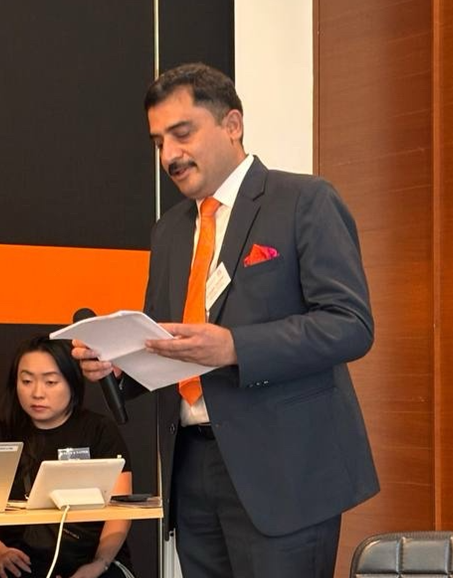
[In Picture: Dr Sanjeev Gemawat]
However, Dr Gemawat explained that his own view of mediation had changed following the development of a statutory framework providing enforceability to mediated settlements. He stressed that credibility of institutions would be critical.
He remarked:
“We need credible institutions.”
Mr Rajeev Virmani responded that mediated settlements before the Delhi High Court Mediation Centre were enforceable as decrees of the court. He explained that pre-litigation mediated settlements also have enforceability under the relevant legal framework. However, he identified an international limitation, noting that India had not yet ratified the Singapore Convention on Mediation.
Mr Yim explained that parties could address this difficulty contractually by providing that once a settlement was reached, the parties would approach the arbitrator to record it as a consent award, allowing the award to potentially benefit from the framework of the 1958 Convention.
Mediation can work, but timing matters
Dr Gemawat further observed that mediation can become effective after litigation or arbitration fatigue sets in. Even in complex and high-stakes matters, there may come a point when the parties are ready to settle because the costs and duration of the dispute have begun to outweigh the perceived benefits of continuing.
The panel also considered whether mandatory mediation introduced too early in a dispute could become an impediment rather than a solution. The discussion acknowledged that while mediation is valuable, its effectiveness may depend substantially on the timing and circumstances in which it is introduced.
Mr Snider explained that mediation could remain strategically useful even where it did not result in an immediate settlement. He noted that the process allows counsel to understand the opposing party and its approach, which can provide useful information for any subsequent arbitration or litigation.
Mr Ashish Chugh added that mediation can change the mindset of the parties. Even where a settlement is not achieved during the mediation itself, the process can encourage parties to think about constructive solutions and may lead to settlement at a later stage.
He explained:
“It gets your mind to start thinking of how can I constructively resolve the dispute.”
Dispute resolution clauses must be drafted with enforcement in mind
The discussion then turned to the importance of enforcement when selecting the mode of dispute resolution, seat, governing law and other contractual terms. Mr Yim observed that dispute resolution clauses are drafted long before the problem arises and therefore require careful consideration at the transaction stage.
The speakers stressed that businesses must consider not only how a dispute will be resolved, but also where the assets of the counterparty are located and whether the eventual outcome can practically be enforced.
The point was put clearly during the discussion:
“In all, in real world, it starts when you are negotiating the deal. That’s the time when you should do your due diligence.”
The discussion emphasised that lawyers should understand the business, its potential pain points and the commercial consequences of a dispute. A dispute resolution clause should therefore not be treated as a standard provision inserted at the end of a contract. Transactional lawyers and disputes lawyers should work together while the agreement is being negotiated.
Mr Yim noted that Drew & Napier advises its transactional lawyers to consult disputes lawyers when drafting such clauses, although he acknowledged that this does not always happen in practice.

[In Picture: Jimmy Yim]
The speakers also cautioned that the governing law of the contract, the law applicable to the arbitration agreement and the law of the seat must be considered carefully. A clause that appears straightforward may create difficulties once a dispute arises if these issues have not been considered at the outset.
Interim relief in Singapore-seated arbitrations involving India
The panel next considered whether parties to a Singapore-seated arbitration seeking interim relief against an Indian party should approach Indian courts directly under Section 9 or rely upon emergency arbitration.
The discussion noted that, in the present position, parties may have to approach Indian courts because there is no general mechanism connecting interim orders of tribunals in one jurisdiction with direct enforcement in another.
A possible solution was discussed through the United Nations Commission on International Trade Law (UNCITRAL) Model Law provisions concerning recognition and enforcement of interim measures. The adoption of such a mechanism between India and Singapore could, it was suggested, create greater predictability for businesses.
The objective was described as making the process quicker, cheaper and more predictable.
Such a mechanism could allow parties to obtain emergency relief from an arbitrator without subsequently having to approach a court merely to make that relief enforceable.
Institutional arbitration as the answer to cost and delay
The discussion then considered why arbitration, originally viewed as a flexible alternative to litigation, has become increasingly expensive and complex.
Ms Sachdeva gave a direct answer:
“I think the answer is institutional arbitration. There is no other answer.”
She explained that institutional arbitration provides greater predictability because parties know the institutional and arbitrator costs at the outset. Referring to MCIA’s experience, she stated that the institution had refunded fees to parties in around 30 per cent of its matters after assessing the actual time spent by arbitrators against applicable standards.
She also highlighted the disciplinary role played by an institution. In institutional arbitration, the institution is there to serve the client and administer the process rather than to serve the arbitrator. This, according to her, can alter the dynamic around fees and procedural discipline.
Dr Sanjeev Gemawat observed that the approach to domestic and international arbitration can be very different. In international arbitration, parties and tribunals generally adhere more closely to prescribed timelines, and the discipline of the tribunal can itself influence the conduct of the parties.
Mr Snider made an important distinction between domestic and international arbitration. He noted that international arbitration was not originally designed simply as a faster and cheaper form of dispute resolution. Rather, it was developed as an alternative to domestic court litigation, offering neutrality and enforceability under the New York Convention.
He explained:
“It was designed as an alternative to domestic court litigation.”
General Counsels and the development of dispute resolution talent
The session then examined whether General Counsels should play a larger role in developing dispute resolution talent and whether India and Singapore could create joint programmes, fellowships and secondments.
Mr Virmani pointed to the lack of practical advocacy-skills training in Indian law schools. He referred to his involvement in an Indo-British advocacy-skills training project through which young lawyers have been trained in case analysis, trial advocacy, drafting, structuring arguments and ethics. He also referred to a GCAI programme conducted in January involving more than 100 interns.
Mr Dewan approached the issue from the perspective of what young lawyers can learn by working in-house. He explained that a General Counsel generally does not want to take the company into a dispute. A young lawyer who spends time within a company can therefore understand the company’s commercial thinking and its preference for moving forward rather than regressing into a dispute.
Mr Rohatgi also highlighted the importance of understanding the implementation of contracts. In infrastructure disputes in particular, he noted that problems often arise because contracts have not been properly understood or managed during implementation.
The discussion also considered the position of General Counsels within organisations. It was noted that GCs are sometimes brought into a transaction only after the commercial terms have already been agreed, even though they are subsequently expected to take responsibility for the legal risks.
The importance of having the General Counsels involved in business decision-making was emphasised through an example where the legal department reported directly to the board. The arrangement allowed lawyers to participate in evaluating risk and facilitating business while ensuring that the company did not cross legal boundaries.
The role of in-house lawyers has also evolved considerably. The discussion noted that in-house practice was previously regarded as a second-grade career option, whereas it has increasingly become a preferred choice for young lawyers, accompanied by significant growth in the size and quality of in-house legal teams.
What is preventing India from becoming a global dispute resolution centre?
The panel then considered the biggest obstacle preventing India from realising its potential as a global dispute resolution centre.
One concern was the time taken for recognition and enforcement of arbitral awards and the subsequent execution process through civil courts. Mr Rohatgi suggested that the problem was not necessarily the absence of supportive law. He pointed out that the Code of Civil Procedure, 1908 already requires courts to give reasons for adjournments, although adjournments are nevertheless frequently granted.
Mr Dewan identified an administrative clog as the central problem. He pointed to India’s English-language legal system, common-law traditions, lawyers and capacity, and argued that greater efficiency in disposing of cases could significantly improve India’s position.
He stated:
“I think it’s an administrative clog. That’s where the problem is.”
The discussion also identified the absence of a sufficiently strong culture of institutional arbitration. The speakers referred to the need for credible institutions operating to international standards and recognised MCIA as an example of institutional arbitration developing successfully in India.
Ms Sachdeva strongly emphasised India’s existing strengths. She noted that India has disputes, talent, law, subject-matter expertise and language, but identified confidence as the missing element.
She said:
“We have the disputes. We have the talent. We have the law. We have the subject. We have the language. What’s lacking? Confidence.”
She argued that India has made significant progress over the last 20 years but has not sufficiently recognised or communicated that progress. Referring to the 18-month timeline for arbitration, she noted that India had been told that such timelines could never work, but had subsequently demonstrated that they could. She therefore urged greater recognition of India’s strengths rather than focusing exclusively on its shortcomings.
India need not simply replicate the Singapore model
The discussion acknowledged that India has deficiencies but cautioned against assuming that India is necessarily worse than other jurisdictions. Experiences in other countries were cited where even court orders could take months to be formally received or where hearings were delayed for several months. In comparison, it was noted that in India, an urgent application could sometimes be filed and heard the following day.
Another concern raised during the discussion was the absence of a coordinated dispute resolution policy. The judiciary, executive and commercial stakeholders were seen as sometimes moving in different directions.
The discussion noted that MCIA’s success was partly attributable to its autonomy and business-led character. At the same time, it was observed that India is fundamentally different from Singapore because of its size, diversity, languages and entrepreneurial environment.
It was therefore suggested that India may be better served by developing multiple credible institutions rather than attempting to reproduce the Singapore model through a single institution. Reference was made to MCIA, the Hyderabad institution and the Chennai-based Nani Palkhivala Arbitration Centre as examples of the potential for different institutions to emerge across India.
The legal profession must also improve its own efficiency
In the closing portion of the discussion, Mr Virmani turned the criticism towards the legal profession itself.
He observed that senior counsel sometimes remain unavailable for arbitration hearings because of commitments in court, resulting in longer dates. He argued that arbitration must be treated seriously and should not be considered secondary to litigation.
He remarked:
“Unless we improve ourselves, we develop a culture that, no, we have to be serious about arbitrations, and not treat it as a second fiddle to litigation.”
The discussion also reflected on the perception of India from outside the country. It was acknowledged that India faces genuine challenges relating to delayed proceedings, written advocacy, professional discipline and legal education. At the same time, it was emphasised that these shortcomings should be viewed alongside the substantial progress made by the country.
It was noted that lawyers dealing with India abroad often encounter a dichotomy in perceptions: criticisms of Indian judgments tend to draw attention to the country’s shortcomings, while positive developments receive comparatively less attention. Nevertheless, there was confidence that continued improvements in legal education, advocacy and professional discipline would gradually address these concerns.
The session concluded with the announcement that the Mediation Council of India had been notified, although its members had not yet been appointed.
Conclusion
The discussion highlighted that effective cross-border dispute resolution begins at the contract-drafting stage, with businesses needing to consider the appropriate mechanism, seat, governing law, location of assets and eventual enforceability of the outcome. The speakers also emphasised the value of credible mediation, institutional arbitration and greater procedural discipline.
The session further presented a balanced picture of India’s dispute resolution ecosystem. While delays, enforcement, institutional development and professional efficiency remain concerns, the speakers also highlighted India’s legal talent, common-law framework and growing arbitration infrastructure. Greater confidence, coordination and efficiency, rather than simply replicating another country’s model, were identified as important to India’s emergence as a global dispute resolution centre.