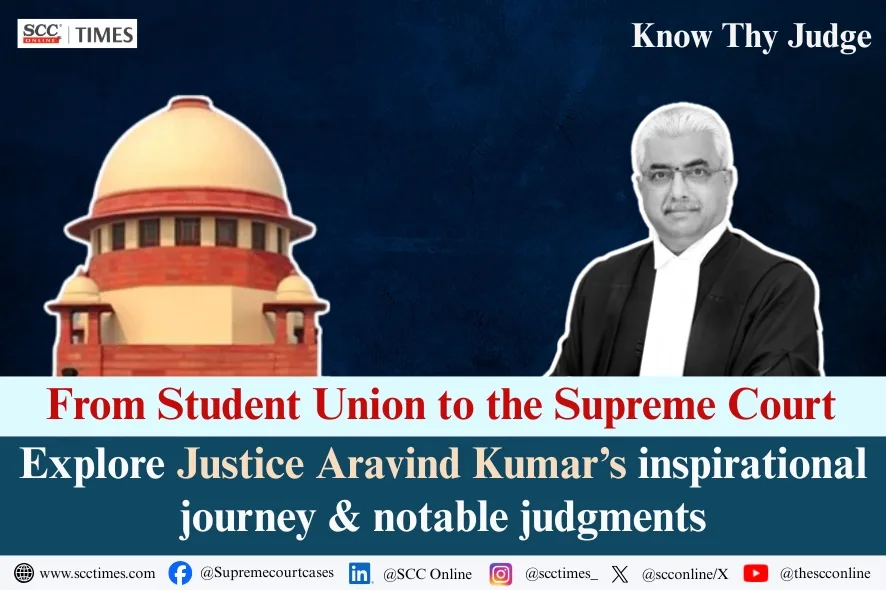
Appointed to the Supreme Court in 2023, Justice Aravind Kumar was born on 14 July 1962 in Karnataka. He did his schooling at Bengaluru (then Bangalore) and continued his further studies from National College. Justice Aravind Kumar obtained his Law degree from Bangalore University1.
Advocacy
Did you Know? During his college days, Justice Aravind Kumar was active as Students Union Leader and was the Vice President of Bangalore University Students Action Committee2.
Justice Aravind Kumar enrolled in 1987 as an Advocate. He appeared in Civil Courts, Magistrate Courts, and Appellate Tribunals for about 4 years before shifting practice to the High Courts. He was later appointed as Additional Central Government Standing Counsel at High Court of Karnataka in 1999 and as Standing Counsel for Income Tax Department for 11 years3.
Justice Kumar was also appointed as Member of Regional Direct Taxes Advisory Committee in the year 2002. Justice Aravind Kumar was also appointed as the Assistant Solicitor General of India in the year 2005.4
Justice Aravind Kumar was one of the founder member and Vice-President of Lahari Advocates Forum, an organization promoted by distinguished Senior Advocates for promoting Legal Education, training young advocates, conducting workshops on various subjects for Advocates, conducting orientation courses to young Advocates seeking appointment as judicial officers. Justice Aravind Kumar acted as a legal advisor to various statutory corporations and companies and had also been appointed as Special Public Prosecutor for the Central Bureau of Investigation till his elevation as Judge of Karnataka High Court.5
Judgeship of the High Court
Justice Aravind Kumar was elevated as Additional Judge of Karnataka High Court on 26 June 2009 and later as Permanent Judge on 7 December 20126.
After serving Karnataka High Court as a Judge for 9 years, Justice Aravind Kumar was appointed as Chief Justice of Gujarat High Court on 13 October 20217.
Notable Initiatives taken by Justice Aravind Kumar during his time in the High Courts
-
During his judgeship in Karnataka High Court, Justice Aravind Kumar along with the then Chief Justice of Karnataka High Court, Abhay S. Oka took significant steps to tackle Covid-19 pandemic in 2021. Chief Justice Oka and Justice Kumar issued several directions to ensure that labs provide COVID results within 24 hours; and that those who have died due to Covid-19 are given dignified burial/ cremation. The Judges also issued directions to address Covid vaccine scarcity and issues related to food security. Furthermore, Chief Justice Abhay S. Oka and Justice Aravind Kumar directed the State Government to ensure availability of oxygen cylinders and medicines effective in treatment of mucormycosis.
-
During his 1.4-year tenure as Chief Justice of Gujarat High Court, Justice Aravind Kumar initiated the creation of ‘Signal Schools’. These schools were launched jointly by the Gujarat State Legal Services Authority (GSLSA) and Ahmedabad Municipal Corporation to provide basic educational facilities to children engaged in begging jobs, with buses converted into classrooms and stationed near traffic signals8.
-
As Chief Justice of Gujarat High Court, Justice Aravind Kumar was committed to tackle the issue of pending cases; therefore, he per cent.9
-
As Chief Justice of Gujarat High Court and patron-in-chief of GSLSA, Justice Aravind Kumar also conducted Lok Adalats to resolve cases pertaining to traffic challans, electricity and water bills, labour disputes and service matters related to pay, allowances and retiral benefits.
-
As Chief Justice of Gujarat High Court, Justice Aravind Kumar also initiated the live streaming of District Courts on pilot basis10.
Elevation to Supreme Court and the Tenure so far
Considering Justice Aravind Kumar’s seniority, merit, performance and integrity; the Supreme Court Collegium recommended his elevation as Judge of Supreme Court of India.
The recommendation was accepted by the Law Ministry and Justice Aravind Kumar’s elevation was confirmed via notification dated 10 February 2023 and finally on 13 February 2023, Justice Aravind Kumar took oath of office as Judge of the Supreme Court of India. He is due to retire on 13 July 2027.11
Justice Aravind Kumar was part of the Judges Inquiry Committee constituted to investigate allegations against Justice Yashwant Varma formally submitted its report to the Speaker of the Lok Sabha, Mr. Om Birla.
In May 2026, Chief Justice Surya Kant announced constitution of a high-powered committee headed by Justice Aravind Kumar to prepare a blueprint for the modernisation of courts across the country and secure a government allocation of 40 to 50 thousand crore rupees for the purpose. The ‘Judicial Infrastructure Advisory Committee’ will address infrastructural deficiencies in courts through substantial financial support from the government12.
Notable Supreme Court Judgments
Judicial Officers with 7 years’ experience in law practice are eligible for direct appointment as District Judge/Additional District Judge: Supreme Court
In Rejanish K.V. v. K. Deepa, (2026) 4 SCC 513, a 5-Judge Constitution Bench comprising of B.R. Gavai, CJI.*, M.M. Sundresh, Aravind Kumar, S.C. Sharma and K. Vinod Chandran, JJ., while deciding a reference on issues related to appointment of Judicial Officers as District Judges, held the following:
-
Judicial Officers who have already completed 7 years in Bar before they were recruited in the subordinate judicial service, would be entitled for being appointed as a District Judge/Additional District Judge in the selection process for the post of District Judges in the direct recruitment process.
-
The eligibility for appointment as a District Judge/Additional District Judge is to be seen at the time of application.
-
Though there is no eligibility prescribed under Article 233(2) of the Constitution for a person already in judicial service of the Union or of the State for being appointed as District Judge; in order to provide a level playing field, the Court directed that a candidate applying as an in-service candidate should have 7 years’ combined experience as a Judicial Officer and an advocate.
-
A person who has been or who is in judicial service and has a combined experience of 7 years or more as an advocate or a Judicial Officer, would be eligible for being considered and appointed as a District Judge/Additional District Judge under Article 233 of the Constitution.
-
In order to ensure level playing field, the Court directed that the minimum age for being considered and appointed as a District Judge/Additional District Judge for both advocates and Judicial Officers would be 35 years of age as on the date of application.
-
The Court held that view taken in Satya Narain Singh v. High Court of Judicature at Allahabad, (1985) 1 SCC 225, till Dheeraj Mor v. High Court of Delhi, (2018) 4 SCC 619, which takes a view contrary to what has been held above, do not lay down the correct proposition of law. Read more
No Bail for Umar Khalid and Sharjeel Imam; 5 Accused get bail: Inside Supreme Court’s Big Verdict in 2020 Delhi Riots Case
While considering the bail pleas of Sharjeel Imam, Umar Khalid, Shifa Ur Rehman, Mohd. Saleem Khan, Meeran Haider, Shadab Ahmed and Gulfisha Fatima who were booked under several provisions of Penal Code, 1860, Unlawful Activities (Prevention) Act, 1967 (UAPA), Arms Act and Prevention of Damage to Public Property Act, 1984, for their alleged involvement in 2020 Delhi NCR communal riots and larger conspiracy; the Division Bench of Aravind Kumar* and N.V. Anjaria, JJ., in Gulfisha Fatima v. State (NCT of Delhi), 2026 SCC OnLine SC 10, refused to grant bail to Sharjeel Imam and Umar Khalid, expressing satisfaction that the prosecution material prima facie discloses attribution of a central and formative role by the 2 accused persons. Vis-a-vis Shifa Ur Rehman, Mohd. Saleem Khan, Meeran Haider, Shadab Ahmed and Gulfisha Fatima, the Court decided to grant them conditional bail having regard to the role attributed, the nature of the material relied upon, and the present stage of the proceedings. Read more
Successive FIRs to Defeat Bail amount to Abuse of Process: Supreme Court invokes Article 32 to grant Bail
In Binay Kumar Singh v. State of Jharkhand, 2026 SCC OnLine SC 208, under Article 32 of the Constitution, alleging repeatedly invoking and deploying the criminal process against the petitioners by way of successive registration of FIRs and custodial remands, particularly after grant of bail, is said to be arbitrary, mala fide, and violative of Articles 14, 19 and 21, a Division Bench of Aravind Kumar and Prasanna B. Varale, JJ., concluded that the successive registration of FIRs was solely to keep the petitioner 1 in custody. The Court granted bail to the petitioner 1 and directed that no coercive steps be taken against petitioner 2, subject to cooperation with investigation. Read more
Personal appearance of accused before appellate/revisional court on every date after suspension of sentence & grant of bail not warranted: Supreme Court
In Meenakshi v. State of Haryana, 2026 SCC OnLine SC 94, while deciding whether, after suspension of sentence and grant of bail in a criminal appeal, the appellate/revisional court is justified in insisting upon the personal appearance of accused on every date of hearing and in cancelling bail with issuance of Non-Bailable Warrant (NBW), a Division Bench of Aravind Kumar and Prasanna B. Varale, JJ., held that directing personal appearance of accused before appellate/revisional court on every date after suspension of sentence & grant of bail is not warranted. In the instant matter, the appellant, accused in a case under Section 138 of the Negotiable Instruments Act, 1881 (NI Act), was initially granted suspension of sentence and released on bail, which was extended from time to time. Subsequently, the appellate court cancelled the bail, issued a Non-Bailable Warrant (NBW), and took the appellant into custody. Read more
“Law can’t change with change of Bench”; Supreme Court directs refund to Adani Power; quashes customs duty on electricity supplied from SEZ to DTA
Finally putting rest to the controversy arose from the levy of customs duty on Adani Power Limited for generating electrical energy within a Special Economic Zone (SEZ) and suppling to the Domestic Tariff Area (DTA), a levy of Customs Duty on Electricity which had earlier been declared to be without authority of law by the Gujarat High Court in Adani Power Ltd. v. Union of India, 2015 SCC OnLine Guj 6720, however, the Union continued to sought recovery of duty for subsequent periods under later notifications, a Division Bench of Aravind Kumar* and N.V. Anjaria, JJ., in Adani Power Ltd. v. Union of India, (2026) 3 SCC 143, held that once the very authority to levy customs duty on electricity had been negated, the State could not reassert the same impost in altered form, nor could a Co-ordinate Bench dilute the binding effect of an earlier declaration of law. The Court directed for the refund of such collected custom duty on electricity to Adani Power. Read more
Explained | Supreme Court upholding validity of notification designating Kolhapur as additional Bench of Bombay High Court
While Ranjeet Baburao Nimbalkar v. State of Maharashtra, 2025 SCC OnLine SC 2855, challenging administrative notification issued by Bombay High Court appointing Kolhapur as a place at which the Judges and Division Courts of the said High Court may sit; the Division Bench of Aravind Kumar and N.V. Anjaria, JJ., upheld that validity of the impugned notification designating Kolhapur as additional Bench of Bombay High Court. The Court reiterated that the power under Section 51(3) of the States Reorganisation Act, 1956 is an independent and continuing power vested in the Chief Justice of a High Court to appoint additional places of sitting for the more convenient transaction of judicial business, subject to the approval of the Governor. The exercise of this power is not dependent upon the establishment of a permanent Bench under Section 51(2), nor is it constrained by administrative decisions taken in the past under different circumstances. Judicial review of such decisions is correspondingly limited and extends only to examining whether the action is within jurisdiction, bona fide, and consistent with constitutional requirements. Read more
Verification of ticket issuance corresponding the date/route of untoward incident by official railway inquiry can be a proof of bona fide travel: SC
While considering the Rajni v. Union of India, 2025 SCC OnLine SC 2182, challenging Madhya Pradesh High Court’s dismissal of the claim petition seeking compensation on account of the death of the appellant’s husband in an alleged railway accident; the Division Bench of Aravind Kumar* and N.V. Anjaria, JJ., held that where an official railway inquiry or evidentiary record verifies the issuance of a ticket corresponding to the date and route of an untoward incident, such verification shall constitute prima facie proof of bona fide travel, shifting the evidentiary burden on the Railway Administration. The Court explained that absence of a seizure memo, or the inability of the police to preserve physical evidence, cannot by itself defeat a legitimate claim when the totality of circumstances supports the claimant’s version. This principle shall guide all future tribunals and High Courts in construing Section 124-A of the Railways Act, 1989, so that the statutory right to compensation remains real, accessible, and consonant with the humanitarian purpose of the enactment. Read more
“Legal process cannot be misused to re-traumatise child abuse survivors”: SC rejects POCSO convict’s plea to recall 11-year-old niece for cross-examination
In Arjun Sonar v. State of Arunachal Pradesh, 2025 SCC OnLine SC 2065, filed by a man convicted under Section 6 of the Protection of Children from Sexual Offences Act, 2012 (‘POCSO Act’) for aggravated penetrative sexual assault on his 11-year-old niece, the division bench of Aravind Kumar and NV Anjaria, JJ. upheld the 20-year rigorous imprisonment sentence awarded by the Special POCSO Court and affirmed by the Gauhati High Court. The Court further emphasised that courts must remain vigilant to ensure that procedural submissions are not misused as tactics for harassment. In strong terms, it held that requests to recall a child victim after the conclusion of trial and concurrent findings of guilt raise serious concerns, particularly when there is no manifest illegality or perversity in the appreciation of evidence. The convict, who was the maternal uncle of the victim, was originally convicted in POCSO Case registered under Sections 376 and 506 of the Penal Code, 1860 (‘IPC’) read with Section 12 of the POCSO Act. The main contention raised by the convict was that he was denied effective legal assistance during trial, as his defence counsel had failed to cross-examine the prosecutrix. Based on this, he sought a fresh opportunity to test her testimony. Read more
Supreme Court Steps In: EDMC and PWD directed to respond to allegations of Manual Scavenging
In Balram Singh (Dr.) v. Union of India, 2025 SCC OnLine SC 1672, concerning manual scavenging, the Division Bench comprising Sudhanshu Dhulia and Aravind Kumar, JJ., directed the East Delhi Municipal Corporation (EDMC) to file a reply to the applications, explaining why manual scavenging and hazardous cleaning were still being carried out using manual labour, thereby endangering workers’ lives and failing to provide them with proper safety gear, as evidenced by the photographs annexed to the applications. Read more
POCSO| ‘No mitigation for crimes that subvert notion of family as space of security’; SC upholds father’s life sentence
While considering Bhanei Prasad v. State of H.P., 2025 SCC OnLine SC 1636, challenging the affirmation of accused person’s conviction and sentence under Section 6 of the Protection of Children from Sexual Offences Act, 2012 (‘POCSO Act’) and Section 506 of the Penal Code, 1860 (IPC) by Himachal Pradesh High Court; the Division Bench of Aravind Kumar and Sandeep Mehta, JJ., confirmed the decisions of the Trial Court and the High Court. Noting that the accused in the case is the father of the victim, the Court strictly emphasised that incestuous sexual violence committed by a parent is a distinct category of offence that tears through the foundational fabric of familial trust and must invite the severest condemnation in both language and sentence. When a child is forced to suffer at the hands of her own father, the law must speak in a voice that is resolute and uncompromising. “There can be no mitigation in sentencing for crimes that subvert the very notion of family as a space of security”.
Therefore, the Court exercising its powers under Article 142 of the Constitution, directed that a sum of Rs 10, 50,000 to be paid to the victim as compensation as per the Scheme by the State of Himachal Pradesh in the peculiar facts of the case. Read more
‘Employer’s discretion ends where employee’s dignity begins’; Supreme Court directs TSRTC to redeploy colour-blind employee
Ch. Joseph v. Telangana SRTC, 2025 SCC OnLine SC 1592, challenged the decision by Division Bench of Hyderabad High Court for State Telangana, whereby it had set aside the direction to Telangana State Road Transport Corporation (TSRTC) to provide the appellant, who is colour blind, with an alternative employment. The Division Bench of J.K. Maheshwari and Aravind Kumar*, JJ., allowed the appeal by holding that the Appellant was prematurely retired from service on medical grounds without any meaningful effort by the Corporation to explore his suitability for alternate employment. This action was taken in disregard of Clause 14 of the binding Memorandum of Settlement dated 17 December 1979 and without adherence to principles of fairness or accommodation and is therefore, unsustainable in law. The duty of a public employer is not merely to discharge functionaries, but to preserve human potential where it continues to exist. The law does not permit the severance of service by the stroke of a medical certificate without first exhausting the possibility of meaningful redeployment. Such obligation is not rooted in compassion, but in constitutional discipline and statutory expectation. The Court said that when an employee is removed from service for a condition he did not choose, and where viable alternatives are ignored; the Court is not crossing a line by intervening as it is upholding one drawn by the Constitution itself. “The employer’s discretion ends where the employee’s dignity begins”. Read more
Beyond Sabarimala: 9-Judge Bench Examines Validity of Parsi Excommunications Under Articles 25/26
A nine-judge Constitution Bench of the Court comprising of Surya Kant, CJ., B.V. Nagarathna, M.M Sundresh, Ahsanuddin Amanullah, Aravind Kumar, Augustine George Masih, Prasanna B Varale, R Mahadevan and Joymalya Bagchi, JJ., is hearing a seminal reference arising from the Indian Young Lawyers Assn. (Sabarimala Temple-5J.) v. State of Kerala, (2019) 11 SCC 1. The Bench has been considering foundational constitutional questions on the balance between individual religious freedom under Article 25 and denominational autonomy under Article 26, the permissibility of gender-based exclusions in matters of faith, and the extent to which courts may scrutinize excommunicatory practices, including those within the Parsi community. Read more
Supreme Court issues notice in challenge to Punjab & Haryana High Court’s decision on EWS reservation in PPSC Agriculture Development Officer recruitment
In Harpreet Singh v. Sikandar Singh, 2025 SCC OnLine SC 769, filed against the judgment passed by the Punjab and Haryana High Court concerning Economically Weaker Section (‘EWS’) reservation in Punjab Public Service Commission (‘PPSC’) recruitment for Agriculture Development Officer, a division bench of J.K. Maheshwari and Aravind Kumar, JJ. issued notice, with a returnable period of 6 weeks. Read more
Supreme Court orders Uttarakhand Govt. to pay Rs. 1 crore to family of doctor killed on duty after 9 years of legal battle
In State of Uttarakhand v. Sarita Singh, 2025 SCC OnLine SC 640, concerning the non-compliance of the proposal to pay Rs 50 lakhs compensation to the family of a government doctor, who was tragically shot dead while working at a Community Health Centre in April 2016, the division bench comprising Justices JK Maheshwari and Aravind Kumar held that, in light of the gravity of the incident, the sanction for compensation must be honored, and the amount should be paid along with interest. The total amount, including interest for approximately nine years, was quantified at Rs. 1 crore. Out of this, Rs. 11 lakhs had already been paid. The Court directed that the remaining Rs. 89 lakhs be paid within six weeks, and compliance with this order must be reported to the Registry on affidavit by the next date of listing. Read more
Road Accident | SC grants interim bail to accused due to his father’s compassionate endeavour towards victim’s orphaned minors
While considering Jay Chandrahas Gharat v. State of Maharashtra, 2025 SCC OnLine SC 498, wherein the appellant sought bail for the offences registered under Sections 201, 279, 304, 304(2), 338, 353, 504 of the Penal Code, 1860 read with Sections 134(A), 134(B) and 184 of Motor Vehicle Act, 1988; the Division Bench of J.K. Maheshwari and Aravind Kumar, JJ., granted interim bail to the accused for period of 3 months after taking note of the peculiar facts of the case and the endeavour of the accused person’s father for taking steps towards restorative justice, by which he has shown his concern to maintain the minor children after the demise of their parents on account of the road traffic accident caused by his son. Read more
From Death Row to Life: Supreme Court commutes sentence of man convicted for Sexual assault and murder of 4-year-old boy
In Sambhubhai Raisangbhai Padhiyar v. State of Gujarat, (2025) 2 SCC 399, filed by the appellant (convict) convicted for the offences of kidnapping, sexual assault and murder of a four-year-old child, the three Judge bench of B.R. Gavai, Aravind Kumar and K. V. Viswanathan*, JJ. while maintaining the conviction under Sections 302, 364, 377 of the Penal Code, 1860 (‘IPC’) and Sections 4 and 6 of Protection of Children from Sexual offences Act, 2012 (‘POCSO Act’), set aside the sentence of death for the offence under Section 302 and substitute the same with that of rigorous imprisonment for a period of 25 years without remission. Further, the Court ordered that the sentence imposed for offences under Section 364 IPC (10 years S.I. and Rs. 10,000/- fine) and Section 6 of the POCSO Act (life imprisonment and Rs.10,000/- fine) to run concurrently with the sentence of rigorous imprisonment for a period of 25 years without remission. Read more
SC restores bail granted to BJP’s Girraj Singh Malinga in 2022 for offences under IPC and SC/ST Act
In Girraj Singh Malinga v. State of Rajasthan, 2024 SCC OnLine SC 3817, while considering the instant appeal filed by BJP leader Girraj Singh Malinga against cancellation of his bail granted for offences punishable under provisions of the Penal Code, 1860 and the SC/ST (Prevention of Atrocities) Act, 1989; the Division Bench of M.M. Sundresh and Aravind Kumar, JJ., restored the earlier bail order granted by Rajasthan High Court, taking into note that the appellant has already surrendered. The Court directed the appellant’s release on the very same terms and conditions based on which he was granted bail. Read more
Supreme Court commutes death sentence of father convicted for murdering his pregnant daughter over inter-caste marriage
While considering Eknath Kisan Kumbharkar v. State of Maharashtra, 2024 SCC OnLine SC 2879, challenging Bombay High Court’s decision confirming death sentence to the appellant for murdering his pregnant daughter, the Division Bench of Aravind Kumar* and KV Viswanathan, JJ., took note of the appellant’s lack of criminal antecedents, presence of mitigating factors, medical reports and satisfactory behaviour with the prison inmates and opined that even though the crime committed by the appellant is unquestionably grave and unpardonable, it is not appropriate to affirm the death sentence that was awarded to him. Hence the Court was in favour of converting the death penalty to fixed sentence during which period the appellant would not be entitled to apply for remission. Thus, the Court confirmed the appellant’s conviction, but death penalty imposed under Section 302, IPC, was converted to 20 years of rigorous imprisonment without remission. Read more
Improper for Court to grant interim relief in routine situations when a party has been directed to seek relief from High Court: Supreme Court
In Gagan Banga v. State of W.B., 2024 SCC OnLine SC 2608, filed by Indiabulls Housing Finance Limited (‘Indiabulls’) praying to lay down appropriate guidelines to be followed by all including the police officials and Judicial Magistrate to desist from initiating or directing initiation of criminal proceedings against the financial institutions, its assignees, management, officers, employees, lawful transferees and purchasers of secured assets at the behest of defaulting borrowers, so as to protect their fundamental rights inter alia guaranteed under Article 14, 19 and 21 of the Constitution of India, 1950, and also prayed for quashing the FIRs, the division bench of Sanjay Kumar and Aravind Kumar, JJ. said that when a party is relegated to the High Court to pursue its remedies, it would not be proper, in the normal course, to bind the said High Court with directions in relation to the proceedings to be impugned before such Court. Thus, when the Supreme Court refuses to entertain a matter and asks the party to approach the High Court, it would be improper to grant interim relief to such party. The Court also noted that such directions can be misconstrued by the High Courts to be observations by this Court on the merits of the matter, thereby influencing the adjudication of the case. Read more
Cause, not length of delay to be examined while considering condonation pleas: Supreme Court
While considering the instant appeal titled Mool Chandra v. Union of India, (2025) 1 SCC 625 revolving around application for condonation of delay of 425 days, the Division Bench of Aravind Kumar* and Sandeep Mehta, JJ., stated that it is not the length of delay that would be required to be considered while examining the plea for condonation of delay, it is the cause for delay which has been propounded will have to be examined. If the cause for delay would fall within the four corners of “sufficient cause”, irrespective of the length of delay same deserves to be condoned. However, if the cause shown is insufficient, irrespective of the period of delay, same would not be condoned. Read more
SC calls for performance audit of Maharashtra Slum Areas Act; Emphasises on review of implementation of Statute to ensure Rule of Law
In Yash Developers v. Harihar Krupa Coop. Housing Society Ltd., (2024) 9 SCC 606, which was an appeal against a decision of the Apex Grievance Redressal Committee and the Bombay High Court, upholding the terminating the development agreement was made in exercise of power under Section 13 of the Maharashtra Slum Areas (Improvement, Clearance and Redevelopment) Act, 1971, the Division Bench of PS Narasimha and Aravind Kumar, JJ. dismissed the appeal for being devoid of merits and upheld the impugned decisions. The Court requested the Chief Justice of the High Court to constitute a Bench to undertake the comprehensive statutory audit of the Act. Read more
Display boards/Signboards | SC clarifies the definition of ‘advertisement’ and the law on requirements of levy of tax on advertisements
The Division Bench of S. Ravindra Bhat and Aravind Kumar*, JJ., in Harsh Automobiles (P) Ltd. v. Indore Municipal Corpn., (2024) 2 SCC 485, held that by mere mentioning the name of the product in which the business establishment is being run would not partake the character of the advertisement until and unless by such display customers are solicited. In the absence of the display of the name board or signboard either by a business establishment or any other establishment including public offices and professionals or schools or colleges, etc. it would drive the potential customer to such a situation where it would be neigh impossible to identify the business establishment from which the potential customer proposes to buy. However, if the signboards so displayed would in any manner promote a particular product or goods or services or in other words it would attract customers to purchase a particular brand of product or goods or services and such display provides information about the product/services and solicit the customers, it may amount to advertisement while the latter would only be an information to the public.
Supreme Court directs HCs and DGPs of all States to ensure Arnesh Kumar guidelines are issued to lower courts and police authorities to prevent unnecessary arrests
The division bench of S. Ravindra Bhat and Aravind Kumar in Mohd. Asfak Alam v. State of Jharkhand, (2023) 8 SCC 632, while setting aside the impugned order, directed all the courts to strictly follow the law laid down in Arnesh Kumar v. State of Bihar, (2014) 8 SCC 469 and further reiterated the directions contained thereunder. Further, it directed the High Court to frame these directions in the form of notifications and guidelines to be followed by the Sessions Courts and all other Criminal Courts dealing with various offences. Read more
Compulsory acquisition of private property: Supreme Court outlines seven sub-rights of Constitutional Right to Property
In Kolkata Municipal Corpn. v. Bimal Kumar Shah, 2024 SCC OnLine SC 968, filed by the Kolkata Municipal Corporation (‘Corporation’) against the Calcutta High Court Judgment, wherein the Court held that there is no power of compulsory acquisition of immovable property under Section 352 of the Kolkata Municipal Corporation Act, 1980 (‘the Act’), the division bench of PS Narasimha and Aravind Kumar, JJ. has upheld the impugned Judgment. Further, while interpreting “authority of law” in Article 300A of the Constitution, the Bench has held that a minimum content of a constitutional right to property comprises of seven sub-rights or procedures such as the right to notice, hearing, reasons for the decision, to acquire only for public purpose, fair compensation, efficient conduct of the procedure within timelines and finally the conclusion. These sub-rights have synchronously formed part of our laws and have attained judicial recognition. Therefore, as Section 352 does not provide for these sub-rights or procedures, it can never be a valid power of acquisition. Further, the Bench held that Section 352 is only intended to enable the Municipal Commissioner to decide whether a land is to be acquired for public purpose. The power of acquisition is in fact vested with the State under Section 537 and it will exercise it, in its own discretion, whenever the Municipal Commissioner makes an application to that effect. Read more
Subordinate legislation ultra vires to Parent Act? Supreme Court summarises principles for deciding cases
In Naresh Chandra Agrawal v. Institute of Chartered Accountants of India, 2024 SCC OnLine SC 114, which was an appeal filed against the Delhi High Court’s decision, wherein the appellant’s challenge to Rule 9(3)(b) of the Chartered Accountants’ (Procedure of Investigation of Professional and Other Misconduct and Conduct of Cases) Rules, 2007 as ultra vires of Section 21A (4) of the Chartered Accountants, 1949, the Division Bench of Pamidighantam Sri Narasimha and Aravind Kumar*, JJ. summarised legal principles relevant in adjudicating cases where subordinate legislation is challenged on the ground of being ‘ultra vires’ to the Parent Act. Read more
Supreme Court illuminates on bail under Section 43D (5) of UAPA against general rule of CrPC
In Gurwinder Singh v. State of Punjab, (2024) 5 SCC 403, challenging order passed by the Punjab and Haryana High Court on 24-04-2023 upholding the rejection of application under Section 439 of Criminal Procedure Code, 1973 for a matter involving offences under Sections 124-A, 153-A, 153-B, 120-B of the Penal Code, 1860 (‘IPC’), Sections 17, 18, 19 of the Unlawful Activities (Prevention) Act, 1967 (‘UAPA’) and Sections 25 and 54 of Arms Act, 1959, the Division Bench of M.M. Sundresh and Aravind Kumar*, JJ. refused to grant bail while explaining the rule against bail delineating provisions under UAPA as against general rule under CrPC. Read more
Consumer Dispute| ‘Eggshell Skull rule’ to be applied in Medical Negligence Cases of victims with pre-existing vulnerability or medical condition: Supreme Court
In Jyoti Devi v. Suket Hospital,
Identification of private forests in Goa| ‘No uniform criteria due to distinctive geographical features’; SC holds existing criteria valid
In T.N. Godavarman Thirumulpad v. Union of India, (2024) 3 SCC 438, challenging National Green Tribunal’s common order, wherein Goa Foundation’s (‘appellant’) application was dismissed on the ground that the issue of determination of criteria for the identification of ‘forest’ formed part of the proceedings in In Re: TN Godavarman Thirumulpad, the three Judge Bench of B.R Gavai, Aravind Kumar* and Prashant Kumar Mishra, JJ. dismissed the appeal and upheld the impugned Order. Read more
Explained | Supreme Court verdict on principles relating to presumption and evidential burden under Ss. 138 & 139 of NI Act
In an appeal titled Rajesh Jain v. Ajay Singh, (2023) 10 SCC 148, that was filed against the Judgment and order of Punjab and Haryana High Court, wherein the Court upheld the acquittal order of the Trial Court concerning an offence under Section 138 of the Negotiable Instruments Act, 1881 (‘NI Act’), the division bench of Aravind Kumar and SVN Bhatti, JJ. while setting aside the impugned judgment, allowed the complaint filed under Section 138 NI Act and convicted the accused with fine of twice the amount of the cheque (Rs.13,90,408/-) failing which he shall undergo simple imprisonment for one year. Read more
What is the ambit of “Commercial Purpose” defined under Consumer Protection Act?: Supreme Court answers
In an appeal titled Rohit Chaudhary v. Vipul Ltd., (2024) 1 SCC 8, against the order passed by the National Consumer Dispute Redressal Commission (‘NCDRC’), wherein the commission held that the commercial space booked by the complainants was for earning profit and not for the purpose of earning a livelihood by self-employment. Thus, the appellants are not consumers as defined under Section 2(1)(d) of the Act, the division bench of S. Ravindra Bhat and Aravind Kumar*, JJ. while setting aside the impugned order, said that the expression ‘for any commercial purpose’ must be understood as covering cases other than those of resale of the goods. The persons buying goods either for resale or for use in large-scale profit-making activity will not be consumers entitled to protection under the Act. However, if commercial use is by purchasers for earning livelihood by self-employment, they will be considered as consumers. Thus, it directed the respondent to refund a sum of Rs.51,10,117/- with interest at 12% per annum from the date of complaint till date of payment with litigation cost of Rs. 1 lakh to the appellant. Read more
Adherence to Article 14 by State must even while acting in Contractual Realm: Supreme Court
In Madras Aluminium Co. Ltd. v. T.N. Electricity Board, 2023 SCC OnLine SC 7839, the three Judge Bench of B.R. Gavai, Sanjay Karol* and Aravind Kumar, JJ., said that the State must abide by Article 14 of the Constitution of India even if its action was in the contractual realm.
“Voting by secret ballot should not be the rule but clearly an exception”; Supreme Court modifies guidelines for designation of Senior Advocates
In the case titled Indira Jaising v Supreme Court of India, 2023 SCC OnLine SC 614, filed by Senior Advocate Indira Jaising against the existing system of designation of Senior Advocates, terming it flawed as it was not objective, fair, and transparent, and thus did not take into account considerations of merit and ability, the 3-Judge Bench of Sanjay Kishan Kaul*, Ahsanuddin Amanullah, and Aravind Kumar, JJ. has fine-tuned the guidelines laid down in Supreme Court’s 2017 Judgment13, to bring in greater transparency and objectivity in the designation process. Read more
Courts cannot prescribe qualification or declare equivalency of a course, unless the rule itself prescribes equivalency
In Unnikrishnan CV v. Union of India, 2023 SCC OnLine SC 343, wherein the appellants were claiming promotion to the post of Superintendent BR Grade-I and Assistant Engineer as per Column 11 of the General Reserve Engineer Force Group ‘C’ and Group ‘D’ Recruitment Rules, 1982 (‘GREF Rules, 1982), the Full Bench of Sanjay Kishan Kaul, Manoj Misra and Aravind Kumar*, JJ. while rejecting the appeal, reiterated that Courts cannot prescribe the qualification and/or declare the equivalency of a course, until and unless the rule itself prescribes the equivalency. Read more
Notable High Court Judgments
Gujarat High Court | Delay in appointment of presiding officer of DRT leading to deprivation of legitimate right to speedy justice
The Division Bench of Aravind Kumar, CJ. and Ashutosh J. Shastri, J., in Nipun Praveen Singhvi v. Union of India, 2022 SCC OnLine Guj 828, allowed a writ petition which was filed seeking for a direction to fill up the post of Presiding Officer in Debt Recovery Tribunal-I, Ahmedabad contending inter-alia such vacancy violates the legal rights of the petitioner, bankers/lenders, borrowers, guarantors and other stake holders. Read More
Gujarat High Court | Show cause notice issued to 9 Judicial officers for disobeying the order of the High Court and not disposing of the case pending since 1977
While deciding the application, the division bench of Aravind Kumar, CJ., and Ashutosh J. Shastri, J., in Patel Ambalal Kalidas v. Patel Motibhai Kalidas11, called upon the Judicial Officers to show cause as to why contempt proceedings should not be initiated against them for wilfully disobeying the order and direction issued by this Court. Read More
Gujarat High Court | Notice for appointment of arbitrator cannot be rejected on ground of vague material particulars
While deciding the instant petition, Aravind Kumar, C.J., in Hemlata Jain v. Padmavati Analkumar Mishra, 2022 SCC OnLine Guj 1787, said that the prayer for appointment of an arbitrator under Section 11(6) of the Arbitration and Conciliation Act, 2016 cannot be rejected on the ground that it is vague or bereft of the material particulars as Section 21 of the A&C Act does not remotely suggests that the nature of dispute has to be enumerated or explained in the notice invoking the arbitration clause. Read More
Karnataka HC | Yipee Magic Masala Noodles and Wai Wai Majedaar Masala Noodles copyright infringement battle
A Division Bench of Aravind Kumar and Pradeep Kumar Yerur, JJ., in ITC Ltd. v. CG Foods (India) (P) Ltd., 2021 SCC OnLine Kar 14700, dismissed the appeal and affirmed the order dated 22-06-2021 passed in O.S.No.177/2021 by LXXXIV Additional City Civil and Sessions Judge (CCH-85) (Commercial Court), Bengaluru. The Court observed that while deciding the question of copyright infringement it is not necessary that the defendants work must be an exact reproduction of the plaintiff’s work. What is essential is to see whether there is a reproduction of the substantial part of the plaintiff’s work. Read More
Karnataka HC | Persons with disabilities are entitled to priority in medical treatment in light of S. 25 of Rights of Persons with Disabilities Act, 2016
A Division Bench of Abhay S Oka, CJ and Aravind Kumar, J., in Mohd. Arif Jameel v. Union of India, 2021 SCC OnLine Kar 15714, gave a slew of directions regarding vaccine allocation. The Court took stock of the various aspect related to COVID vaccination in the State. Read More
1. Chief Justice & Judges | SUPREME COURT OF INDIA (sci.gov.in)
2. Supra
3. High Court of Gujarat (gujarathighcourt.nic.in); Chief Justice & Judges | SUPREME COURT OF INDIA (sci.gov.in)
4. Chief Justice & Judges | SUPREME COURT OF INDIA (sci.gov.in)
5. Chief Justice & Judges | SUPREME COURT OF INDIA (sci.gov.in)
6. Hon’ble Mr. Justice Aravind Kumar (kar.nic.in)
7. High Court of Gujarat (gujarathighcourt.nic.in)
8. Signal school idea came from experience in Karnataka: Chief Justice of Gujarat High Court | Gandhinagar News, The Indian Express
9. Aravind Kumar – Supreme Court Observer (scobserver.in)
10. Centre confirms Gujarat Chief Justice Aravind Kumar’s elevation to Supreme Court | Ahmedabad News, The Indian Express
11. Chief Justice & Judges | SUPREME COURT OF INDIA (sci.gov.in)
12. https://newsonair.gov.in/sc-constitutes-high-powered-committee-for-modernisation-of-courts-across-the-country/
13. Indira Jaising v. Supreme Court of India, (2017) 9 SCC 766