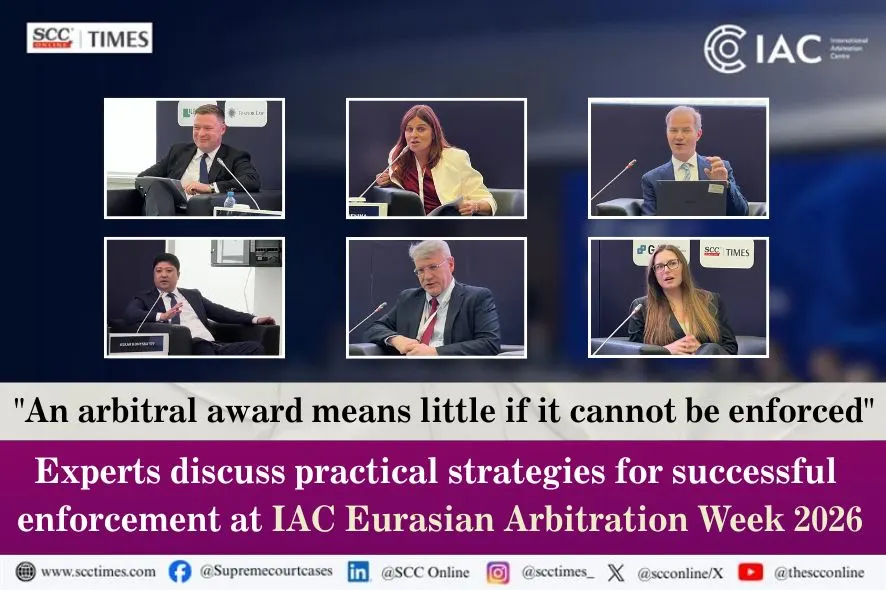
International arbitration has become the preferred mechanism for resolving cross-border commercial disputes, but even the most carefully reasoned arbitral award ultimately derives its value from one critical factor, whether it can be recognised and enforced. As international commerce grows increasingly complex and sanctions, public policy concerns and jurisdictional challenges reshape the legal landscape, enforcement has emerged as one of the defining issues in modern arbitration.
These questions formed the focus of Panel 3: “Enforcing Arbitration Awards: Strategies for Success” at Eurasian Arbitration Week (EAW) 2026, where leading practitioners examined the practical realities of enforcing arbitral awards across jurisdictions and explored how businesses, counsel and arbitral institutions can better prepare for the final, and often most difficult stage of the arbitral process.
Moderated by Christopher Campbell-Holt OBE, Registrar and Chief Executive of the AIFC Court and International Arbitration Centre (IAC), the panel brought together Sergei Vataev, Partner, Legit Advocates’ Bureau; Askar Konysbayev, Partner, GRATA International; Dr. Ilia Rachkov, Partner, Nektorov, Saveliev & Partners; Caitlin Walczyk, Associate, White & Case LLP; and Tatiana Menshenina, Partner, Fladgate LLP. Drawing on experience from Kazakhstan, Russia, Central Asia, the United Kingdom and the United States, the discussion demonstrated that while international arbitration has become increasingly harmonised, enforcement remains deeply influenced by domestic legal systems and geopolitical realities.

Enforcement is no longer an afterthought
The discussion began with a simple but significant proposition: obtaining an arbitral award is only part of the dispute resolution process. The real test comes when the successful party seeks to convert that award into meaningful relief.
Christopher explained that the purpose of the session was to move beyond legal theory and examine the practical realities practitioners encounter while enforcing awards across different jurisdictions. Bringing together perspectives from civil law and common law jurisdictions, as well as institutional and private practice experience, the panel sought to identify practical strategies that improve the prospects of successful enforcement.
Throughout the discussion, one message repeatedly emerged. Effective enforcement does not begin after an award is issued, it begins much earlier, often during contract drafting, while selecting the arbitral seat, and throughout the arbitration proceedings themselves.
Kazakhstan’s arbitration ecosystem continues to mature
Examining Kazakhstan’s evolving arbitration landscape, Sergei observed that the country has made significant progress in developing an arbitration-friendly legal environment. Domestic arbitral awards, he explained, generally encounter fewer obstacles than they did only a few years ago.

Sergei remarked that the situation is not as bad as it used to be, noting that Kazakh courts have become increasingly familiar with arbitration procedures while domestic arbitral institutions have continued to strengthen their practices. The number of instances in which domestic awards are refused enforcement or set aside has also steadily declined.
At the same time, Sergei cautioned that the picture is less straightforward when foreign arbitral awards are involved.
Drawing from recent practical experience, he explained that certain provisions of Kazakhstan’s procedural legislation continue to create uncertainty for parties seeking recognition and enforcement. One recurring issue concerns Article 503 of Kazakhstan’s Civil Procedure Code, which links jurisdiction to the location of the debtor’s registered office.
In practice, this may create significant procedural difficulties where a company maintains substantial assets and commercial operations within Kazakhstan but is incorporated elsewhere. Such situations, Sergei suggested, may leave successful parties navigating jurisdictional obstacles despite possessing a valid arbitral award.
While acknowledging that these challenges remain, he expressed confidence that Kazakhstan’s legal framework continues to move in a positive direction. Continued engagement between practitioners, legislators and the judiciary, he observed, would help resolve existing ambiguities and further strengthen confidence in Kazakhstan as an arbitration-friendly jurisdiction.
Planning for enforcement from the outset
As the discussion progressed, the focus shifted from recognition proceedings to a broader strategic question: when should parties begin planning for enforcement?
For Askar, the answer was unequivocal, long before the tribunal renders its award.
Too often, he observed, parties devote enormous attention to winning the arbitration itself while giving comparatively little thought to whether the award can ultimately be enforced. Yet enforcement frequently depends upon decisions taken months, or even years, before the award is delivered.
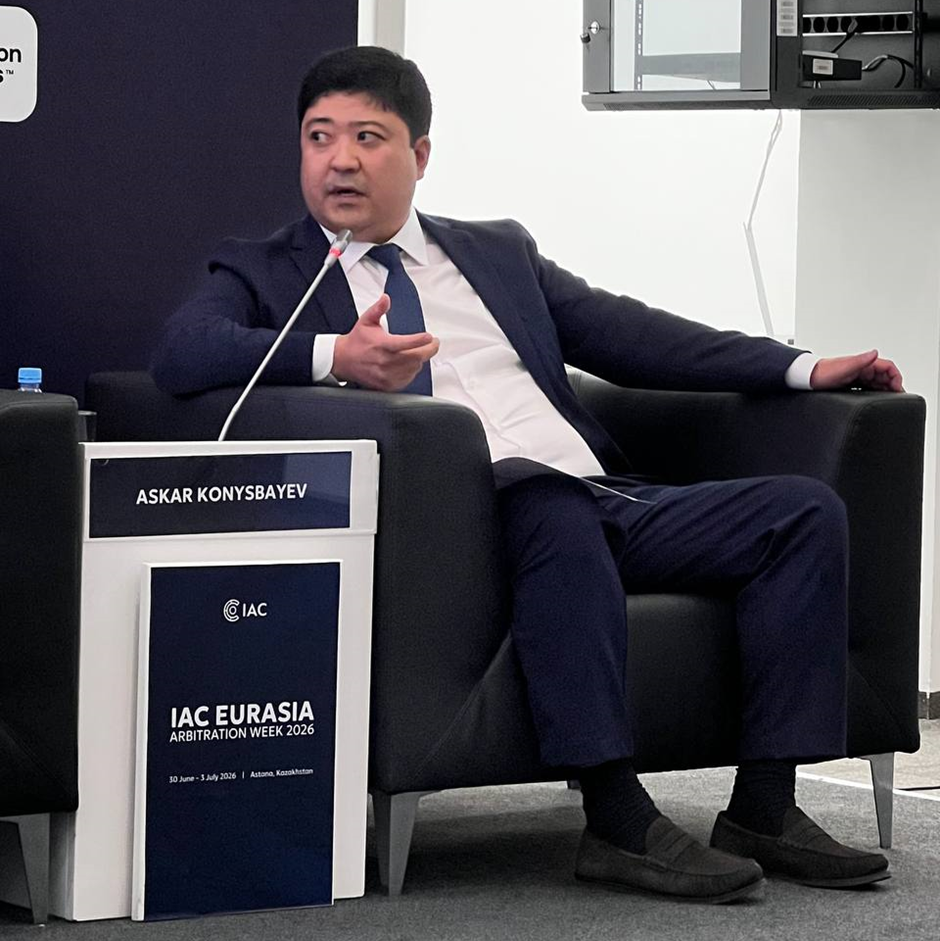
One of the most important recommendations, according to Askar, is involving local counsel at an early stage whenever enforcement is likely to take place in a particular jurisdiction.
Rather than viewing enforcement as a separate exercise after arbitration concludes, practitioners should understand the procedural expectations of domestic courts while the arbitration is still underway. Early advice from local practitioners can influence how relief is formulated and significantly reduce enforcement risks later.
This is particularly important where domestic procedural law adopts a formalistic approach.
Kazakhstan’s courts, Askar explained, expect complete documentary compliance. Original documents, certified translations and evidence demonstrating proper notice during the arbitration should all be assembled before enforcement proceedings commence. Because recognition applications are often considered within a relatively short timeframe, parties may have little opportunity to rectify deficiencies after proceedings have begun.
The discussion therefore highlighted an important shift in modern arbitration practice. Enforcement can no longer be viewed as the final administrative stage of dispute resolution. Instead, it has become an integral part of arbitration strategy itself.
Drafting awards with enforcement in mind
The panel also explored a practical issue that rarely receives sufficient attention during arbitral proceedings, the drafting of relief.
Askar explained that awards capable of succeeding before an arbitral tribunal do not always translate easily into domestic enforcement procedures.
One recurring difficulty concerns monetary awards containing complex formulas for calculating interest or penalties. While tribunals may adopt sophisticated methods for determining ongoing financial liability, domestic courts and enforcement authorities are often not empowered to recalculate those figures during execution.
Instead, they require definitive monetary amounts capable of immediate enforcement.
Similarly, non-monetary relief should be expressed using legal concepts familiar to domestic courts and enforcement officers. Awards employing terminology that lacks an obvious equivalent under domestic procedural law may create practical uncertainty during execution, even where the tribunal’s intention is perfectly clear.
Askar therefore encouraged counsel to consider not only whether relief accurately reflects the tribunal’s decision, but also whether domestic authorities will readily understand how that relief should be implemented.
Rather than treating enforcement as a separate phase of proceedings, practitioners should draft awards with the enforcement process firmly in mind from the outset.
The AIFC Court seeks to simplify the enforcement process
Building on the discussion around Kazakhstan’s arbitration framework, Christopher outlined how the AIFC Court has sought to address one of arbitration’s most persistent challenges by creating a streamlined mechanism for recognising and enforcing arbitral awards issued by the International Arbitration Centre (IAC).
Describing the process as deliberately straightforward, Christopher explained that parties seeking recognition and enforcement submit a single electronic application, which is then considered by an AIFC Court judge. Once recognition is granted, the Court issues an execution order that may be presented directly to Kazakhstan’s enforcement authorities.
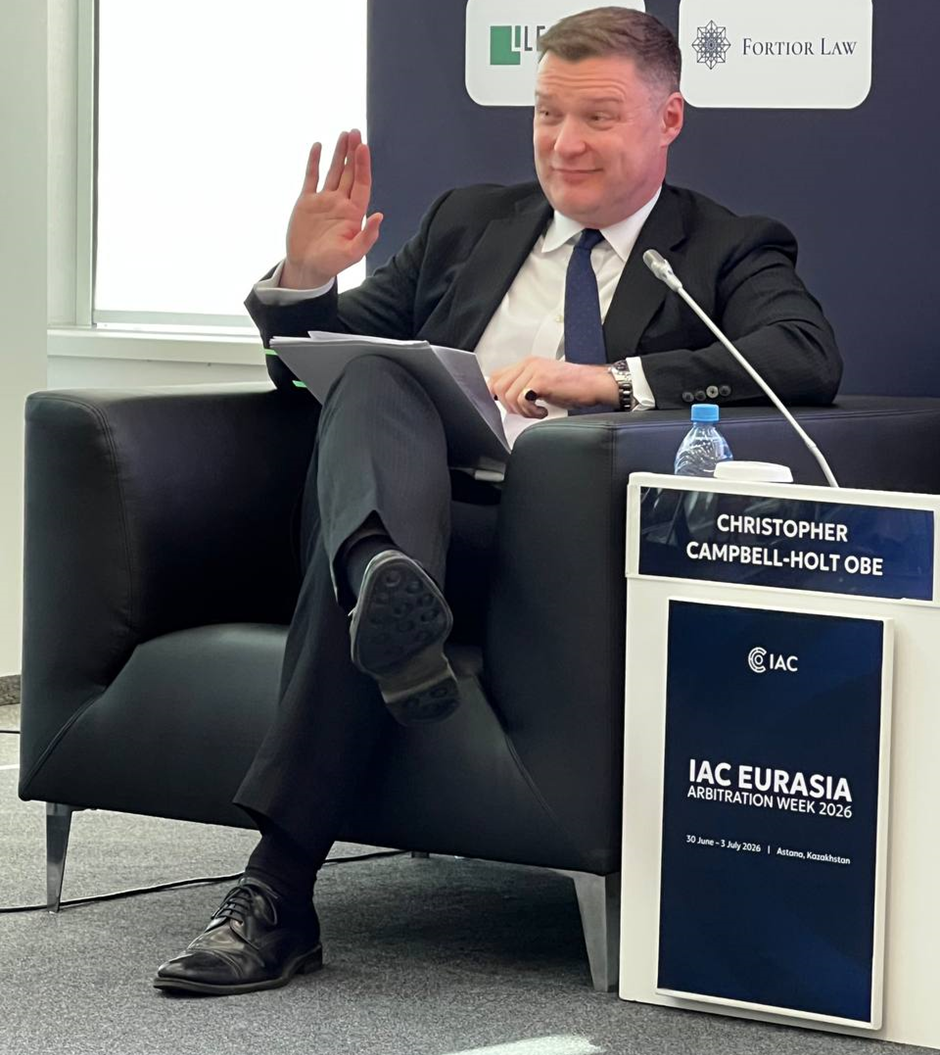
He noted that efficiency has been one of the Court’s principal objectives since its establishment.
In one instance, Christopher revealed, an application seeking recognition and enforcement of an ICC arbitral award progressed from electronic filing to issuance of the Court’s order in approximately one hour. While acknowledging that not every application can be completed within such a timeframe, he said the example demonstrated the Court’s ambition to make enforcement as efficient and predictable as possible.
Christopher also highlighted the institutional arrangements underpinning the system, including cooperation with Kazakhstan’s Ministry of Justice and the Republican Chamber of Private Bailiffs. These partnerships, he explained, have enabled enforcement of AIFC Court execution orders across Kazakhstan while providing parties with greater certainty at the post-award stage.
The discussion illustrated how procedural efficiency has become an increasingly important consideration for parties selecting an arbitral institution. Speed alone is no longer sufficient; confidence that an award can move efficiently through domestic enforcement mechanisms has become equally valuable.
Predictability remains arbitration’s greatest strength
While enforcement procedures naturally differ across jurisdictions, Caitlin suggested that one principle consistently influences parties when choosing where to enforce an arbitral award, predictability.
Drawing on the United States’ experience, she explained that the country’s reputation as a preferred enforcement jurisdiction rests not upon any single feature, but upon a combination of legal certainty, judicial consistency and effective enforcement powers.
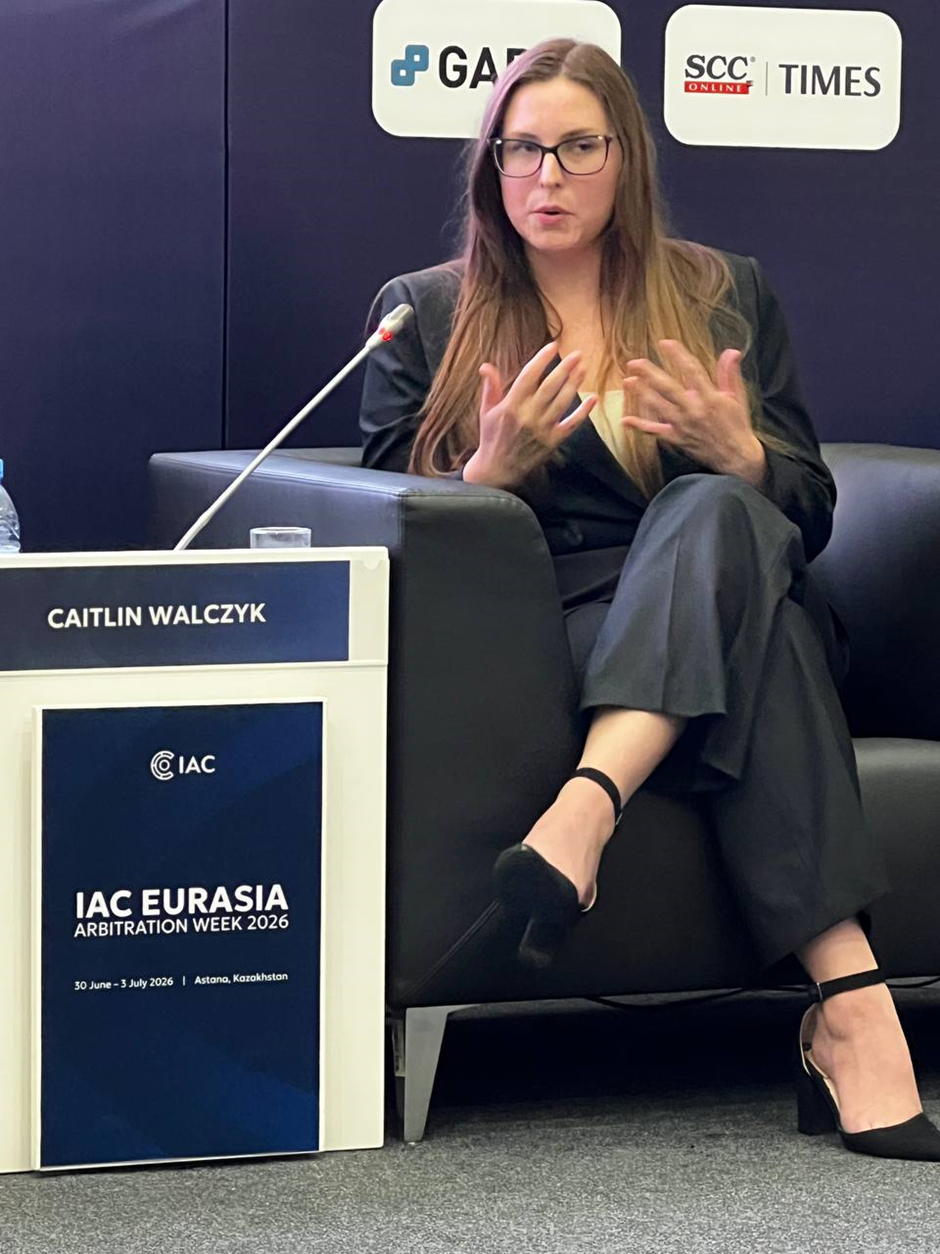
A significant factor, she observed, is the concentration of international assets within the United States. With governments, multinational corporations and financial institutions maintaining substantial investments there, successful parties frequently find attachable assets against which judgments can be enforced.
Equally important, however, is the legislative framework governing enforcement.
The United States Federal Arbitration Act closely incorporates the principles of the New York Convention, creating what Caitlin described as a relatively straightforward and predictable recognition process. Unless one of the Convention’s limited exceptions applies, U.S. courts generally recognise and enforce foreign arbitral awards.
For commercial parties, that predictability often proves just as important as speed.
Once an award has been recognised, U.S. courts also possess extensive powers to identify and attach assets through robust discovery procedures. These mechanisms, Caitlin explained, make it significantly more difficult for debtors to conceal assets in an effort to frustrate enforcement.
Perhaps the greatest strength of the American system, however, lies in its long-standing judicial support for arbitration.
According to Caitlin, U.S. courts consistently interpret the New York Convention’s grounds for refusing enforcement narrowly, placing a substantial burden upon parties seeking to invoke public policy or other exceptions.
Referring to Gary Born’s keynote address earlier during Eurasian Arbitration Week, she observed that although concerns have emerged regarding increasing judicial intervention in some jurisdictions, the United States continues to demonstrate a strong institutional commitment to upholding international arbitration.
COMMISA v PEMEX demonstrates the limits of judicial intervention
Illustrating that commitment, Caitlin discussed the landmark COMMISA v PEMEX litigation.
The dispute arose from a contract between Corporación Mexicana de Mantenimiento Integral (COMMISA) and Mexico’s state-owned oil company, PEMEX, concerning the construction of offshore oil platforms.
After arbitration resulted in an award worth approximately US$300 million in COMMISA’s favour, Mexican courts subsequently set aside the award following legislative changes affecting the arbitrability of the dispute.
Despite the annulment at the seat of arbitration, COMMISA sought recognition before U.S. courts.
The United States Court of Appeals for the Second Circuit ultimately enforced the award, concluding that retrospective legislative changes could not override the parties’ original agreement to arbitrate or fundamental principles of justice.
For Caitlin, the decision demonstrated how judicial predictability strengthens confidence in arbitration. Commercial parties, she suggested, place significant value on legal systems that consistently respect arbitration agreements and apply the New York Convention in a principled and predictable manner.
The discussion also resonated with a broader theme emerging throughout Eurasian Arbitration Week: that certainty, rather than simply speed or cost, increasingly influences parties when selecting seats of arbitration and jurisdictions for enforcement.
Sanctions and public policy are reshaping the enforcement landscape
While much of the discussion focused on improving enforcement procedures, the panel also acknowledged that geopolitical developments have fundamentally altered the environment in which international arbitral awards are enforced.
Drawing from recent developments in Russia, Ilia observed that the recognition and enforcement of foreign arbitral awards has become considerably more complex following the introduction of counter-sanctions legislation after 2022.
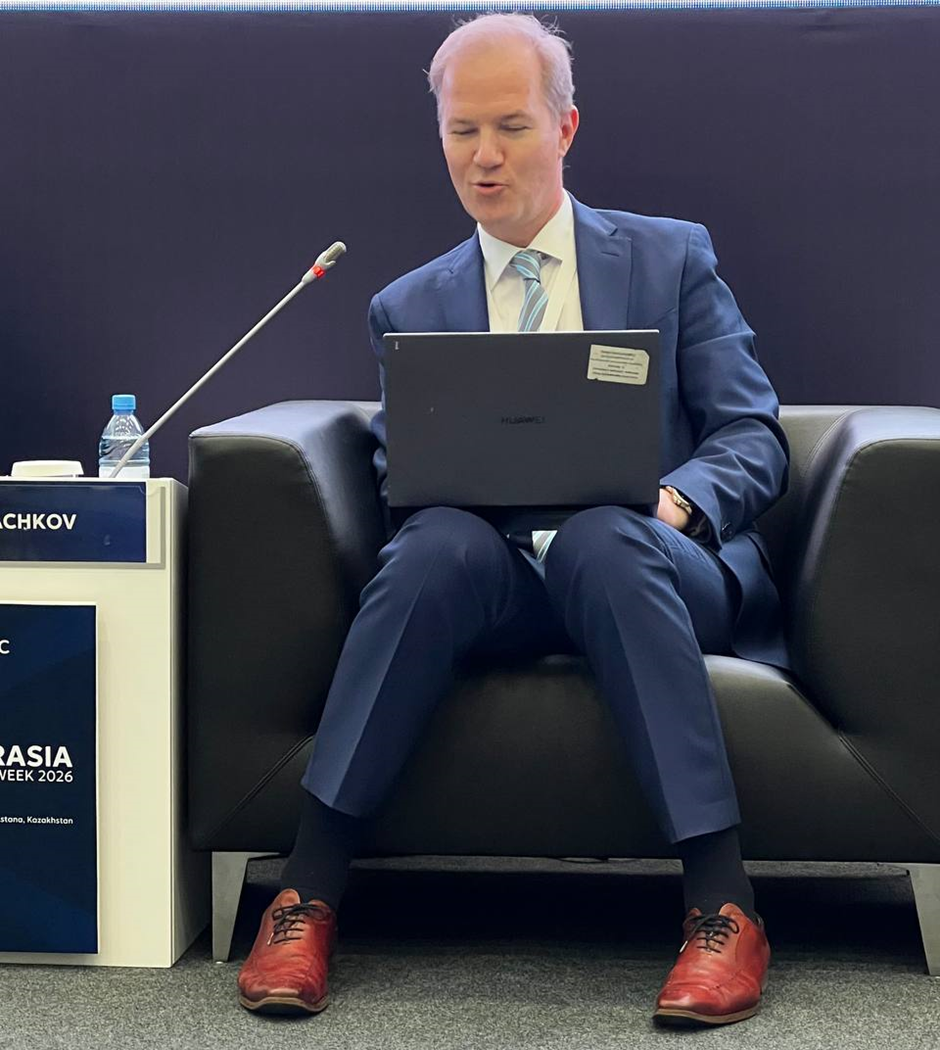
Although Russia remains a Contracting State to the New York Convention, he explained that domestic courts have increasingly relied upon public policy considerations and sanctions-related legislation when determining applications for recognition and enforcement.
According to Ilia, enforcement prospects today often depend upon the identity of the parties, the jurisdictions involved and the wider sanctions framework applicable to the dispute.
He referred to the amendments introducing Articles 248.1 and 248.2 of the Russian Arbitrazh Procedure Code, which enable Russian courts to assume jurisdiction over disputes involving sanctioned parties and, in certain circumstances, grant anti-arbitration injunctions restraining proceedings before foreign arbitral tribunals.
These developments, he suggested, have significantly altered the strategic considerations for parties negotiating arbitration agreements involving Russian counterparties.
Against this backdrop, Ilia encouraged parties to think carefully about the choice of arbitral seat and institution at the contract drafting stage itself. Selecting a neutral forum and considering interim protective measures at an early stage, he explained, may significantly improve the prospects of preserving assets and securing eventual enforcement.
He observed that securing emergency arbitration orders or freezing injunctions during the dispute process is critical, particularly where there is a risk that assets may be dissipated before enforcement proceedings begin.
The discussion reflected a broader reality confronting international arbitration today: enforcement strategies can no longer be divorced from geopolitical developments. Instead, sanctions regimes, domestic legislation and public policy considerations increasingly influence decisions that were once driven primarily by commercial considerations.
Enforcement under sanctions requires balancing access to justice with regulatory compliance
Tatiana expanded the discussion by examining how sanctions have transformed enforcement practice in the United Kingdom and Europe.
Rather than viewing sanctions solely as an obstacle to arbitration, she framed the issue through three practical questions: whether sanctioned parties may obtain arbitral awards, whether those awards can subsequently be enforced, and whether awards against sanctioned parties can themselves be enforced.

The first question, she explained, has largely been resolved by English courts.
Obtaining an arbitral award does not, in itself, amount to making funds or economic resources available to a sanctioned party. Consequently, sanctions do not prevent arbitral tribunals or courts from determining disputes on their merits.
Tatiana remarked emphasising that while access to justice has been preserved, enforcement presents a very different challenge.
She explained that the introduction of general licences by the United Kingdom’s Office of Financial Sanctions Implementation (OFSI) addressed an immediate practical difficulty by permitting sanctioned parties, within prescribed limits, to pay lawyers, arbitrators and arbitral institutions.
Those measures ensured that arbitration proceedings themselves could continue despite sanctions restrictions.
The position becomes considerably more complicated, however, once an award has been rendered.
Unlike legal fees, enforcement generally requires a specific licence where sanctioned assets are involved, transforming what would ordinarily be a straightforward enforcement exercise into a regulatory process requiring detailed licensing approvals.
Tatiana also observed that English courts have increasingly been required to consider public policy arguments linked to sanctions, an issue that rarely arose before 2022.
While English courts continue to recognise the importance of arbitration agreements, sanctions have introduced an additional layer of legal and regulatory complexity that practitioners must now navigate alongside traditional enforcement procedures.
She further noted that parties are increasingly restructuring transactions through assignments of awards or judgment debts to entities that are not themselves designated under sanctions regimes. Such arrangements, however, often generate fresh disputes concerning ownership, control and the true beneficiary of enforcement proceedings.
Enforcement remains arbitration’s ultimate test
As the discussion drew to a close, Christopher returned to the central theme that had united the panel’s diverse perspectives.
Despite differences in legal systems, procedural rules and enforcement mechanisms, each speaker had emphasised that the effectiveness of arbitration is ultimately measured not by the quality of the award alone, but by the successful enforcement of that award.
The conversation also illustrated how enforcement has evolved over the past decade. Once regarded primarily as the final procedural step following arbitration, enforcement has increasingly become an integral component of dispute resolution strategy itself.
Whether discussing the drafting of relief, selecting an arbitral seat, preserving assets, navigating sanctions regimes or choosing jurisdictions with predictable judicial practice, the panel repeatedly returned to the same conclusion: parties that consider enforcement only after receiving an award may already have missed their greatest opportunity.
Closing the session, Christopher observed that lawyers play a crucial role in guiding clients through the procedural and practical differences that exist between jurisdictions. While international arbitration continues to offer an effective framework for resolving commercial disputes, achieving meaningful justice ultimately depends upon ensuring that arbitral awards are capable of recognition, execution and compliance.
The discussion concluded with a clear message for arbitration users worldwide. As international commerce becomes increasingly interconnected and legal systems continue to adapt to new geopolitical realities, successful arbitration will depend not only upon obtaining favourable awards, but upon designing disputes and dispute resolution strategies with enforcement firmly in mind from the very beginning.