Khaitan & Co. hosted a media roundtable on “IBC and Competition Law in India” on 3 July 2026 at Le Meridien, New Delhi, bringing together leading legal experts to discuss the latest developments in India’s insolvency and competition law landscape. The session focused on recent amendments to the Insolvency and Bankruptcy Code, 2016 (IBC), evolving trends in insolvency resolution, cross-border insolvency, competition law enforcement, and the changing antitrust regime in India.
The discussion was led by Pranjal Prateek, Partner — Competition Law; Prateek Kumar, Partner — Dispute Resolution; and Siddharth Srivastava, Partner — Banking, Finance & Insolvency, who shared practical insights on key legislative reforms, landmark judicial developments, regulatory challenges, and the implications of these changes for businesses, investors, lenders, and the broader commercial ecosystem.
Recent Amendments, Key Developments and Emerging Trends in India’s Insolvency and Bankruptcy Framework

A Decade of Continuous Evolution
Setting the context, Prateek Kumar described the Insolvency and Bankruptcy Code as a transformative legislation that fundamentally altered India’s approach towards distressed assets. Unlike the fragmented insolvency regime that existed prior to 2016, the IBC created a unified framework with the primary objective of rescuing financially distressed companies and, where revival is not possible, ensuring an orderly liquidation process.
He observed that the Code has undergone continuous refinement over the past decade through judicial interpretation and legislative intervention, with the latest amendments incorporating extensive stakeholder feedback and lessons drawn from judicial decisions.
Siddharth Srivastava added that the current round of amendments is among the most consequential since the enactment of the Code, addressing several practical difficulties that had emerged during its implementation.
Clarifying the Position of Secured Creditors
One of the most significant reforms discussed was the legislative response to the STO v. Rainbow Papers Ltd., (2023) 9 SCC 545 (Rainbow Papers judgment). Explaining the issue, Siddharth Srivastava noted that the judgment had created uncertainty by recognising statutory authorities as secured creditors solely because certain statutes created an automatic first charge over assets. This raised concerns that tax authorities and government departments could rank alongside banks and financial institutions during liquidation, potentially affecting lender recoveries and investment confidence.
The recent amendment, he explained, restores certainty by making it clear that a security interest can arise only through an agreement or consensual arrangement between parties and cannot be created merely by operation of law.
According to him, the clarification protects the commercial expectations of lenders while preserving confidence in India’s insolvency framework.
Debt and Default Remain the Core Test
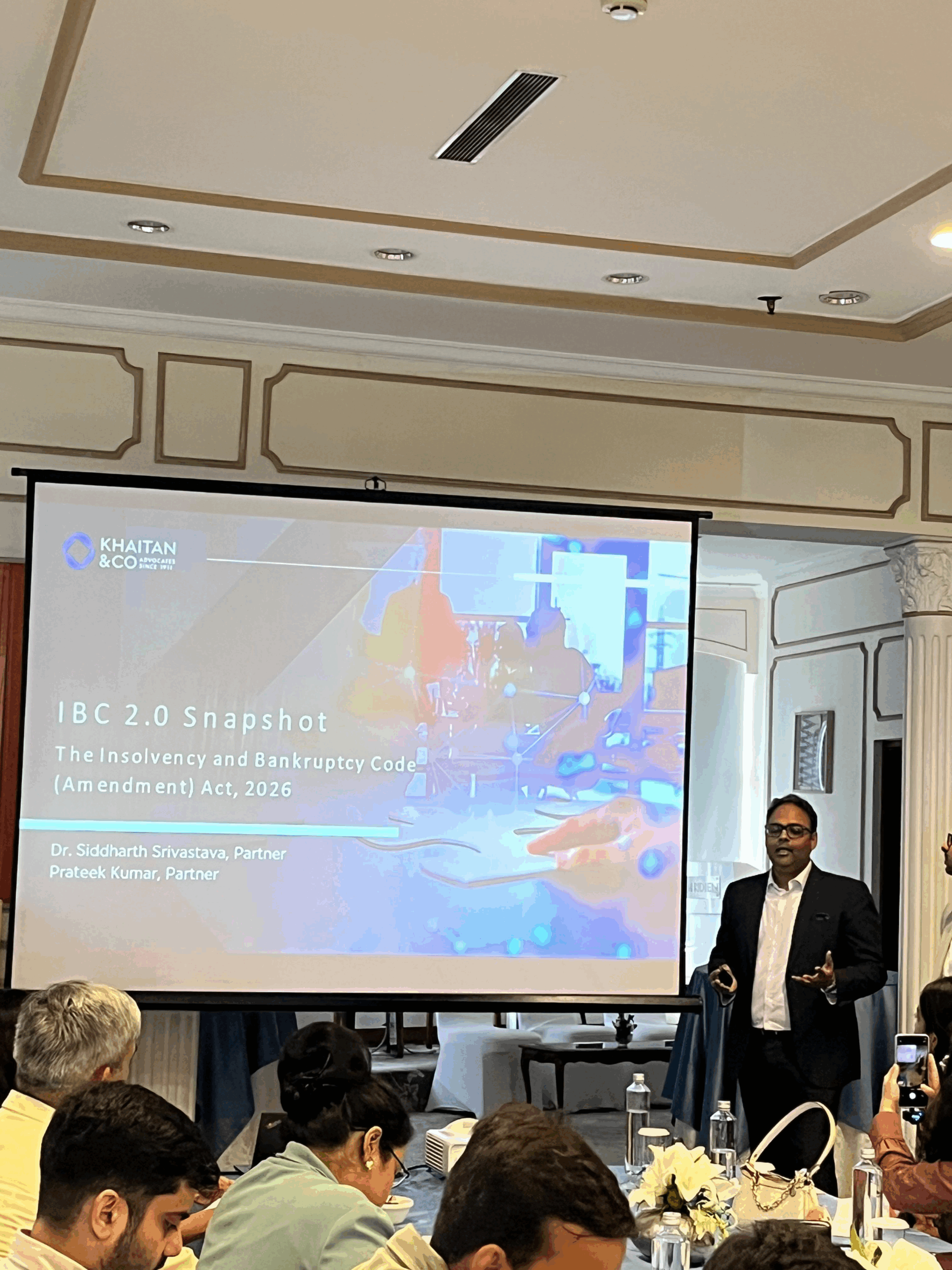
The speakers also highlighted amendments intended to simplify the admission of insolvency proceedings.
Siddharth Srivastava explained that recent judicial interpretations had created uncertainty regarding whether tribunals could consider a borrower’s future ability to repay before admitting insolvency proceedings.
The amendment now reinforces the original legislative intent: if debt and default are established, the insolvency application should ordinarily be admitted.
He noted that this restores predictability and removes unnecessary subjective considerations during admission.
Curtailing Strategic Withdrawals and Delays
Another important reform concerns withdrawal of insolvency proceedings under Section 12A of the Insolvency and Bankruptcy Code, 2016 (IBC).
Prateek Kumar explained that promoters had increasingly used the insolvency process to discover market valuations before submitting higher settlement offers after bids had already been received. Such tactics frequently resulted in prolonged litigation reaching appellate courts and the Supreme Court.
The amended framework now limits the withdrawal window to the period after constitution of the Committee of Creditors (CoC) but before issuance of the Expression of Interest, thereby preventing parties from waiting until market value has been discovered through competitive bidding.
Siddharth Srivastava observed that the amendment seeks to eliminate tactical delays while preserving genuine opportunities for settlement.
Phased Approval of Resolution Plans
The experts identified phased approval of resolution plans as one of the most practical reforms introduced by the amendments.
Siddharth Srivastava explained that implementation of approved resolution plans has often been delayed because disputes among financial creditors over distribution of proceeds continued long after a successful resolution applicant had been selected.
He remarked that this amendment may have its own challenges, but it is a great cause and should really help investors restore confidence in the IBC.
Under the amended framework, tribunals may approve implementation of a resolution plan while allowing disputes relating to distribution among creditors to be decided separately. This approach, he said, enables successful bidders to assume control of distressed companies without waiting for lengthy litigation among lenders to conclude.
Prateek Kumar acknowledged that certain legal questions regarding distribution, particularly where equity allocations are involved, may still arise, but described the amendment as a welcome step that allows commercial activity to continue while disputes are resolved independently.
The speakers agreed that reducing implementation delays is critical to preserving enterprise value, particularly in technology-driven businesses where prolonged litigation can rapidly erode commercial viability.
Restoration of CIRP Before Liquidation
The discussion also focused on the newly introduced mechanism permitting restoration of the Corporate Insolvency Resolution Process (CIRP) before liquidation.
Siddharth Srivastava explained that the amendment formally empowers the National Company Law Tribunal (NCLT) to provide an additional opportunity for resolution before directing liquidation. The tribunal may now restore CIRP for a limited period, enabling fresh bids to be invited where prospects of resolution continue to exist. He further observed that few commercial legislations have been as receptive to stakeholder feedback as the IBC and that the legislature has consistently sought to make the law clearer and more effective through successive reforms. Prateek Kumar noted that although tribunals had previously exercised similar discretion through judicial innovation, codification of the mechanism provides greater certainty and eliminates the need for separate litigation over extensions.
Separating Resolution Professionals from Liquidators
The experts also discussed the amendment preventing the Resolution Professional (RP) from serving as the liquidator of the same corporate debtor.
Siddharth Srivastava explained that the reform addresses concerns over institutional incentives by ensuring that professionals supervising the resolution process do not have any perceived interest in liquidation proceedings that may follow.
According to him, one of the key reasons for introducing the amendment was to address concerns over potential conflicts of interest. He observed that there had been a perception that Resolution Professionals could have an incentive to prefer liquidation because it could extend their appointment for a considerable period. The amendment, he noted, seeks to remove that possibility and reinforce confidence in the neutrality of the insolvency process.
Timing of Competition Commission Approval
Another notable clarification concerns approval by the Competition Commission of India (CCI).
Siddharth Srivastava observed that previous judicial interpretation required successful bidders to obtain competition approval before submission of resolution plans, creating unnecessary costs and duplication where multiple bidders participated.
The amendment provides that Competition Commission approval must be obtained before the resolution plan is submitted to the NCLT, rather than before it is placed before the Committee of Creditors. Siddharth Srivastava noted that this position has now been expressly codified in the statute, reducing unnecessary regulatory burden and duplication during the bidding process.
He stated that the revised timeline reduces regulatory burdens, avoids unnecessary filings and prevents commercial information leakage during competitive bidding.
Emerging Framework for Cross-Border Insolvency
The latter part of the discussion focused on India’s evolving approach towards cross-border insolvency.
Prateek Kumar explained that although Sections 234 and 235 IBC contemplated reciprocal arrangements with foreign jurisdictions, those provisions were never operationalised. He said that the recently introduced enabling provision empowers the government to formulate a comprehensive cross-border insolvency framework.
He noted that modern businesses increasingly operate through multinational corporate structures, making international cooperation indispensable for effective insolvency resolution.
He emphasised that the proposed framework is expected to draw substantially from the UNCITRAL Model Law, incorporating principles such as recognition of foreign proceedings, cooperation between courts, access for foreign insolvency representatives and coordinated relief across jurisdictions.
He noted that insolvency proceedings today often have implications beyond national borders, underscoring the need for a comprehensive cross-border insolvency framework.
Siddharth Srivastava added that a robust cross-border framework would help preserve asset value by preventing fragmented enforcement across multiple countries while insolvency proceedings remain pending.
Group Insolvency and Future Reforms
The experts also touched upon the proposed introduction of group insolvency and Creditor Initiated Insolvency Resolution Process (CIIRP), both of which remain under consideration.
Siddharth Srivastava explained that CIIRP proposes a hybrid model where creditors can initiate a resolution process without immediate judicial intervention while allowing existing management to remain in control under regulatory supervision.
He distinguished CIIRP from the existing pre-pack insolvency framework, observing that the two mechanisms differ in both procedural design and the treatment of promoters during resolution.
The speakers noted that these reforms could significantly expand India’s insolvency toolkit once formally notified.
Practical Challenges in International Insolvency
Illustrating the growing complexity of cross-border insolvency, the discussion examined practical issues arising from international sanctions and multinational corporate structures.
Prateek Kumar referred to recent litigation involving sanctions imposed by the United States’ Office of Foreign Assets Control (OFAC), where Indian courts were required to consider whether a company unable to make payment due to foreign sanctions could nonetheless be treated as having committed a default under the IBC.
He added that such cases demonstrate the increasing need for internationally harmonised insolvency principles capable of addressing conflicts between domestic insolvency law and foreign regulatory regimes.
IBC Continues to Evolve Through Legislative Reforms
Siddharth Srivastava observed that despite the challenges encountered during implementation, the IBC has evolved rapidly through continuous stakeholder consultation and judicial experience. He remarked that few commercial legislations have been receptive to stakeholder feedback, adding that the legislature’s intent has consistently been to make the framework clearer and more effective.
Earlier in the discussion, Prateek Kumar noted that beyond the formal insolvency process, the IBC has fundamentally transformed India’s debt recovery ecosystem by encouraging timely settlements and improving recoveries compared to traditional enforcement mechanisms.
The discussion underscored that IBC continues to evolve as a dynamic framework aimed at balancing timely resolution, value maximisation, and stakeholder confidence. The recent amendments seek to address several practical challenges that emerged over the past decade, including delays in resolution, uncertainty around secured creditor status, withdrawal of insolvency proceedings, inter-creditor disputes, and the need for greater clarity in cross-border and group insolvency matters.
Recent amendments, key developments, and emerging trends shaping India’s Competition and Antitrust landscape
The competition law landscape in India is undergoing a period of rapid evolution, driven by increasing merger activity, expanding enforcement by the Competition Commission of India (CCI), and significant judicial interventions shaping the contours of antitrust regulation. These developments formed the focus of a media roundtable, where Pranjal Prateek discussed recent amendments, emerging enforcement trends, landmark judgments, and the practical implications for businesses operating in India.
Opening the discussion, Pranjal Prateek noted that competition law has become an integral part of commercial decision-making in India, observing that while public attention to the subject fluctuates, it inevitably returns to the spotlight because of its direct impact on businesses and markets.
Merger Control Continues to Witness Record Activity

Pranjal Prateek explained that competition law broadly operates through two principal pillars—merger control and enforcement.
Discussing merger control, he observed that the CCI reviews mergers, acquisitions and combinations involving enterprises above prescribed thresholds to ensure that such transactions do not substantially lessen competition in the market.
Highlighting recent trends, he noted that 2025 was the busiest year for merger control since the CCI assumed these powers in 2011, with the Commission approving 132 combinations, while over 75 merger notifications had already been examined by mid-2026.
He explained that scrutiny generally intensifies where significant competitors seek to combine, as such transactions may increase market concentration and adversely affect consumers through reduced competition, higher prices, or diminished consumer choice.
Behavioural and Structural Remedies
Pranjal Prateek explained that where competition concerns arise, the CCI may approve transactions subject to remedies designed to preserve market competition.
He distinguished between behavioural remedies, which require parties to conduct themselves in a specified manner for a defined period, and structural remedies, which involve permanent market restructuring through measures such as divestiture of assets.
According to him, the Commission increasingly seeks to resolve competitive concerns during the initial stage of review itself, thereby reducing the need for prolonged Phase-II investigations.
Deal Value Threshold Expands Regulatory Oversight
The discussion also focused on the recently introduced deal value threshold, under which transactions exceeding ₹2,000 crore may require CCI approval even if the traditional asset or turnover thresholds are not met.
Pranjal Prateek observed that the reform reflects evolving transaction structures, particularly in the technology and private equity sectors, where enterprise value may significantly exceed conventional financial thresholds.
He noted that private equity and financial sponsor transactions now constitute a substantial proportion of merger notifications before the Commission.
Green Channel Mechanism Faces Practical Challenges

Pranjal Prateek also examined the functioning of the Green Channel approval mechanism, introduced as a self-assessment route for transactions posing no appreciable competition concerns.
While describing the initiative as an industry-friendly reform in principle, Prateek observed that its practical application has become increasingly restrictive owing to the Commission’s stringent interpretation of eligibility conditions.
He explained that even limited overlaps or complementary business activities between the acquiring and target enterprises may render a transaction ineligible for Green Channel approval, exposing parties to regulatory scrutiny and potential penalties.
As a result, many parties now prefer conventional notification despite the availability of the expedited route.
Gun Jumping Jurisprudence and the Amazon Decision
One of the key highlights of the discussion was the evolving jurisprudence relating to gun jumping, where parties either fail to notify notifiable transactions or consummate them prior to obtaining CCI approval.
Pranjal Prateek discussed the Supreme Court’s recent judgment involving Amazon which overturned the CCI’s penalty of approximately ₹202 crore imposed in connection with Amazon’s investment in Future Coupons.
He explained that the Supreme Court reaffirmed that the Commission, being a statutory authority, must exercise its powers strictly within the framework of the Competition Act.
According to him, the Court found that Amazon had disclosed the material aspects of the transaction before the Commission and that the CCI could not reopen an approved transaction beyond the statutory limitations by invoking its penal powers.
The decision, he noted, provides important clarity on the limits of the Commission’s jurisdiction while reinforcing principles of regulatory certainty.
Enforcement Continues to Expand Across Sectors
Turning to the enforcement side of competition law, Pranjal Prateek discussed investigations relating to cartels, abuse of dominant position, and vertical agreements.
He observed that the Commission continues to actively investigate several sectors, including steel, media, fragrances and labour markets.
Among the emerging developments, he highlighted investigations involving anti-poaching agreements, where competing employers allegedly agreed not to recruit each other’s employees,a theory of harm that has received increasing attention in international competition law.
He noted that while the Indian proceedings remain under investigation, the issue reflects the expanding scope of competition enforcement into labour markets.
He also reviewed the Commission’s newly introduced settlement framework, under which parties facing investigations involving vertical agreements and abuse of dominance may resolve proceedings without prolonged litigation.
Concluding the discussion, he observed that India’s competition law regime continues to mature through a combination of legislative reforms, regulatory experience and judicial oversight. With record merger filings, expanding enforcement across emerging sectors, and evolving jurisprudence on merger control, abuse of dominance and jurisdictional issues, the Competition Act remains central to corporate strategy and commercial decision-making. They noted that as markets become increasingly complex, competition law is expected to play an even greater role in balancing economic growth with consumer welfare and preserving competitive markets.
Conclusion
The roundtable underscored that both India’s insolvency and competition law regimes are entering a new phase of maturity. While the IBC continues to evolve through targeted legislative reforms aimed at improving resolution outcomes and preserving enterprise value, the competition law framework is adapting to increasingly sophisticated markets through enhanced merger control, expanding enforcement and evolving judicial guidance. Collectively, the discussions highlighted the growing emphasis on regulatory certainty, commercial efficiency and institutional accountability as India continues to refine its legal framework for businesses and investors.