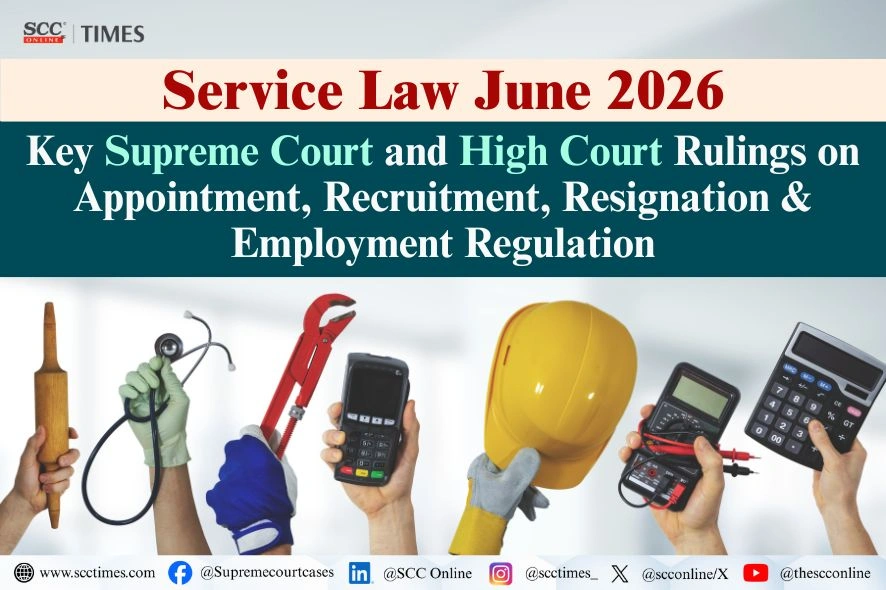
This Service Law June 2026 Roundup brings together the month’s key legislative updates and significant judicial developments, including the Supreme Court’s draft Regulations for use of Artificial Intelligence (AI) in Courts, 2026, rulings on police appointments, TET eligibility for in-service teachers, territorial jurisdiction in service matters, recruitment and selection, employment regulation, recruitment transparency under the RTI Act, and resignation in the context of service bonds. These developments offer valuable insights into the evolving legal landscape governing appointments, recruitment, eligibility, employment conditions, service disputes, and other important aspects of service law.
HIGHLIGHT OF THE MONTH
Courts May Use AI, Judges Retain Control: Inside Supreme Court’s Draft AI Regulations
On 3 June 2026, the Supreme Court issued the draft Regulations for Use of Artificial Intelligence (AI) in Courts, 2026, proposing a structured framework for integrating AI into the judicial system while safeguarding constitutional values, fairness, and judicial independence. Read more HERE
APPOINTMENT
Supreme Court| Pre-Marital Physical Relationship Between Consenting Adults Not Ground to Draw Adverse Inference on Character: Supreme Court Restores Police Constable’s Appointment
In a case titled Gajula Thirupathi v. State of Telangana, 2026 SCC OnLine SC 1104, wherein the appellant challenged the cancellation of his provisional selection for the post of Stipendiary Cadet Trainee Police Constable (SCTPC) by the respondent on grounds of moral turpitude, the Division Bench of Manoj Misra and Manmohan, JJ., allowed the appeal and held the respondent’s action to be arbitrary. The Court stated that merely because the appellant’s pre-marital relationship with his neighbour did not culminate in marriage, the same is not a ground to believe that the appellant had cheated and draw an adverse inference. The Court stated that pre-marital relationships are common today and physical relationship between 2 consenting unmarried adults cannot and should not by itself be a ground to draw an adverse impression about the character of the person in that relationship. Read more HERE
ELIGIBILITY
Supreme Court| No Error in Anjuman Ishaat-e-Taleem Trust Verdict: SC Upholds TET Requirement for In-Service Teachers; Extends Compliance Deadline to 31 August 2028
In State of U.P. v. Anjuman Ishaat-E-Taleem Trust, 2026 SCC OnLine SC 998, the Supreme Court reaffirmed the correctness of its judgment in Anjuman Ishaat-e-Taleem Trust, holding that Section 23, RTE Act always contemplated acquisition of prescribed qualifications by in-service teachers and that TET is a mandatory eligibility requirement rooted in the constitutional guarantee of quality education under Article 21-A. Read more HERE
JURISDICTION
Supreme Court| CAPF Personnel Can Approach Delhi HC’s Writ Jurisdiction in Service Matters Despite Cause of Action Arising Elsewhere
In Baksish Ahmad v. Union of India, 2026 SCC OnLine SC 1098, concerning the scope of territorial jurisdiction under Article 226 of the Constitution and the applicability of the doctrine of forum non conveniens in service matters, the Division Bench of Dipankar Datta and Satish Chandra Sharma, JJ., held that the Delhi High Court erred in refusing to entertain a Border Security Force (BSF) personnel’s writ petition on the ground of forum non conveniens. The Court clarified that where the Union of India and the Director General of the Central Armed Police Force are necessary parties situated in Delhi, the Delhi High Court possesses territorial jurisdiction under Article 226(1), irrespective of where the disciplinary proceedings or cause of action arose. Read more HERE
REGULATION OF EMPLOYMENT
Supreme Court| SC Restores Arbitral Award in Teesta Stage III BOCW Cess Dispute; Reiterates BOCW Cess Becomes Enforceable Only Upon Constitution of Welfare Boards
In Navayuga Engg. Co. Ltd. v. Sikkim Urja Ltd., 2026 SCC OnLine SC 957, the Supreme Court set aside the impugned judgment insofar as it affected the appellants and restored the arbitral award, holding that the controversy was squarely covered by its earlier judgment in Prakash Atlanta (JV) v. NHAI, 2026 SCC OnLine SC 1998, wherein it was held that BOCW cess could not be leviable until constitution of Welfare Boards under the Building and Other Construction Workers’ (Regulation of Employment and Conditions of Service) Act, 1996 (BOCW Act). Read more HERE
RECRUITMENT AND SELECTION
Supreme Court| Procedural irregularity in final appointment process cannot invalidate fair recruitment: Haryana Cooperative Society directed to reconsider employees’ appointments
The Supreme Court in Gaurav Mehla v. State of Haryana, 2026 SCC OnLine SC 1107, held that on compliance with Rule 3, Service Rules, 2003 relating to the presence and concurrence of specified officials in the Board of Directors (BOD) meeting approving appointments constitutes a curable procedural irregularity and not a substantive illegality. Where the advertisement and selection process are otherwise fair, transparent, and free from infirmity, such a defect does not render the entire recruitment process void ab initio. Further, the Court directed the Haryana Cooperative Society to reconsider the appointments of the employees through a duly constituted BOD, in compliance with the applicable statutory rules. Read more HERE
Sikkim High Court| Recruitment Transparency Prevails: Disclosure of Merit List and Marks Sought Under RTI Ordered, Subject to No Social Media Publication
In Sikkim PCS v. Sikkim Information Commission, 2026 SCC OnLine Sikk 42, writ petition filed by the Sikkim Public Service Commission (SPSC) assailing the orders of the Sikkim Information Commission directing disclosure of recruitment-related information under the Right to Information Act, 2005, the Single Judge Bench of Meenakshi Madan Rai, J., directed the State Public Information Officer to furnish the relevant information to the RTI applicant and recorded the applicant’s undertaking not to place the information on any social media platform. Read more HERE
RESIGNATION
Bombay High Court| Relieving letter is consequential upon acceptance of resignation; employer justified in withholding it where resignation is in breach of service bond
In Bharat Aviation (P) Ltd. v. Rahul Sudhindra Soni, 2026 SCC OnLine Bom 2900, a writ petition challenging the interim order of the Industrial Court directing issuance of a relieving letter and service certificate to an employee who resigned in breach of a service bond, a Single Judge Bench held that the order dated 13 January 2025 was unsustainable. The Court emphasised that issuance of a relieving letter is only a consequential act following valid acceptance of resignation and highlighted that when non-acceptance of resignation is justified due to violation of contractual stipulations, the employer cannot be compelled to issue such documents. The Court further observed that the apprehension of unhealthy competition and poaching of trained engineers was not without substance and accordingly set aside the Industrial Court’s order, directing expeditious adjudication of the complaint. Read more HERE
ALSO READ: