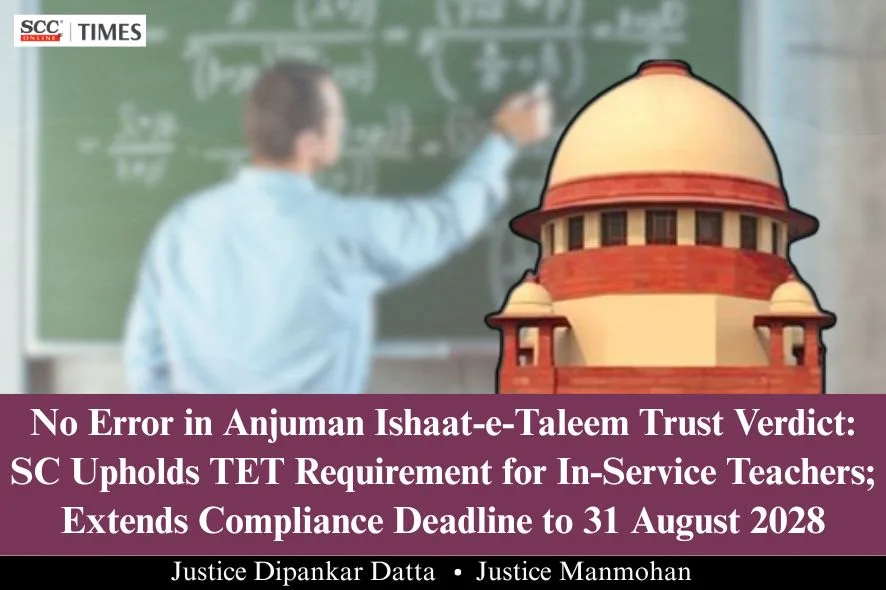
Supreme Court: In a batch of review petitions filed by various States, teachers’ associations, organizations and individual teachers seeking review of a part of judgment rendered in Anjuman Ishaat-e-Taleem Trust v. State of Maharashtra, 2025 SCC OnLine SC 1912, requiring in-service teachers, appointed prior to the Right of Children to Free and Compulsory Education Act, 2009 (RTE Act) and having more than 5 years of service remaining, to qualify the Teacher Eligibility Test (TET) within 2 years from 1 September 2025, failing which they would be ineligible to continue in service, the Bench of Dipankar Datta* and Manmohan, JJ., reaffirmed the correctness of its judgment in Anjuman Ishaat-e-Taleem Trust, holding that Section 23, RTE Act always contemplated acquisition of prescribed qualifications by in-service teachers and that TET is a mandatory eligibility requirement rooted in the constitutional guarantee of quality education under Article 21-A.
“The RTE Act is a child centric legislation and must be read so. Service of teachers cannot come at the cost of educational future of the children.”
The Court rejected all grounds urged in review, including allegations of retrospective application, conflict with the NCTE Act, and impermissible alteration of service conditions. However, adopting a pragmatic approach under Article 142, it extended the compliance period for obtaining TET qualification from 2 years to 3 years, fixing 31 August 2028 as the final deadline.
Also Read: An overview of Supreme Court decision mandating Aspiring and In-service Teachers to qualify the TET
Factual Matrix
The instant review petitions, the challenge to Anjuman Ishaat-e-Taleem Trust, was confined not to the entire judgment but specifically to that part which held that in-service teachers, who were teaching students recruited prior to the enactment of the RTE Act and who had more than 5 years of service left before superannuation, were required to qualify TET within 2 years from 1 September 2025. Failure to do so would disentitle them from continuing in service. The Court had further held that qualification of TET was mandatory for promotion irrespective of the remaining service tenure of a teacher.
The petitioners contended that these directions proceeded on an erroneous interpretation of the RTE Act and had caused grave injustice.
Review Petitioners’ Contentions
The petitioners contented that neither the RTE Act nor the Amendment Act of 2017 could be applied retrospectively to teachers who had been appointed before those enactments.
Referring to first proviso to Section 12-A, National Council for Teacher Education Act, 1993 (NCTE Act), the petitioners argued that teachers recruited prior to the commencement of the NCTE Amendment Act, 2011 could not be removed solely because they failed to fulfil qualifications later prescribed by the NCTE.
The petitioners further submitted that making TET mandatory for in-service teachers was arbitrary and unreasonable. They contended that they had entered service under prevailing recruitment rules at a time when TET was not an essential qualification. In some States, specific exemptions had been granted. According to them, imposing TET midway through their careers violates a fundamental principle of service jurisprudence, thereby causing serious prejudice.
The petitioners relied heavily on paragraph 4(c), NCTE notification dated 23 August 2010 and argued that teachers appointed for Classes I to VIII before issuance of the notification stood exempted from possessing the minimum qualifications prescribed therein, including TET qualification.
Without prejudice to the above submissions, some petitioners contended that the period of 2 years granted by the Court was inadequate and sought for extension of time to acquire the TET qualification.
Also Read: ReT Closure: SC quashes litigation-based exclusion; relief to select panel candidates subject to TET
Issue for Determination
Whether in-service teachers appointed prior to the enactment of the RTE Act or before TET was prescribed as a minimum qualification are legally required to qualify the TET for continuation in service and promotion, and whether the contrary view advanced by the review petitioners disclosed any error apparent on the face of the record justifying review of the judgment in Anjuman Ishaat-e-Taleem Trust?
Analysis
Considering the importance of the issues raised and in the interest of justice, the Court directed that the review petitions be heard in open court.
Before examining the merits, the Court reiterated the settled limitations governing review jurisdiction. Relying upon Northern India Caterers (India) Ltd. v. State (UT of Delhi), (1980) 2 SCC 167 and Bharti Airtel Ltd. v. A.S. Raghavendra, (2024) 6 SCC 418, the Court observed that review is not an appeal in disguise and can be entertained only where there exists an error apparent on the face of the record.
The Court asserted that in the garb of seeking a review the court cannot be invited to rehear and redecide an issue which stands finally decided, unless the parameters envisaged in Section 114 read with Order 47, Civil Procedure Code, 1908 (CPC) are satisfied. Nevertheless, considering the allegation of violation of the audi alteram partem rule, it permitted extensive arguments as though the matter were being considered afresh.
Applicability of the RTE Act: Whether Retrospective?
The Court stated that even if subordinate legislation or notifications appeared to grant exemptions, such subordinate instruments could never override the parent statute. Therefore, the inquiry had to be anchored in the language of the RTE Act itself.
The Court undertook a close reading of Section 23, RTE Act and noted that sub-section (1) begins with the expression “Any person”, thereby regulating eligibility for future appointments. In contrast, the first proviso to sub-section (2) uses the expression “a teacher” and specifically addresses teachers already in service at the commencement of the Act who lacked the prescribed qualifications. Such teachers were expressly granted 5 years to acquire those qualifications. The Court emphasised that this distinction in language was deliberate and significant.
The Court asserted that the use of the word “teacher” instead of “person” demonstrated that Parliament intended from the very inception of the RTE Act that in-service teachers must also satisfy the prescribed minimum qualifications. The first proviso protected their continuance in service while simultaneously imposing a time-bound obligation to acquire the required qualifications.
The Court further examined the second proviso inserted by the 2017 Amendment Act with retrospective effect from 1 April 2015. Rather than introducing retrospectivity, the amendment merely acknowledged the reality that some teachers had failed to acquire the qualifications within the original 5-year period and granted them an additional statutory window for compliance. Therefore, the amendment reinforced the requirement under the RTE Act, not altered the legislative scheme.
The Court held that the statutory framework neither invalidated past appointments nor imposed immediate disqualification. Instead, it recognised existing appointments while requiring teachers to acquire minimum qualifications within a reasonable period in the larger interest of educational standards.
Consequently, the Court rejected the argument that the RTE Act and the 2017 Amendment Act had been retrospectively applied to in-service teachers.
NCTE Act Vis-a-VIS RTE Act
Addressing the reliance placed on Section 12A of the NCTE Act, the Court noted that the petitioners had concentrated exclusively on the first proviso, which protects persons recruited before commencement of the NCTE Amendment Act, 2011 from being adversely affected solely because they lacked qualifications subsequently specified by the NCTE.
The Court asserted that this submission overlooked the second proviso, which expressly mandates that such minimum qualifications must nevertheless be acquired within the period specified either under the NCTE Act or under the RTE Act. Thus, the second proviso directly reinforces the requirement embodied in Section 23, RTE Act.
Change of Service Conditions
The Court next considered the argument that TET constituted a new service condition imposed retrospectively upon existing teachers. It noted that neither the first proviso nor the second proviso to Section 23(2) had ever been directly challenged in any original proceeding before or after the decision in Anjuman.
While expressing sympathy for teachers who might face practical difficulties, the Court held that such concerns could not justify reopening a concluded legal issue. Reiterating its earlier observations in Anjuman Ishaat-e-Taleem Trust, the Court stated that “TET is not only a mandatory eligibility requirement but it is a constitutional necessity flowing from the right to quality education under Article 21-A”. It also reaffirmed the principle that operation of a statute can never be viewed as an evil.
The Court held that the provisions of Section 23 did not introduce a new condition of service. Instead, they merely granted teachers a compliance window to equip themselves with qualifications designed to improve the quality of elementary education. Since the statutory scheme itself contemplated acquisition of qualifications by in-service teachers, no impermissible alteration of service conditions could be said to have occurred.
Public Interest Ramifications of Displacement of Teachers
The Court noted that several State Governments contended that compulsory TET qualification within the stipulated period could result in a large number of teachers losing their jobs, thereby adversely affecting public education and causing disruption in schools.
The Court acknowledged the concern but observed that nearly 15 years had elapsed since the enforcement of the RTE Act and almost a decade since the extension granted through the 2017 Amendment Act. In its view, 15 years constituted more than sufficient time for a teacher to acquire TET qualification. Recognizing practical realities, the Court in Anjuman Ishaat-e-Taleem Trust had already exercised its powers under Article 142 and granted a further 2 years, yet even this extension was now claimed to be insufficient.
The Court held that rendering the original judgment ineffective merely because many teachers might become ineligible would have the undesirable consequence of allowing unqualified teachers to continue in service indefinitely. Such an outcome would directly affect the educational future of children. Since the RTE Act is fundamentally a child-centric legislation, it must be interpreted in a manner that protects children’s right to quality education. The Court unequivocally declared that the service interests of teachers cannot be allowed to override the educational future of children.
The Conundrum
Despite rejecting the legal challenge, the Court considered whether the practical difficulties highlighted by the petitioners merited limited intervention. Referring to State of Nagaland v. Lipok AO, (2005) 3 SCC 752, the Court observed that where substantial justice and technical considerations are in conflict, a pragmatic approach should prevail.
The Court recognised that a substantial number of in-service teachers could face loss of employment within a short time frame, which might in turn adversely affect the functioning of schools and the educational welfare of children. Although the requirement of TET could not be diluted in any manner, the Court considered it necessary to balance statutory compliance with practical realities.
Decision and Relief
The Court held that no error existed in the judgment under review, much less an error apparent on the face of the record. Accordingly, it was held that they were not entitled to the substantive relief sought.
However, invoking its powers under Article 142 of the Constitution, the Court granted limited relief, holding that continuity in elementary education demanded some extension of the compliance period. Accordingly, para 217 of the original judgment was modified.
The Court extended the period available to in-service teachers for acquiring TET qualification from 2 years to 3 years. Consequently, instead of obtaining the qualification by 31 August 2027, teachers were granted time until 31 August 2028.
The Court further asked the States and competent authorities to conduct TET examinations periodically and preferably twice every year, with an interval of approximately 6 months between examinations, thereby ensuring that teachers receive adequate opportunities to comply with statutory requirements. At the same time, the Court made it abundantly clear that no future prayer seeking further extension of time would be entertained.
Accordingly, subject to this limited modification, all review petitions were dismissed.
Also Read: Empowering Educators: Unpacking Laws, Landmark Judgements, and Rights of Teachers
[State of U.P. v. Anjuman Ishaat-e-Taleem Trust, 2026 SCC OnLine SC 998, decided on 29-5-2026]
*Judgment by Justice Dipankar Datta