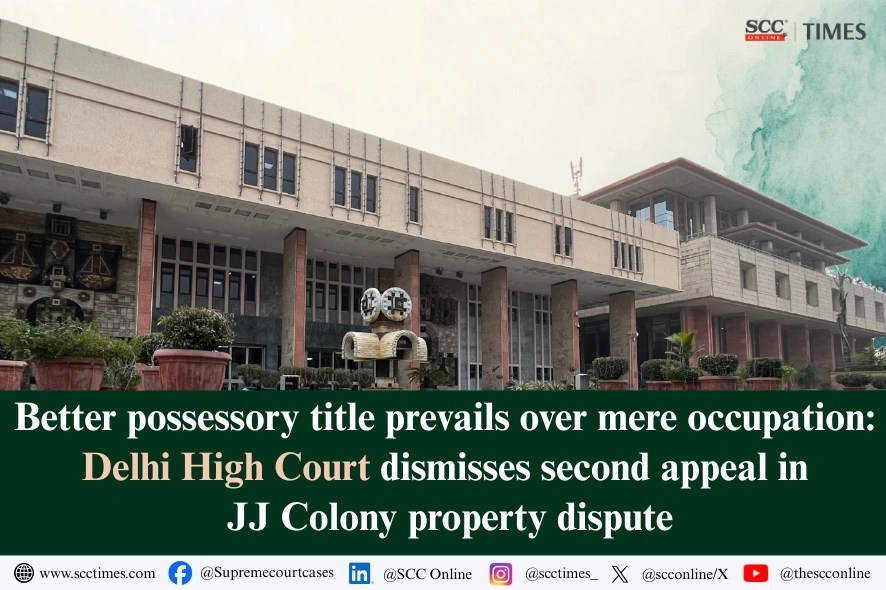
Delhi High Court: In a second appeal filed under Section 100, Code of Civil Procedure, 1908 (CPC), challenging the judgment of the Additional District Judge, who had overturned the trial court’s dismissal of a suit for possession, arrears of rent and permanent injunction and granted relief to the respondent (plaintiff), a Single Judge Bench of Neena Bansal Krishna, J. upheld the decree for possession in favour of the respondent. The Court reiterated that a person who establishes a better title to possession cannot be denied recovery of property merely because absolute ownership is not proved. Therefore, a person who establishes a better possessory title to a property is entitled to recover possession from an occupant who fails to demonstrate any superior or lawful right to continue in possession.
Dismissing the appeal, the Court observed that the appellant had not raised any substantial question of law that required interference under Section 100 CPC.
Background
The dispute concerned a property in JJ Colony over which the respondent claimed possessory and proprietary rights based on a General Power of Attorney (GPA), agreement to sell, affidavit, receipt, possession letter and will executed in her favour by the original allottee in 2006. She asserted that after purchasing the property and raising construction thereon, she inducted the appellant (defendant) as a tenant in 2009. The appellant, however, denied both the respondent’s ownership and the alleged tenancy, contending that her late husband had purchased the property directly from the original allottee in 2006 and that the family had been residing there ever since.
While the trial court dismissed the suit on the ground that the respondent had failed to establish the landlord-tenant relationship, the first appellate court reversed the decision and granted possession by applying the doctrine of “better title”. The appellate court found that the respondent had produced documentary evidence tracing her rights to the original allottee, whereas the appellant had failed to place on record any document evidencing transfer of rights in favour of her husband or herself.
Analysis and Decision
The Court observed that the respondent had successfully discharged her initial burden by producing the chain of documents executed by the original allottee. Once such evidence was led, the burden shifted to the appellant to substantiate her competing claim. However, apart from bare assertions regarding her husband’s alleged purchase of the property, no receipt, agreement, allotment record or other documentary proof was produced. The Court noted that even the school records relied upon by the appellant only indicated occupation of the premises from 2010-2011 and did not establish possession since 2006 as claimed.
The Court further endorsed the appellate court’s reliance on the principle recognised in Anathula Sudhakar v. P. Buchi Reddy, (2008) 4 SCC 594, that where rival claims to possession arise, courts must examine the comparative strength of the parties’ claims. Referring to the maxim possessio contra omnes valet praeter eum cui ius sit possessionis (possession is good against all except the person with a better right), the Court held that the respondent’s claim, supported by documentary evidence originating from the allottee, clearly outweighed the appellant’s unsupported assertions.
Rejecting the appellant’s contention that unregistered documents such as a GPA, agreement to sell and will could not form the basis of relief, the Court clarified that the case was not one involving declaration of absolute ownership but a comparative assessment of possessory rights. The issue before the Court was whether the respondent had a better entitlement to possession than the appellant and on the evidence available; that question was correctly answered in the respondent’s favour.
The Court also found no merit in the objections based on limitation and the Slum Areas (Improvement and Clearance) Act, 1956. It noted that the suit property had been shown not to fall within a notified slum area and that a suit for possession based on title is governed by Article 65, Limitation Act, which prescribes a limitation period of 12 years. Since the defendant had neither pleaded nor established adverse possession, the suit was held to be within time.
Concluding that the findings of the first appellate court were based on proper appreciation of evidence and settled legal principles, the High Court held that the appeal merely sought a re-evaluation of factual findings and did not involve any substantial question of law. The second appeal was consequently dismissed.
[Khatiza Begam v. Salma Khan, 2026 SCC OnLine Del 4749, decided on 16-6-2026]
Advocates who appeared in this case:
For Appellant: Namita Roy and Ms. Gopa Biswas, Advocates.
For Respondent: Mohd Moonis Abbasi, Adv