

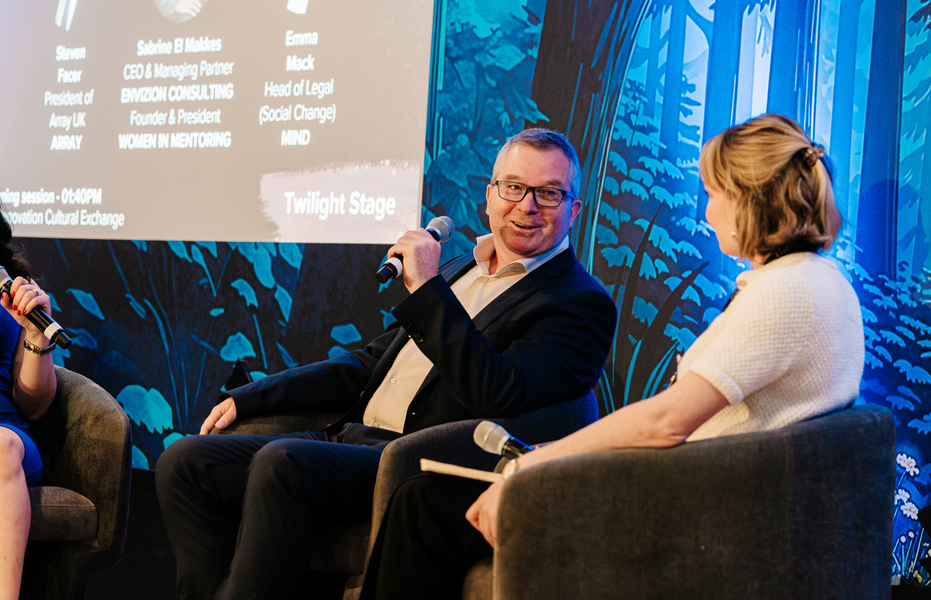
At LegalTechTalk 2026, a panel discussion titled “Litigation Is Sexy Now, Haven’t You Heard?” brought together speakers from different areas of legal practice to discuss contemporary issues affecting litigation. Moderated by Sabrine El Makkes, CEO and Managing Partner at Envizion Consulting and Founder and President of Women in Mentoring (WIM), the session featured Emma Mack, Head of Legal (Social Change) at Mind, and Steven Facer, President of Array UK. The discussion drew on the speakers’ respective experiences in social change litigation, litigation support services and team leadership, offering differing perspectives on developments within the field.
Opening the session, Sabrine introduced herself and noted that she was based in Dubai. Welcoming the audience to Legal Tech Talk in London, she remarked that she was pleased to be participating in the event and observed that the Twilight Stage was known for hosting engaging and provocative discussions.
Turning to the topic of the session, Sabrine introduced the discussion titled “Litigation Is Sexy Now, Haven’t You Heard?” and invited members of the audience to indicate, by a show of hands, whether litigation was the most exciting aspect of their professional careers. Observing the response from the audience, she remarked that she was pleased to see a number of hands raised.
Sabrine then noted that the session would explore that question with the panellists and introduced Emma Mack and Steven Facer, before inviting them to introduce themselves.

Introducing himself, Steven stated that he is President of Array UK, describing it as a “very American job title”. Reflecting on his professional background, he remarked that he has worked in the litigation support services industry since 1999.

Looking back on the early stages of his career, Steven observed that litigation support at the time largely involved lever-arch files and bankers’ boxes and remarked that projects involving 30,000 to 50,000 documents were then considered substantial undertakings.
Steven further noted that he founded a company in the mid-2000s that offered what he described as the new wave of technology at the time. Reflecting on more recent developments, he remarked that his company was acquired by Array in the previous year and observed that the acquisition also brought new job titles.
Concluding his introduction, Steven remarked that he has witnessed considerable change in both technology and litigation practice over the course of his career.

Introducing herself, Emma stated that she is Head of Legal at Mind, a mental health charity in the United Kingdom. Reflecting on the nature of her work, she observed that legal influence, in her context, involves seeking to effect social change through law.
Explaining the ways in which laws are made or changed, Emma remarked that there are two primary routes: legislation through Parliament and case law developed through the courts. She observed that her team works with Parliament on legislative drafting and also participates in national and public inquiries by placing evidence before those inquiries and seeking recommendations and findings aimed at improving laws relating to mental health.
Turning to litigation, Emma remarked that her team is also involved in case work and, in particular, intervenes in proceedings before the Court of Appeal and the Supreme Court. According to Emma, these interventions are intended to influence binding case law that subsequently governs hospitals, GP surgeries and community settings.
Reflecting on a previous introductory conversation with Steven and Sabrine, Emma observed that she and Steven had both been involved in the COVID Inquiry and the Nottingham Inquiry, albeit from different perspectives, and remarked that this provided an area of overlap between their respective experiences.
Responding to the introductions, Sabrine remarked that the discussion was “exactly why this session is sexy”, observing that the panellists approached the subject from different perspectives. She then turned to Emma and asked whether she believed litigation is “sexy” today and, if so, what makes it so.
1. Why Is Litigation “Sexy” Now?
Responding to the question, Emma observed that describing litigation as “sexy” is deliberately provocative and remarked that non-lawyers might regard the term as somewhat overstated. She nevertheless noted that she had heard the expression used within the legal industry, particularly in discussions relating to litigation, and reflected on why that might be the case.
According to Emma, litigation is fundamentally human in nature. She observed that it concerns relationships, disagreements, attempts at resolution, and questions of who ultimately prevails. In that sense, she remarked that litigation involves a significant degree of drama, referring to courtroom dramas and the way lawyers and legal proceedings are often portrayed in the media. She observed that advocacy involves both persuasion and provocation and remarked that, ultimately, she views litigation as being concerned with power and control, including questions of who possesses it, who has lost it, and how it may be regained. According to Emma, these elements are what make litigation “sexy”.

Turning to the inclusion of the word “now” in the session title, Emma observed that this aspect was equally significant. Reflecting on her own experience, she remarked that she had moved from commercial litigation at a Magic Circle law firm into social change and social impact litigation, where litigation is used as a tool for social reform and as one of several means of improving societal outcomes.
While acknowledging that such a description might sound grandiose, Emma observed that the beneficiaries of Mind’s work are ordinary people who require the support provided by the charity and who often do not expect that they will need such assistance. In that context, she remarked that the stakes can be extremely high.
Looking beyond her own experience, Emma observed that litigation tends to become particularly significant during periods of turbulence. Referring to the current geopolitical environment, she remarked that it is likely to generate additional disputes that will eventually make their way through the courts. She also referred to developments in artificial intelligence and technology, observing that these may create risks that could become the subject of litigation, while also affecting the volume of legal work and potentially contributing to an increase in social interest litigation. She concluded that these factors explain why, in her view, litigation is “sexy now”.
Thanking Emma for her remarks, Sabrine observed that, from her perspective, the human element is central to the discussion. Referring to the work of charities and purpose-driven organisations, she remarked that Emma’s comments highlighted what she described as the human side of litigation, a subject she noted is often discussed in the context of artificial intelligence. She indicated that the discussion would return to that theme later in the session.
Turning to Steven, Sabrine observed that he would offer a different perspective and invited him to explain, from his standpoint, why litigation might be considered “sexy” today.
Responding to the question, Steven observed that his focus was less on the word “sexy” and more on the word “now” in the session title. Referring to Emma’s earlier remarks, he observed that the legal profession is currently at a particularly interesting intersection because of the growing volume of data and the increasing level of risk involved in litigation.
Reflecting on the growth of data, Steven remarked that figures frequently suggest that the volume of data is doubling every two or three years. He observed that the amount of data involved in litigation continues to increase and now comes from a much wider range of sources than in the past. According to Steven, litigation once focused primarily on emails, whereas parties are now also expected to provide data from mobile phones because those devices are used for many aspects of everyday life.
Turning to risk, Steven observed that mistakes are now amplified and can be very difficult to reverse. He remarked that this forms an important part of why litigation has gained increased attention.
Steven also referred to the regulatory dimension, observing that it is a topic of widespread discussion. Referring to comments by Prime Minister Keir Starmer regarding regulation, Steven questioned what impact such developments might have. According to Steven, regulation is often behind current technological developments.
Reflecting on his work from a technical perspective, Steven observed that organisations collect data from different parts of the world and remarked that the process involves more than simply obtaining data. According to him, appropriate mechanisms must also be in place to ensure that data is transferred properly.
Drawing his remarks together, Steven observed that the combination of increasing data volumes, risk and regulatory considerations has brought greater attention to litigation. He concluded by remarking that issues receiving public attention often come to be viewed as “sexy”.
2. Technology and the Changing Practice of Litigation
Turning to the next topic, Sabrine observed that the discussion naturally led to the subject of technology. Addressing Steven, she invited him to share his perspective on how technology is transforming litigation today. Referring to an earlier conversation, Sabrine also noted that he had discussed a case from the early 2000s and invited him to share that experience with the audience.
Responding to the question, Steven reflected on the early stages of his career and observed that his work initially involved acting as a consultant. He remarked that, at the time, only Magic Circle firms typically had access to the expensive software and hardware required for litigation support, all of which was locally hosted. According to Steven, his client base therefore consisted primarily of Magic Circle firms.

Reflecting on subsequent developments, Steven observed that litigation systems later became web-enabled, allowing them to be distributed more widely. He remarked that this led to what he described as a democratisation of the process and observed that boutique litigation companies emerged that were able to compete with larger organisations. According to Steven, this development also contributed to the growth of managed review services, enabling smaller and more specialised companies to outsource increasing amounts of work.
Steven observed that these developments lowered the cost of entry into litigation and remarked that it represented a significant moment for the industry because participation was no longer limited to a select group of firms.
Turning to more recent developments, Steven observed that generative AI has accelerated that process further. Reflecting on document review and disclosure exercises, he remarked that reviews involving between 100,000 and 150,000 documents would previously take months to complete, whereas similar work can now be completed in a matter of days. According to Steven, these developments have increased both speed and efficiency, although he noted that they also bring additional pressures.
Responding to Steven’s remarks, Sabrine reflected on her own experience in arbitration and observed that his comments brought back memories of working through physical binders and folders. She remarked that, during her early years in practice as counsel at the International Chamber of Commerce (ICC), she worked on a number of arbitration matters involving large volumes of documents and evidence.
Reflecting on the process at the time, Sabrine observed that reviewing materials and conducting due diligence could require weekends and even weeks of work. Contrasting that experience with present capabilities, she remarked that similar exercises can now often be completed in a matter of hours.
Continuing the discussion, Steven reflected on the early introduction of litigation technology and observed that reviewing large volumes of documents had often been regarded as a rite of passage for junior lawyers. He remarked that, when technology first began to be introduced, litigation support professionals had to explain to partners that the systems required training by experienced lawyers rather than junior practitioners. According to Steven, many partners were reluctant to take on that responsibility because they had no desire to return to the intensive document-review exercises they had undertaken earlier in their careers.
Responding to the observation, Sabrine remarked that the development was fascinating before turning to Emma and asking whether Steven’s use of the term “democratisation” resonated with her.
3. Democratisation, Accessibility and Inequality
Responding, Emma observed that democratisation is, in theory, a positive idea, while adding that it remains to be seen how developments unfold in practice. Returning to the earlier discussion, she remarked that AI and technology have the potential to remove some of the repetitive work and large-volume tasks associated with litigation, thereby allowing litigators to devote more time to strategy. According to Emma, this may shift the balance of litigation practice towards what she described as the more substantive aspects of the work.
Reflecting on accessibility, Emma observed that AI should, in theory, be capable of increasing both accessibility and proportionality. Referring to Steven’s observations about technology becoming more widely available over the course of his career, she remarked that AI may continue that trend by enabling more people to access products that were previously highly specialised or bespoke.
According to Emma, this could potentially contribute to greater democratisation within litigation. She observed that technology may help prevent situations in which larger parties overwhelm smaller parties with documents and data and remarked that litigation may become less dependent on manpower or the financial resources available to fund extensive review exercises. In theory, she noted, this could lead to greater equality of arms between parties.
At the same time, Emma cautioned that attention must be paid to situations in which AI may exacerbate or compound existing inequalities. Referring to information issued by the courts, she observed that warnings have been given about the use of open-source AI because of potential loss of confidentiality. She remarked, “without confidentiality, you cannot have privilege”.
Reflecting on who is most likely to rely on open-source tools, Emma observed that such tools may be used by individuals or organisations without substantial financial resources and by those who do not have access to legal representation. According to Emma, parties with greater resources may be able to rely on closed-source systems available through law firms, whereas those already at a disadvantage may find that gap increasing further.
Speaking from the perspective of Mind, Emma remarked that charities do not operate with large budgets and observed that the affordability of closed-source AI systems is a genuine concern. She welcomed discussions with technology companies about corporate social responsibility initiatives and partnerships with NGOs, non-profit organisations and charities, observing that such collaboration could help those organisations provide services comparable to those available to for-profit organisations that are able to pay for such technologies. Otherwise, she remarked, there is a risk of a broader divide emerging between those who have access to these resources and those who do not.
Responding to Emma’s remarks, Steven observed that the issue is also interesting from a different perspective. He remarked that technology companies may benefit from engaging with organisations such as Mind and hearing perspectives beyond those of corporate clients.
According to Steven, such engagement could help ensure that technological models reflect the needs not only of larger organisations but also of a broader range of users. He suggested that technology companies should engage in conversations with organisations working in this space and observed that this may assist in ensuring that access to justice is considered more broadly.
4. Agentic AI and Emerging Challenges
Building on Emma’s remarks, Sabrine observed that the discussion highlighted what she described as a digital divide. Reflecting on developments over the last three decades, she remarked that similar concerns had previously arisen in relation to internet access, particularly regarding differences between those who had access to technology and those who did not, as well as between developing and developed countries.
According to Sabrine, the discussion suggested that a similar question may now be emerging in the context of litigation and legal technology. Referring to a recent meeting with the chief executive officer of a legal technology company, she remarked that the company was developing AI agents for litigators and law firms.
Reflecting on a conference on artificial intelligence that she attended in Dubai the previous year, Sabrine observed that one of the themes discussed was the suggestion that agentic AI remained years away. However, she remarked that recent developments indicate that agentic AI is already present and is beginning to enter areas such as litigation that have traditionally been regarded as more protected or resistant to change.
Observing that the session was running short on time, Sabrine turned to what she described as one of her favourite topics: wellness and mental health. Referring to her work as a leadership coach and as the founder of Women in Mentoring, she remarked that mental health and wellbeing are particularly important for the next generation of lawyers.
Introducing the final topic of the discussion, Sabrine invited the panellists to reflect on wellness and access to wellbeing support in both charitable and corporate environments. Addressing Emma, she asked how Mind seeks to ensure that its litigation team maintains a mentally healthy culture consistent with the organisation’s mission. She then invited Steven to discuss how resilient teams can be built while keeping wellbeing and mental health in mind.
5. Wellbeing, Leadership and Team Culture
Responding to the question, Emma observed that it had been particularly interesting to consider litigation within the context of Mind. Reflecting on her experience since joining the organisation approximately nine months earlier on a fixed-term contract covering a period of paternity leave, she remarked that it had been a positive experience to observe how the organisation approaches these issues in practice.
According to Emma, Mind does not always get everything right, but she observed that the organisation is open about that reality. She remarked that one of the qualities she most appreciated was the willingness to examine where things are working well and where they are not. In her view, acknowledging shortcomings is an important part of improving processes and practices.
Turning to the nature of litigation work, Emma observed that litigation can be time-intensive, high-stakes, stressful and relentless. She further remarked that, in Mind’s context, some matters also carry an emotional dimension. According to Emma, the organisation actively seeks to employ people with lived experience, which adds another layer to the work being undertaken.
Reflecting on workplace practices, Emma observed that Mind places significant emphasis on flexibility, describing it as an approach she had not previously encountered in private practice and one that she does not regard as common within the wider legal sector. According to Emma, getting the best out of people often requires understanding their individual needs, which may change at different stages of their careers and personal lives as responsibilities and obligations evolve.
Discussing team management, Emma remarked that she encourages her team to follow what she described as an “80-20” approach by planning work to occupy only around 80 per cent of their available capacity. According to Emma, additional demands inevitably arise, and leaving some capacity unallocated helps teams respond when unexpected work emerges.
At the same time, Emma acknowledged that maintaining such balance is an ongoing challenge because people often want to accomplish as much as possible and may underestimate the time and effort required for particular tasks. She observed that this requires repeated conversations within teams about workload and expectations.
Reflecting on specific practices within the organisation, Emma observed that Mind places considerable emphasis on regular check-ins, particularly at the beginning and end of meetings. While noting that discussions do not dwell excessively on personal issues, she remarked that the organisation consistently acknowledges challenges and provides space for individuals to reflect when needed.

According to Emma, reflective practice is deliberately incorporated into meetings, an approach she had not previously encountered and about which she had initially been uncertain. However, she observed that she had come to appreciate its value. Concluding her remarks, Emma observed that doing things well often begins with acknowledging the human element in any situation and remarked that this does not necessarily require elaborate interventions, but can simply involve taking a moment to recognise and verbalise what people may be experiencing.
Responding to Emma’s remarks, Sabrine observed that the discussion ultimately returns to the human element in the age of AI. Referring to the practice of regular check-ins, she remarked that it is important for senior professionals to dedicate time to such conversations with their teams and observed that even a simple question can sometimes have a significant impact. According to Sabrine, this is an area that may not always have received sufficient attention in the past but appears to be changing across both charitable and corporate environments.
Turning to Steven, Sabrine raised the subject of resilience, observing that it has become a frequently used term alongside concepts such as agility, and invited him to share his perspective.
Responding, Steven remarked that there has been a noticeable shift in mindset over time. Reflecting on the early stages of his career, he observed that teams working through the night were often regarded as a badge of honour and that people frequently took pride in discussing such experiences. According to Steven, he began to notice a change around 2015, when working excessive hours increasingly came to be viewed as an indication of poor time management rather than a mark of dedication. He observed that when attitudes change at the top of an organisation, those changes tend to filter through the wider structure.
Returning to a recurring theme of the discussion, Steven remarked that, for him, everything ultimately comes back to the human element. While observing that technology can remove friction, automate repetitive tasks and provide greater visibility into future workloads, he noted that people remain central to the success of teams and organisations.
Reflecting on his own experience, Steven referred to projects that have now entered their third and fourth years. He observed that his teams conduct check-ins at least twice a week and also organise social events and educational sessions. According to Steven, these activities help pull people out of the routine of simply meeting targets and repeating the same tasks.
Discussing the impact of those practices, Steven remarked that the results have been notable. He observed that projects of such duration would ordinarily be expected to experience relatively high levels of staff turnover, but stated that his teams have responded positively and that many individuals have chosen to remain with the organisation.
6. Closing remarks
Bringing the discussion towards a close, Sabrine reflected on the themes that had emerged during the session and observed that healthy organisational cultures are not built solely through policies and procedures. According to Sabrine, leadership plays a central role in shaping workplace culture, including how managers support their teams, protect team members and maintain appropriate boundaries themselves.
Returning to themes discussed throughout the session, Sabrine observed that questions relating to the digital divide and technological change had featured prominently in the conversation. At the same time, she remarked that the human element remained the common thread connecting those issues and described it as a fitting way to conclude the discussion.
As the session drew to a close, Sabrine asked how much time remained and was informed that the panel was already running “negative five” minutes beyond schedule, prompting a light-hearted exchange before she thanked the panellists and audience for their participation and concluded the session.
Conclusion
Throughout the discussion, the panellists reflected on litigation from a range of perspectives, including social impact litigation, litigation support services, technological change and workplace wellbeing. The conversation examined the impact of AI and legal technology on litigation practice, alongside questions of accessibility, confidentiality, equality of arms, team culture and mental health. Although the speakers approached these issues from different professional backgrounds, the discussion repeatedly returned to the role of people, whether in the context of litigants, legal teams, organisational culture or access to justice.