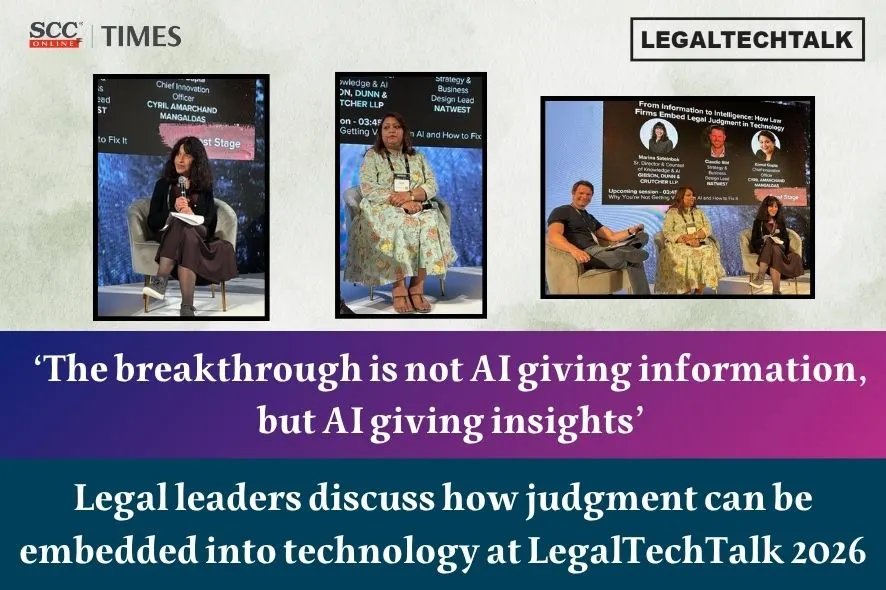
At LegalTechTalk 2026, a panel titled “From Information to Intelligence: How Law Firms Embed Legal Judgment in Technology” examined one of the legal profession’s most pressing questions: can legal judgment be embedded into technology without losing the human qualities that define legal practice?
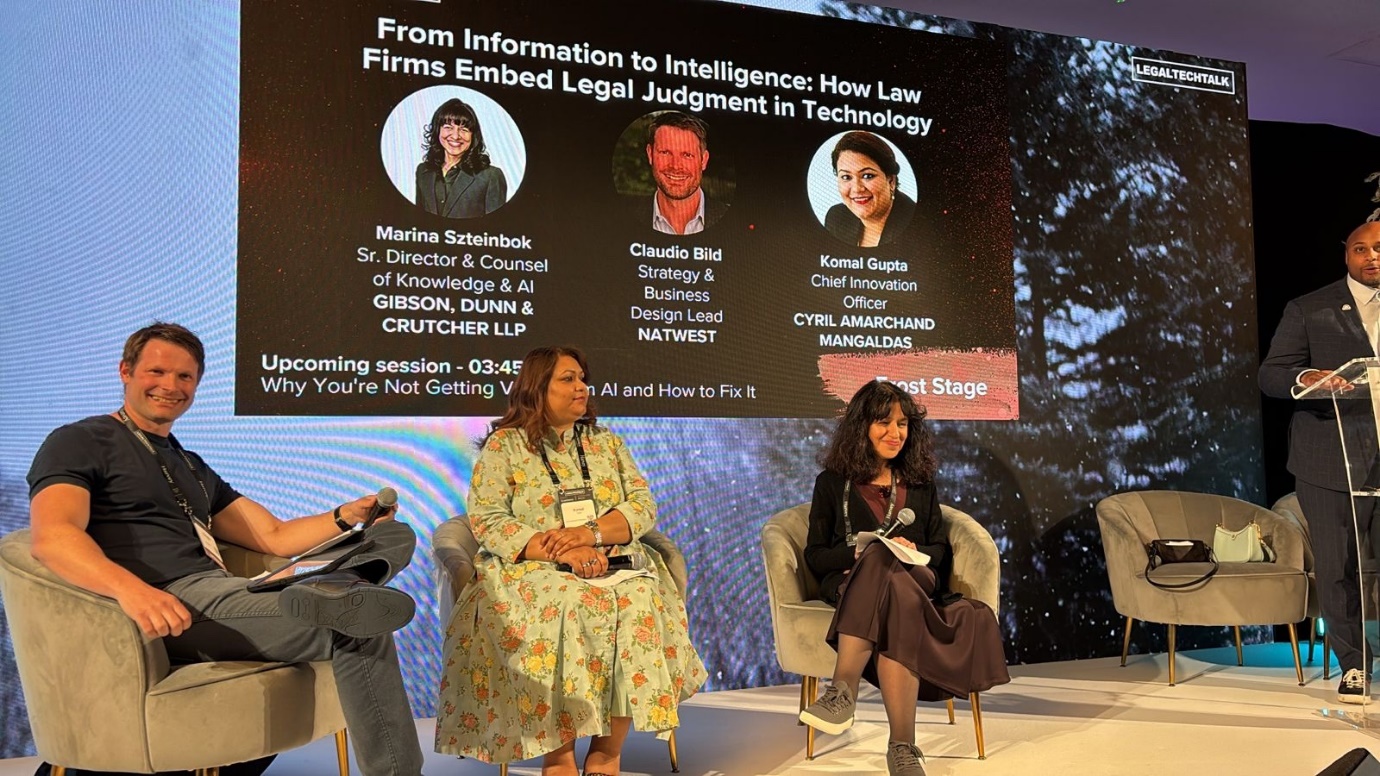
The session was moderated by Mr. Claudio Bild, Strategy & Business Design Lead, NatWest and featured Ms. Marina Szteinbok, Senior Director & Counsel of Knowledge and AI at Gibson, Dunn & Crutcher LLP, and Ms. Komal Gupta, Chief Innovation Officer at Cyril Amarchand Mangaldas. The discussion explored the distinction between legal knowledge and legal judgment, the growing role of AI in law firms, and the continuing importance of human expertise, accountability and client relationships.
Legal Knowledge and Legal Judgment Are Not the Same
Opening the discussion, Ms. Marina Szteinbok drew a distinction between knowing the law and exercising legal judgment. According to her, legal judgment is not merely about understanding legal rules but about applying them to specific facts, circumstances and business objectives.

As she explained:
“Legal judgement, I think of as how you apply the law.”
She noted that legal judgment requires lawyers to evaluate risks, understand client goals, assess likely regulatory or judicial responses and determine how legal principles operate in a particular context. While technology can assist in identifying patterns from past experience, the exercise of judgment remains rooted in context and application.
AI Makes Institutional Knowledge More Systematic
Ms. Szteinbok argued that technology now allows law firms to capture and organise experience in ways that were previously impossible. By identifying recurring patterns across matters, firms can institutionalise expertise and create systems capable of supporting future decision-making.
As she observed:
“You look at the totality of your experience as a lawyer and really the totality of the law firm’s experience and say what are the patterns that we can draw upon so that we can encode that for the future.”
She emphasised that this ability to make knowledge more systematic represents one of the most significant opportunities presented by AI.
The Real Shift Is From Information to Intelligence
Ms. Komal Gupta suggested that the legal profession has never lacked information. What has changed, she argued, is the ability to derive meaning from it.

Reflecting on the evolution of legal research and knowledge systems, she stated:
“The breakthrough is not generative AI giving me information. The breakthrough is generative AI giving me the insights from that information.”
Ms. Gupta noted that traditional search tools helped lawyers locate information, but they did not explain what the information meant or what actions should follow from it. Generative AI, by contrast, is increasingly capable of extracting insights and helping users convert information into practical outcomes.
Not Every Aspect of Legal Work Can Be Systematised
The panel agreed that certain categories of legal work are more suitable for technological assistance than others. Ms. Gupta noted that analytical, repetitive and data-heavy tasks can often be systematised effectively. However, she cautioned that strategic thinking, value-based decision-making and relationship management remain deeply human functions.
Ms. Szteinbok highlighted this point, noting that clients do not form relationships with technology. Instead, they seek trusted legal advisors who understand their concerns and can provide nuanced guidance. She added that clients continue to value lawyers who can listen, understand context and provide judgment that extends beyond technical legal analysis.
Expertise Must Come Before Technology
A recurring theme throughout the session was that successful AI adoption depends far more on expertise than on technology selection. Ms. Gupta warned against organisations becoming overly focused on acquiring popular tools while neglecting the quality of their underlying knowledge.
She observed that many firms invest in technology before properly organising their expertise and information assets.
Ms. Gupta identified four elements as critical to successful AI implementation:
-
Expertise before technology;
-
Creation of strong knowledge assets;
-
Meaningful human input and judgment;
-
Continuous feedback and improvement.
She explained that competitive advantage will not come from using the same technology as everyone else, but from the expertise embedded within an organisation.
Human Input Remains Essential
The discussion repeatedly returned to the importance of human involvement in AI-assisted workflows. Ms. Gupta noted that disappointing AI outputs often stem from unrealistic expectations rather than technological limitations.
She recounted situations where lawyers expected sophisticated answers from minimal instructions and then blamed the technology when results were unsatisfactory. She emphasised that meaningful outcomes require thoughtful participation by lawyers throughout the process. She further stressed that accountability cannot be transferred to AI simply because technology was used.
Data Quality Is Still a Major Challenge
Ms. Szteinbok highlighted data quality as one of the most overlooked barriers to effective AI deployment. While AI systems can generate impressive results, she explained that those results depend heavily on the quality of underlying information.
Law firms, she noted, have historically struggled with organising and structuring their knowledge. As she observed, significant investment in data management remains necessary before firms can fully realise AI’s potential. Without clean and structured information, even the most sophisticated AI tools cannot perform at their highest level.
Governance and Oversight Cannot Be Outsourced
The panel also examined the role of governance and professional responsibility. Ms. Szteinbok argued that trust and accountability remain the foundations of legal practice and cannot be delegated to technology.
As she stated:
“Trust and accountability are the foundation.”
In her view, AI itself possesses neither accountability nor professional responsibility. Human oversight therefore remains indispensable. She emphasised that responsible AI adoption requires governance frameworks, verification processes and continuous supervision to ensure systems operate safely and ethically.
AI Could Transform How Law Firms Preserve Expertise
Looking ahead, Ms. Szteinbok suggested that AI may fundamentally alter how legal expertise is captured and preserved. Historically, valuable institutional knowledge often remained concentrated within individual lawyers or practice groups. When those individuals departed, firms frequently lost significant expertise.
AI-driven knowledge systems now offer opportunities to preserve that experience and make it accessible across the organisation. According to her, this could reshape associate training, collaboration across practice groups and consistency in client service.
What Has Not Changed
While much of the discussion focused on technological transformation, Ms. Gupta stressed the importance of recognising what remains constant. According to her, clients have never approached law firms simply for document execution. They seek legal advice, judgment and guidance. As she explained, regardless of technological advances, the advisory function of lawyers remains central to legal practice. Clients will continue to seek trusted professionals capable of helping them navigate complex decisions and risks.
Strategy and Emotional Intelligence Remain Human Strengths
In concluding remarks, Ms. Szteinbok argued that some lawyer skills may become even more valuable in an AI-enabled future. While AI can assist with pattern recognition and analysis, she suggested that strategy remains fundamentally human.
Strategic thinking requires understanding people, anticipating reactions, managing relationships and finding creative solutions to difficult problems. Similarly, emotional intelligence continues to play a critical role in legal practice. She highlighted that now clients want lawyers who are committed, passionate and invested in their situations.
As routine legal tasks become increasingly automated, these human qualities may become even more important.
Great Lawyers, Great Knowledge and Great Systems
When asked by Mr. Bild what firms should prioritise when building the future legal operating model, Ms. Gupta rejected the idea that any single element could stand alone.
Ms. Gupta remarked:
“Great lawyers are going to create great judgments. Knowledge is going to institutionalise that judgement. And great systems are going to help scale that expertise.”
The future of legal services, the panel suggested, will not be built on technology alone. It will depend on combining legal expertise, institutional knowledge and technological capability in a manner that enhances, rather than replaces, human judgment.
Concluding Reflections
The discussion highlighted a growing consensus that AI’s value lies not in providing information, but in helping law firms transform information into intelligence and institutional knowledge. While technology can scale expertise and support decision-making, legal judgment remains rooted in human experience, context and accountability.
For law firms, the challenge is no longer whether to adopt AI, but how to integrate it effectively while preserving the trust, oversight and professional judgment that remain central to legal practice.