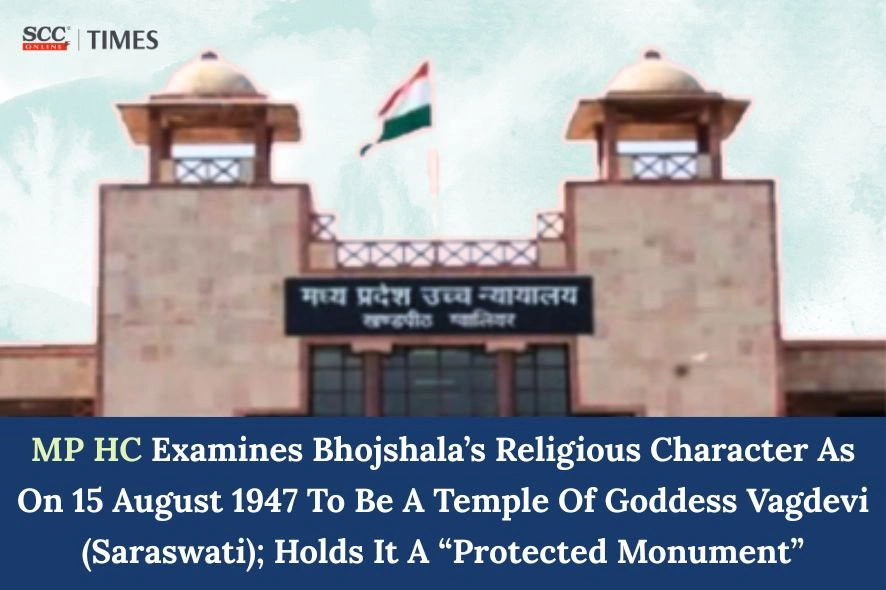
MP High Court: In a writ petition filed under Article 226 of the Constitution, where multiple writ petitions and appeals were decided through a common order due to common issues raised and similar reliefs sought, a Division Bench of Vijay Kumar Shukla* and Alok Awasthi, JJ., declared the “disputed area” of Bhojshala complex to be a “protected monument” under the Ancient Monuments and Archaeological Sites and Remains Act, 1958 and the disputed site was held to be Bhojshala Temple of Goddess Vagdevi (Saraswati) and centre of Sanskrit learning, associated with Raja Bhoj of Paramar dynasty. The Court quashed the impugned order passed by Archaeological Survey of India in 2003, restricting right of Hindus to worship within Bhojshala Temple and permitting namaz by Muslim community.
The Court stated that:
“Government has the constitutional obligation to ensure preservation and protection of not only the ancient monuments and structures including temples of archaeological and historical importance, but also of sanctum sanctorum as well as the deity of spiritual importance. There is a constitutional duty even to sanction funds for providing basic amenities to pilgrims, proper arrangements for shelter places, maintenance of law and order and the preservation of purity and pristine character of the deity.”
Background
The writ petitions filed under Article 226 of the Constitution and a writ appeal filed under Section 2(1), Madhya Pradesh Uchcha Nyayalaya (Khand Nyaypeeth Ko Appeal) Adhiniyam, 2005, raised common issues related to the claim of prayer by Hindus/namaz by Muslims/prayer by Jain samaj in “disputed area” of Bhojshala and Kamal Maula Mosque situated at Dhar. A challenge was made to the order dated 7 April 2003 passed by Archaeological Survey of India to the extent restricting the right of Hindus to worship in Bhojshala Complex on a particular day and timing and the order permitting the Muslim community to offer namaz on Friday. Different reliefs were claimed in relation to the same disputed area.
The impugned order, passed by Archaeological Survey of India (ASI), in exercise of the powers under Rule 4, Ancient Monuments and Archaeological Sites and Remains Rules, 1959, and partially notifying order dated 5 February 1998 making provisions for the entry into the Bhojshala-Kamal Maula Mosque at Dhar, allowed the Muslim community to access the premises for Friday namaz between 1.00 to 3.00 p.m. and Hindus were permitted to hold traditional ceremonies on the occasion of Basant Panchami every year, access on every Tuesday from sunrise to sunset and the visitor could take a flower or 2 and a few granules of rice. Hence the order was challenged in the petitions.
Therefore, several writ petitions and appeals were disposed of by this common order.
Issue
Apart from the preliminary issues, the primary issue on merits dealt with by the Court was —
Whether the disputed area is a “protected monument” and what was its character as on 15th day of August 1947?
Analysis
Pursuant to dealing with the preliminary issues in the matter, which were the objections raised by the respondents, the Court adjudicated the matter on merits.
It was the observation of the Court that the provisions of Ancient and Historical Monuments and Archaeological Sites and Remains (Declaration of National Importance) Act, 1951, create a deeming fiction, giving retrospective effect, treating such monuments as protected under the Ancient Monuments Preservation Act, 1904 and the Ancient Monuments and Archaeological Sites and Remains Act, 1958, continues this protection vesting control and management with ASI.
Legislative History and its Discussion — The Court reviewed the dispute’s legal history, considering all petitions, appeals, and related proceedings filed in connection with the matter since 1962. Further, the Court examined the legislative and administrative history of the disputed area, including the various notifications issued by ASI from time to time, notification issued under the Ancient Monuments Preservation Act, 1904, declaring the site as “protected monument”, Ancient and Historical Monuments and Archaeological Sites and Remains (Declaration of National Importance) Act, 1951 and the Ancient Monuments and Archaeological Sites and Remains Act, 1958.
The Court observed that all these Acts were passed for preservation and protection of ancient monuments and objects of archaeological, historical and artistic interest. Several provisions were considered by the Court.
The Court went on to examine the provisions of Ancient Monuments and Archaeological Sites and Remains Act, 1958 (1958 Act) such as Sections 16, 21 and 39 and stated that there can be no iota of doubt that statutory duty of ASI exists to ascertain the nature, character and original form of the place of worship. The ASI did not discharge this statutory duty and notified the property as Bhojshala or Kamal Maula Mosque.
Historical Literature and Archaeological Features — A fresh survey was conducted by ASI after the application being filed in 2024. The ASI report and the videography conducted by them during the survey was also examined. Moreover, the Court considered and examined the historical literature and archaeological features produced by the parties along with historical references, published journals, inscriptions, etc. and held that the disputed property is a Hindu temple and place of learning of Sanskrit language.
The Court observed that ASI relied on Sanskrit inscriptions, sculptural elements and temple style pillars and slabs for their report which indicate that materials from a pre-existing Hindu structure were used. The report established Dhar as the capital of Hindu rulers (Parmars) and that later Islamic rulers constructed mosques using materials from earlier Hindu temples, including the disputed site. The Court addressed the provisions of Acts and how the disputed site came to be protected under the 1958 Act.
Protected Monument — On the point of reliance on the 1935 Notification to determine the religious character of the site, the Court held that the provisions of Government of India Act, 1935 regarding federation and authority were not fully operational in relation to Princely States like Dhar, thus the reliance was legally questionable. And since Section 4, Places of Worship Act, 1991, excludes the monuments governed by 1958, therefore, the Places of Worship Act, 1991 is not applicable to this monument and cannot be used to claim fixed religious status.
The Court observed that no material was placed before them regarding any survey by ASI treating the disputed site to be Bhojshala and Kamal Maula Mosque, thus, the Court held that by virtue of Section 39(2), 1958 Act, the disputed area was a “protected monument” since 1904 as the property was being managed by ASI under the Acts of 1951 and 1958.
The Court held that, “The Statutory duty of ASI exists under Section 16, Ancient Monuments and Archaeological Sites and Remains Act, 1958 to ascertain the nature, true character and original form of the place of worship, followed by exercise of excavation under Section 21, 1958 Act, if the Archaeological Officer has reason to believe that the area contains ruins or relics of historical or archaeological importance.”
Ruling on Merit — Pursuant to examining the report on multidisciplinary scientific survey conducted by ASI, ASI notifications, archaeological and historical facts and the principles laid down in Ayodhya case, the Court held that the earlier structure was a center of learning and religious activity associated with Saraswati worship (Sharda Sadan), which was modified, damaged and reused, leading to destruction of idols and its conversion into a Mosque. And the present structure was built over a pre-existing temple of the Paramar period. The historical literature placed establishes that the character of the disputed area was Bhojshala as a centre of Sanskrit learning, associated with Raja Bhoj of Paramar dynasty. The literature and architectural references, connected with the period of Raja Bhoj, indicate the existence of temple dedicated to the Goddess Saraswati at Dhar.
[Hindu Front for Justice v. Union of India, 2026 SCC OnLine MP 11410, decided on 15-5-2026]
*Judgment Authored By: Justice Vijay Kumar Shukla
Advocates who appeared in this case:
For Petitioners: Vishnu Shankar Jain, Vinay Joshi, Varsha Parashar, Harishankar Jain, Parth Yadav, Saurabh Singh, Mani Munjal Yadav, Utkarsh Dubey, Devendra Nagar, Vagish Parashar, Rohit Shukla, Shalini Joshi, Shivangee Parmar, Satyanarayan Dubey, Priyanka Sharma, Bhuvnesh Gupta, Lalit Namdev, Pradhumna Malpani, Arpit Singh Parihar, Rajesh Joshi, Pooja Verma
For Respondents: Salman Khurshid, Noor Ahmed Sheikh, Zishan Khan, Lubna Naaz, Azra Rehman, Tausif Warsi, Arshad Mansuri, Shobha Menon, Mohd. Ikram Ansari, Rahul Choubey, Sunil Kumar Jain, Aviral Vikas Khare, Rishi Bhargava, Ayushi Agrawal, Nandini Sharma, Kushagra Jain, Bhoomika Mev, Jyoti Sencha, Sachin Patel, Ayush Agrawal, Vishwajit Joshi, Ms. Nena Mishra, Shreesh Dubey, Surbhi Bahal, Syed Ashhar Ali Warsi, Poorvi Asati, Manan Sharma, Mohd. Hashim, Priyal Agrawal, Prashant Singh, Nilesh Yadav, Rahul Sethi, Dhirendra S. Parmar, Ashish Yadav, Sonal Gupta, Sudeep Bhargava, Shrey Raj Saxena, Swapnil Ganguly, Abhijeet Awasthy, Surendra Kumar Gupta, Viraj Godha, Sahil Sonkusale, Viraj S. Jha