Supreme Court asks P&H HC to decide PIL petitioner’s locus before examining merits of religious conversion allegations
The Supreme Court declined to interfere with the interim order in the religious conversion PIL.

Bringing you the Best Analytical Legal News


The Supreme Court declined to interfere with the interim order in the religious conversion PIL.
The PIL calls for an effective roadmap to eliminate quackery, prevent cross-disciplinary medical practice by unqualified persons and ensure that only duly qualified practitioners operate clinical establishments
The Court noted that if no sitting Judge were made available, the State is to constitute a Commission headed by a retired Judge of the Calcutta High Court, in accordance with the Commissions of Inquiry Act.

In Nikunj Berlia v. High Court at Calcutta, WPA 4575 of 2020, decided on 22 February 2021, a Division Bench of the Calcutta High Court considered proposals for standardising the quality and size of paper used for court filings.
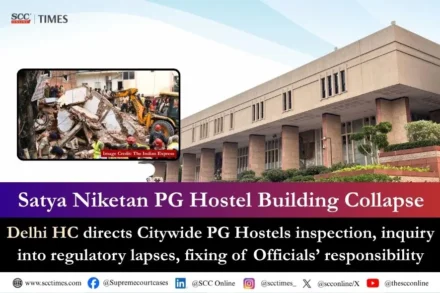
Taking note of the assurance given by the MCD, Union of India and Delhi Police that all possible steps were being taken and the rescue operation was being conducted in full swing, the Court expressed the hope that the efforts would be doubled so that human lives could be saved.

Describing the petition as a “speculative litigation”, the Kerala High Court dismissed a PIL challenging the Priyadarshini Bus Scheme, holding that there was no corroborative material to support the allegation that bus accidents occurred due to overcrowding. The Court, however, emphasised that passenger safety must be adequately safeguarded.
The protest stemmed from systemic examination irregularities surrounding national-level exams, most notably recent NEET-UG medical entrance exam paper leak.
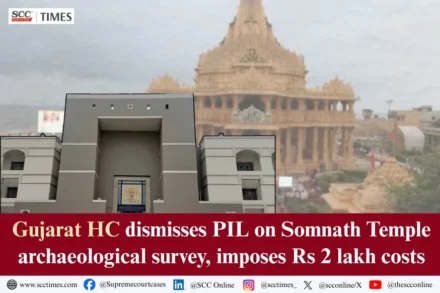
The Court held that a PIL seeking disclosure of the scientific archaeological survey of the Somnath Temple site was not maintainable where it was founded on unverified media reports, contained incorrect factual assertions, and failed to disclose the petitioner’s bona fides and credentials.

Citing newspaper reports on unresolved boundary disputes over Rupsagar Talab, recurring structural failures in Madar Canal, and unchecked development near Fatehsagar Lake, the Court invoked Article 21’s right to a clean environment and the Public Trust Doctrine to direct that no further encroachment, construction or pollution be permitted in any of Udaipur’s lakes pending a coordinated status report from eleven state authorities.

“The issue is not related to the ‘title of the property’ but for the claim of fundamental right of worship or prayer and if the ‘disputed area’ is held to be a ‘protected monument’ under the provisions of the Ancient Monuments and Archaeological Sites and Remains Act, 1958, the bar under the Places of Worship Act, 1991 would not apply.”
“Every order issued by the Princely Ruler survives as law only when it goes through the test as prescribed under the Constitution, thus, the Ailan of 1935 was merely an executive or administrative arrangement and not a legislative enactment and the ASI report establishes a pre-existing temple structure, whose remains form the base of the present monument.”
“The religious character of the “disputed area” of Bhojshala Complex and Kamal Maula Mosque was held to be a Temple of Goddess Vagdevi (Saraswati) in the light of provisions of Ancient Monuments and Archaeological Sites and Remains Act, 1958 and Places of Worship (Special Provisions) Act, 1991.”

During an interaction at Queen Mary University of London, Chief Justice of India Justice Surya Kant reflected on the evolution of Indian constitutional jurisprudence and its wider global relevance.
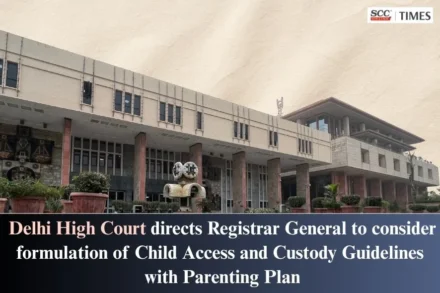
With similar frameworks already emerging in other states, the Delhi High Court begins evaluating whether formal child access and parenting plan guidelines are needed.
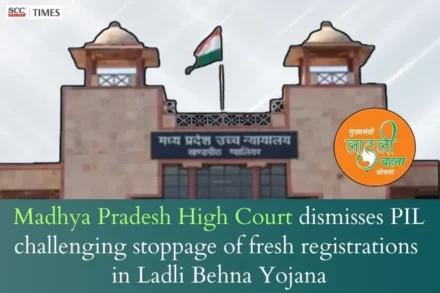
The Court held that decisions relating to eligibility criteria, age limits, and closure of registrations fall within the executive policy domain of the State and are not amenable to judicial review in the absence of arbitrariness, statutory violation, or unconstitutionality.

“Provision for banning of caste based political rallies and preventing them is very much in place, whether it be during the election process or not. The only thing which remains is the will to implement the provisions effectively without any bias or favour.”

“Merely prosecuting petty vendors or users does not discharge the State’s obligation, and what was conspicuously absent was any serious attempt to dismantle the illegal supply chain.”

“It is the duty of the parents to make known to their child the consequences of his/her action and to make aware the child what is good and what is bad for him/her and others.”

The Court said that “to our mind, this issue calls for urgent executive and/or judicial intervention.”

The grievance was that livestock across inhabited islands were left without access to qualified and registered Veterinary Surgeons, resulting in prolonged absence of medical care.