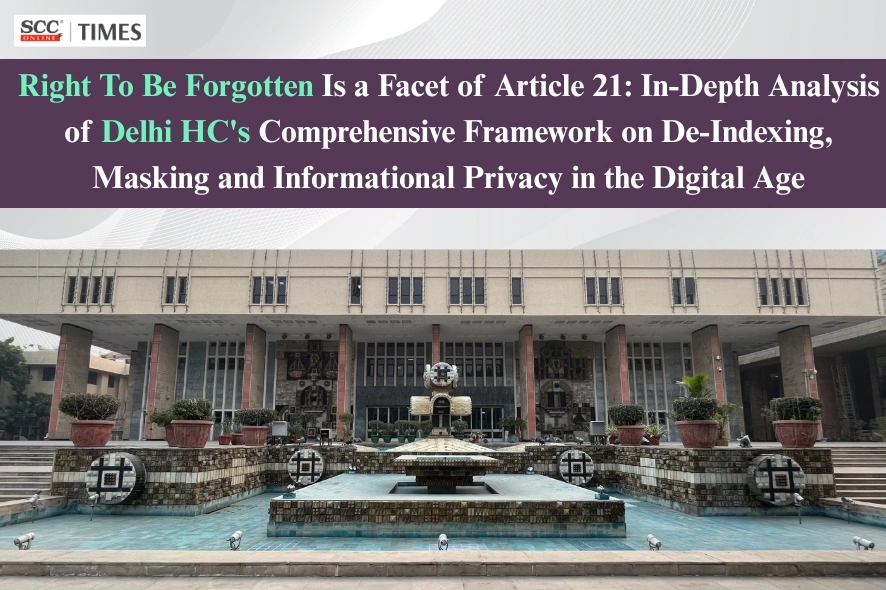
Delhi High Court: In a batch of writ petitions seeking enforcement of the “right to be forgotten”, including de-indexing of judicial records from search engines, removal of links, restriction of searchability, and masking of names and personal identifiers from judicial records available in the digital public domain, the Single Judge Bench of Sachin Datta, J., recognised that the right to be forgotten is a constitutional facet of informational privacy protected under Article 21.
While reaffirming the principle of open justice, the Court held that unlimited digital accessibility and name-based searchability of judicial records may, in appropriate cases, disproportionately infringe privacy, dignity and reputation. The Court, therefore, evolved a constitutional framework permitting de-indexing and, where justified, masking of personal identifiers while preserving the integrity, accessibility and transparency of judicial records.
The Court held that de-indexing may be justified where:
1. Proceedings ended in acquittal, discharge, closure or quashing.
2. Information has become obsolete or irrelevant.
3. Continued accessibility causes disproportionate harm.
4. Public interest no longer outweighs privacy concerns.
5. The information relates to intensely private matters such as matrimonial disputes and family affairs.
6. Where proceedings have abated.
Cases where de-indexing may not be appropriate and relief might be declined where:
1. Serious public interest continues to exist — convictions for offences against women or children.
2. The petitioner is a public figure and allegations remain relevant to public discourse.
3. The proceedings involve issues of substantial public concern.
4. Accessibility remains necessary for transparency and accountability.
The Court observed that,
“The right to be forgotten, understood as subsuming the right of an individual to seek removal or restriction of personal information from public digital accessibility, where such information is no longer relevant or serves no legitimate public purpose, flows naturally and necessarily from the constitutional recognition of informational privacy under Article 21.”
Factual Matrix
The present batch of 35+ petitions arose from diverse factual situations but were united by a common grievance. The petitioners included persons who had been acquitted of criminal charges, discharged from criminal proceedings, beneficiaries of quashing orders, parties to matrimonial disputes, persons whose names appeared only incidentally in judicial records, professionals whose reputations were affected by outdated allegations, and individuals seeking protection of personal information contained in judicial records.
Many petitioners complained that although criminal proceedings had ended in their favour, judicial orders, first information report (FIR)-related reports, arrest reports, news articles, blogs and other digital content continued to appear whenever their names were searched online. Several petitioners asserted that the continued accessibility of such material created a misleading and stigmatic impression, adversely affecting employment opportunities, business prospects, personal relationships, social standing and mental well-being.
Certain petitions related to matrimonial and family disputes which had long attained finality. Others concerned private civil disputes, name-change proceedings, maintenance proceedings, allegations that ultimately resulted in acquittal or discharge, and cases where parties had settled disputes leading to quashing of proceedings. Some petitioners sought masking of their names from judgments, while others sought complete removal of links and search results. Victims of sexual offences also sought protection of identity and removal of records revealing personal information.
The common thread running through all petitions was that digital permanence and search-engine accessibility caused continuing prejudice disproportionate to any surviving public interest.
Issues for Determination
-
Whether the writ petitions maintainable against persons other than the State or its instrumentalities?
-
Whether, and to what extent, the “right to be forgotten” finds recognition within the constitutional and legal framework, and whether it stands embedded within the right to privacy guaranteed under Article 21 of the Constitution?
Analysis
Maintainability
At the threshold, the Court examined the preliminary objection raised by several respondents, that the writ petitions were not maintainable under Article 226 of the Constitution.
The Court acknowledged that the principle is well settled that writ jurisdiction is generally exercised against bodies performing public functions. Referring to Sanchit Gupta v. Union of India, 2024 SCC OnLine Del 5880, where a challenge against a social media platform, X formerly known as Twitter, was held to be not maintainable because the grievance essentially arose from a private law relationship, the Court observed that “the present proceedings are directed at enforcing the fundamental rights of the petitioners, originating from Article 21 of the Constitution”, rights which the Supreme Court in K.S. Puttaswamy (Privacy-9J.) v. Union of India, (2017) 10 SCC 1, had expressly recognised as operating against both State and non-State actors.
The Court further emphasised that informational privacy is a facet of the right to privacy and that threats to privacy may arise not only from the State but also from non-State entities. Consequently, the fact that search engines, online platforms and digital intermediaries are private entities could not by itself defeat a claim seeking protection of fundamental rights under Article 21.
Relying upon Puttaswamy, the Court noted that informational privacy is a facet of the right to privacy and that threats to privacy may originate not only from the State but also from non-State entities. The Supreme Court had recognised that the “ubiquitous presence of technology” enables both State and non-State actors to assemble, analyse and disseminate personal information on an unprecedented scale. Therefore, the protection of informational privacy cannot be confined only to actions of the State.
The Court held that in exercise of its powers under Article 226, this Court can issue directions to the respondents, including private parties, since fundamental rights are enforceable even against persons other than the State or its instrumentalities.
“The violation of informational privacy by private commercial entities, operating at such extensive scale, is as real and as constitutionally significant as any violation by a State actor. To hold otherwise, would render the fundamental right to informational privacy illusory in precisely the domain where it is most acutely threatened, i.e. the digital domain.”
Accordingly, the Court held that the petitions were maintainable.
Jurisprudence on Privacy and Right to be Forgotten
The Court referred to R. Rajagopal v. State of T.N., (1994) 6 SCC 632 (the Auto Shankar case), where the Supreme Court recognised that the right to privacy is implicit in the guarantee of life and personal liberty under Article 21. The Supreme Court also recognised that matters forming part of public records, including court records, ordinarily cease to enjoy the same degree of privacy protection. However, acknowledged the exceptions in cases involving victims of sexual offences, whose identities ought not to be exposed to further indignity through publicity. It referred to PUCL v. Union of India, (1997) 1 SCC 301, wherein the Supreme Court, while examining the legality of telephone tapping and surveillance, affirmed privacy as integral to the dignity and liberty of the individual; Mr ‘X’ v. Hospital ‘Z’, (1998) 8 SCC 296, wherein considering the delicate balance between individual privacy and public interest, the Supreme Court held that the right to privacy is not an absolute right and may be restricted; District Registrar and Collector v. Canara Bank, (2005) 1 SCC 496, reiterating that the right to privacy is subject to reasonable restrictions and Puttaswamy, holding that “privacy includes at its core the preservation of personal intimacies, the sanctity of family life, marriage, procreation, the home and sexual orientation. Privacy also connotes a right to be left alone. Privacy safeguards individual autonomy and recognises the ability of the individual to control vital aspects of his or her life”.
Relying on Puttaswamy, the Court noted that privacy is a constitutionally guaranteed right, integral to life and personal liberty under Article 21, however, the right is not absolute and is subject to reasonable restrictions. “Restrictions are permissible only when they serve legitimate State or public interests, and every encroachment must withstand constitutional scrutiny by satisfying the tests of legality, necessity, and proportionality.”
The Court held that the right to be forgotten, is a “right of an individual to seek removal or restriction of personal information from public digital accessibility, where such information is no longer relevant or serves no legitimate public purpose”, flows naturally from the constitutional guarantee of informational privacy.
Relying significantly on the observations of Sanjay Kishan Kaul, J., in Puttaswamy, the Court observed that while human beings forget, the internet does not. Individuals should not be permanently defined by allegations, mistakes, disputes or incidents that have lost contemporary relevance.
The Court further referred to Vysakh K.G. v. Union of India, 2022 SCC OnLine Ker 7337, wherein the Kerala High Court defined “right to be forgotten” and its various facets including the right to rehabilitation, the right to erasure/deletion, the right to delisting/de-indexing, the right to obscurity, and the right to oblivion.
The Court clarified that the right to be forgotten is not absolute. The right enables an individual to seek restriction of continued digital accessibility of personal information that no longer serves a legitimate public purpose. At the same time, it is not an unrestricted right of erasure and must be balanced against competing constitutional values, particularly freedom of expression, freedom of information, historical preservation and public interest.
Principle of Open Justice
Examining the apparent conflict between the constitutional right to informational privacy and the long-established principle of open justice, the Court asserted that while judicial proceedings must remain transparent and accessible, the doctrine of open justice cannot be stretched to justify perpetual digital exposure of an individual’s past legal difficulties through name-based internet searches.
The Court observed that the doctrine of open justice was intended to ensure transparency of the judicial process and not to facilitate the perpetual amplification of an individual’s legal misfortunes. In a significant observation, the Court stated that it would be a “perverse extension” of the doctrine if it were used to justify search engines repeatedly projecting a person’s arrest, accusation or legal troubles whenever his or her name is searched. The Court specifically remarked that “an acquittal buried at the bottom of the search results, while the arrest dominates the search results, cannot be characterised as an ingredient of open justice”. Such prominence is a consequence of the manner in which search engines aggregate, rank and serve information in response to name-based queries.
The Court rejected the notion that search engines are merely passive intermediaries and observed that search engines perform functions of indexing, aggregating, ranking and presenting information, thereby actively shaping how information is discovered and consumed.
The Court asserted that the real injury suffered by the petitioners does not arise from the existence of judicial records but from the manner in which search engines transform those records into instantly retrievable and highly visible results linked to a person’s name. By “aggregating, ranking and serving” information in response to a name-based query, search engines create a qualitative transformation in the dissemination of information. It referred to Google Spain, S.L. v. Agencia Española de Protección de Datos (AEPD) & Mario Costeja González (Case C-131/12), wherein it was held that such search engines are not “passive channels of information”, instead they are in the nature of a “commercial platform”, deriving revenue by leveraging user searches and associating them with advertising opportunities.
Regarding position of Indian Kanoon, the Court noted that it performs functions like a publication, as it curates, organises and makes available judicial records in a manner that facilitates widespread dissemination of legal information, thereby differing from a search engine. It was asserted that the relief against Indian Kanoon, is not for removal or takedown of judicial orders/judgments, but the specific and narrow restriction of name-based search functionality within the platform and judgment could remain be accessible by case number, citation, court, date and subject-matter.
Resolution of the Conflict
The Court held that neither privacy nor open justice enjoys automatic supremacy. The appropriate approach is a contextual balancing exercise. Factors such as the nature of proceedings, seriousness of allegations, outcome of proceedings, lapse of time, continuing public interest, status of the individual, and societal value of accessibility must be evaluated. The Court adopted a proportionality-based framework to reconcile the competing constitutional values.
De-Linking/De-Indexing
Examining the concept of de-linking/de-indexing as a constitutional remedy intended to protect informational privacy without erasing judicial records, the Court noted that European Court of Human Rights in Hurbain v. Belgium, Grand Chamber, European Court of Human Rights, Application No. 57292/16, explained that de-indexing does not involve deletion of material from archives; rather, it moderates accessibility by preventing a person’s name from functioning as an unrestricted gateway to past proceedings. It clarified that “de-linking” or “de-indexing” signify the removal of a specific URL or judicial record from name-based search results generated by search engines or legal database platforms. Judicial records continue to remain available through conventional legal research methods, citations, case numbers and court databases. What is restricted is name-based discoverability.
The Court held that de-indexing cannot be granted mechanically and must be guided by a structured balancing exercise between privacy and transparency. The following considerations were identified as relevant:
1. the nature of the information and whether it concerns intimate personal matters, professional conduct or public affairs;
2. the period elapsed since publication and the continuing relevance of the information;
3. the public role and status of the individual concerned;
4. the accuracy, completeness and contemporaneous relevance of the material;
5. the extent of harm caused to dignity, autonomy, reputation and ability to lead a dignified life;
6. the degree to which search engines amplify accessibility in the digital sphere; and
7. the impact of the relief on freedom of expression and the integrity of public records.
The Court cautioned that these factors are not a checklist. Their weight must depend upon the facts and circumstances of each individual case.
Within this broader framework, the Court devised 3 tests to be applied for identifying legal parameters for de-indexing.
Test One: Character of Information and Outcome of Proceedings
The Court held that de-indexing may be justified where:
1. Proceedings ended in acquittal, discharge, closure or quashing.
2. Information has become obsolete or irrelevant.
3. Continued accessibility causes disproportionate harm.
4. Public interest no longer outweighs privacy concerns.
5. The information relates to intensely private matters such as matrimonial disputes and family affairs.
Test Two: Public Role of the Individual
The Court recognised that public officials and public figures are subject to greater scrutiny regarding acts performed in their public capacity. Relying upon R. Rajagopal, it observed that conduct connected with discharge of public duties constitutes a legitimate subject of public interest and public debate. Judicial proceedings directly relating to performance of public functions therefore attract a stronger public interest in continued accessibility.
However, the Court limited this principle and stated that matrimonial disputes, personal relationships and matters unconnected with public duties continue to attract privacy protection notwithstanding the individual’s public stature.
Test Three: Accuracy and Continuing Relevance
The Court held that even information lawfully published at one point in time may cease to justify continued processing and unrestricted accessibility. Relying upon Google Spain S.L., it observed that personal data may become inadequate, irrelevant, excessive or no longer relevant with the passage of time. In such circumstances, continued name-based searchability fails the proportionality requirement. The case for relief becomes even stronger where information is demonstrably inaccurate or misleading.
The Court also recognised that where criminal proceedings have abated owing to death, continuing digital association with allegations may unjustly burden surviving family members and therefore justify relief.
The Court further identified categories where de-indexing or masking would ordinarily be inappropriate:
1. Convictions for offences against women or children
Where a person stands convicted of offences against women or children, a continuing public interest survives in maintaining accessibility of such information. The protection of potential victims and those responsible for their safety justifies continued public access. The Court observed that this concern does not diminish merely with the passage of time and finds support in Article 15(3) of the Constitution and legislations such as the Protection of Children from Sexual Offences Act, 2012 (POCSO Act).
2. Convictions involving breach of public trust
The Court also excluded cases involving convictions of public servants, elected representatives and persons occupying fiduciary positions where offences involve abuse of public trust. Democratic accountability requires that the public retain access to information concerning misuse of public office and breach of public confidence.
The Court rejected the notion that de-indexing should be confined to a particular national domain such as google.co.in and held that de-indexing directions issued under the framework laid down in the judgment shall operate globally across all versions and domains of the search engine concerned, to the extent necessary to secure effective protection of the petitioner’s informational privacy rights under Article 21.
Masking: Jurisdiction, Entitlement and Parameters
The Court recognised masking as a separate remedy from de-indexing. Masking involves replacing names and personal identifiers in publicly accessible digital versions of judicial records while preserving unredacted versions in official court records. The Court held that courts possess jurisdiction to direct masking in appropriate circumstances. Such relief must be exercised cautiously and generally through the court that rendered the original judgment.
The Court held that masking may ordinarily be granted in the same categories where de-indexing is permissible.
-
In cases of acquittal, discharge or quashing of proceedings.
-
Where proceedings have ended through settlement or compounding.
-
In matrimonial disputes and purely private civil proceedings.
At the same time, the Court clarified that the absolute bars applicable to de-indexing apply equally to masking. There can be no separate or more liberal standard for masking. Thus, relief would ordinarily remain unavailable in categories involving convictions for offences against women or children, matters involving breach of public trust, and cases concerning the public conduct of public figures where overriding public interest justifies continued accessibility.
The Court formulated detailed guidelines to govern future masking requests:
-
Only names and personal identifiers are masked, not the substance of the judgment. The reasoning, findings, legal conclusions, case number, court details, relevant dates, etc., remain intact and publicly accessible. The judicial record retains its full institutional, precedential and accountability functions.
-
The complete and unredacted version of the judgment is preserved in the court’s internal records without exception. Masking applies only to the publicly accessible digital versions. The unredacted version remains accessible to courts, parties, advocates, and authorities with a legitimate legal purpose.
-
Masking operates both retrospectively, in respect of the existing publicly accessible digital version and prospectively, in respect of any future digitisation or uploading.
-
A masking order issued by a competent court constitutes a valid judicial order for the purposes of Rule 3(1)(d) of the Information Technology (Intermediary Guidelines and Digital Media Ethics Code) Rules, 2021. Upon receipt of such an order, search engines such as Google become obliged to de-index the masked judgment from name-based searches, while legal databases such as Indian Kanoon must disable name-based search functionality in respect of that judgment. Such directions may expressly be incorporated into the masking order itself.
-
The Court concerned retains jurisdiction to review and revoke a masking direction if subsequent circumstances bring the matter within the absolute bars or other categories where relief is not available.
-
Masking applications must be disposed of expeditiously, having regard to the continuing nature of the harm caused by the availability of personal identifiers in the public digital domain.
Having laid down the governing principles, the Court clarified that wherever de-indexing relief had been granted in favour of any petitioner, such petitioner would also remain at liberty to approach the court that originally rendered the relevant judgment or order and seek masking of names and personal identifiers from publicly accessible digital versions of the judicial record. Any such application is required to be considered and decided expeditiously by the Court concerned.
Decision
The Court classified the petitions into categories and applied the above framework.
Petitions Involving Acquittal, Discharge and Quashing
The Court granted relief in several cases where petitioners had been acquitted, discharged or benefited from quashing of proceedings. It held that continued digital prominence of allegations despite judicial exoneration unjustifiably burdens reputation and dignity.
Petitions Involving Settlement and Compounding
The Court granted relief in appropriate cases where disputes had been settled, offences compounded or proceedings quashed on settlement. The Court considered whether any meaningful public interest survived after resolution of disputes.
Petitions Involving Purely Private Civil and Matrimonial Disputes
The Court treated matrimonial and family disputes as lying at the core of privacy interests. The Court directed de-indexing, where such disputes had concluded long ago and no public interest remained. It held that disclosure of intimate family disputes years after conclusion serves little public purpose and may seriously impair privacy and dignity.
Other Petitions
The Court separately evaluated petitions involving professional reputation, name change proceedings, incidental references, private information and other unique circumstances. The Court granted or denied relief based upon the balancing framework developed in the judgment.
Also Read: Right to Privacy: A look back at the 9-Judge Bench hearing & it’s possible impact on Aadhaar
Further Directions
The Court further directed:
-
Compliance within 2 weeks unless otherwise specified.
-
Google and other search engine operators to de-index relevant content from name-based search results wherever relief had been granted.
-
Indian Kanoon to restrict name-based search functionality regarding the identified records while preserving access through case numbers, citations, court details and dates.
-
Affected petitioners remain free to seek masking before the courts that originally rendered the judgments or orders.
-
The Union of India through Ministry of Electronics and Information Technology (MEITY) to ensure compliance by intermediaries.
Also Read: The Evolution of Right to be Forgotten in India
[Laksh Vir Singh Yadav v. Union of India, 2026 SCC OnLine Del 4491, decided on 29-5-2026]
*Judgment authored by Justice Sachin Datta
Advocates who appeared in this case:
Mr. Rohit Madan and Mr. Akash, Advs., Counsel for the petitioner in W.P.(C) 1021/2016.
Ms. Aditi Mohan, Mr. Sparsh Goel, Advs. for Registrar General, DHC in W.P.(C) 1021/2016.
Mr. B.S. Shukla (CGSC) along with Ms. Jiniya Saha, Mr. Praveen Gupta, Advs., Counsel for Respondent in W.P.(C) 1021/2016.